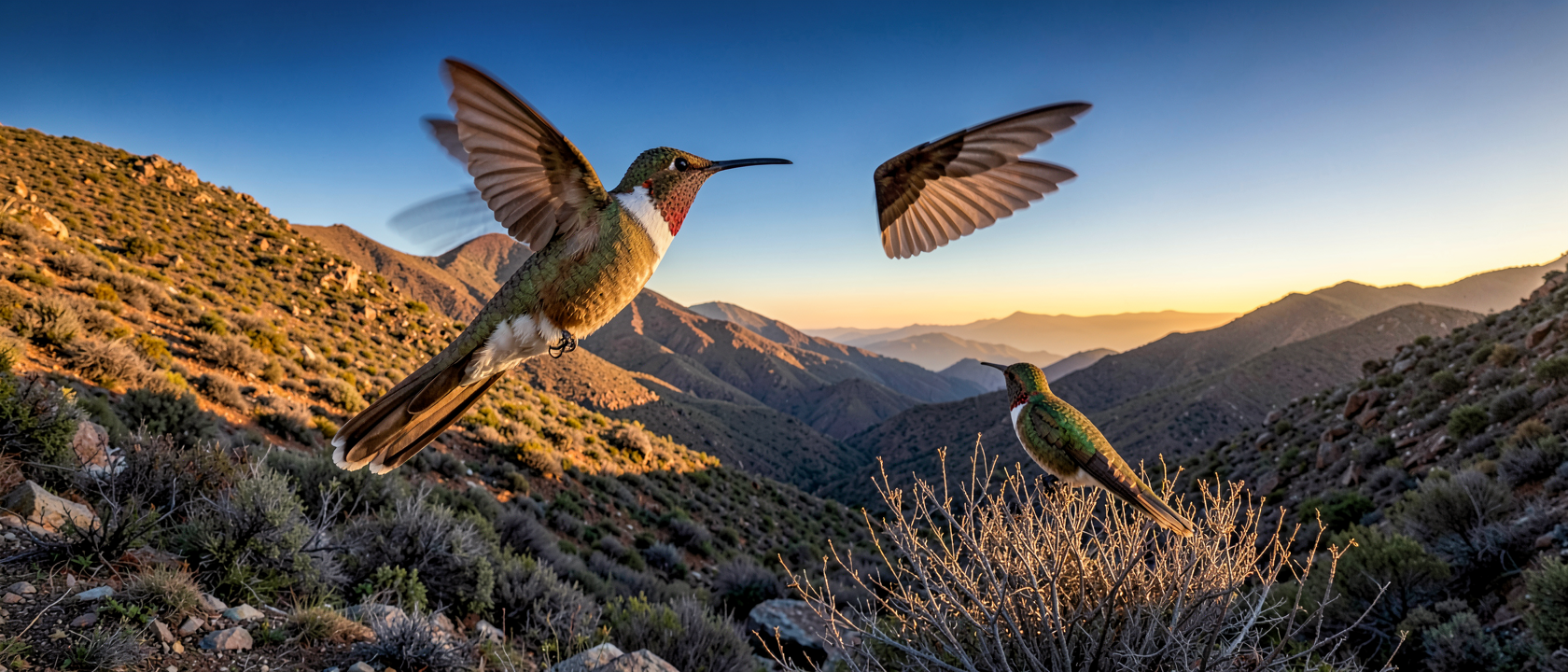
One Bird. Two Birds. Neither Could Tell.
For well over a century, every ornithologist who studied the Giant Hummingbird agreed: one species, Patagona gigas, the largest hummingbird on earth. A study published in Proceedings of the National Academy of Sciences in May 2024, led by Jessie Williamson at the Cornell Lab of Ornithology and senior author Chris Witt at the University of New Mexico, ran genome sequencing across 375 wild-caught and museum-vouchered birds and found two species instead of one. The genomes are as different from each other as a chimpanzee’s is from a bonobo’s. The plumage, the proportions, the bill length: identical. Scientists had been watching both birds on the same wintering grounds and logging them under the same name for generations, and nothing in a field notebook or a museum drawer suggested otherwise.
The northern species, a permanent resident of the high Andes, now carries the valid name Patagona peruviana (Boucard, 1893), a name that predates the Williamson team’s proposed name by 131 years under nomenclatural priority rules. The migratory southern species retains Patagona gigas. Both look exactly alike. The genomes say they have not been the same species for between 2.1 and 3.4 million years.
What Actually Split Them, and How Far One of Them Goes to Prove It
To establish the migration directly, the Williamson and Witt team attached geolocators and satellite transmitters to 8 individual Southern Giant Hummingbirds. The southern species breeds near sea level on the Chilean coast and spends the non-breeding months at elevations up to 14,000 feet (4,270 m) in the Andes of Peru. The round-trip covers more than 5,100 miles (8,300 km), which the 2024 paper describes as among the longest hummingbird migrations on record, and possibly the longest. The bird climbs roughly 13,450 feet (4,100 m) in elevation over approximately three weeks.
That behavioral split, migrating versus staying put, is what the research team identifies as the engine of speciation. Two populations breeding in different places, at different elevations, on different schedules, eventually stopped exchanging genes. Whether one lineage gained migration or the other lost it cannot be determined from the available data; the researchers say so explicitly.
The Evolutionary Payoff of Going Nowhere (or Everywhere)
Until this paper, the Giant Hummingbird sat alone on its branch of the hummingbird family tree while its closest relatives had diversified into 165 distinct species. The 2024 finding changes that picture: the branch was not static but hiding a split that behavioral divergence had driven over millions of years without producing any visible signal in plumage or morphology.
In visually uniform groups, behavior can be the primary engine of reproductive isolation, accumulating into full genetic divergence without any external feature ever changing. Patagona is now the clearest example of a hummingbird speciation event driven by migratory behavior alone, a case where the bird you see tells you almost nothing about the evolutionary process underneath it.
The Classification That Genomes Killed in One Paper
The consensus that the Giant Hummingbird was a single species was not a careless assumption. Professional ornithologists observed both populations on the same high-elevation wintering grounds and found nothing to distinguish them: same plumage, same proportions, same visible behavior. No external feature has been identified that separates P. peruviana from P. gigas in the field. The myth the 2024 paper kills is not that those ornithologists were careless, it is that expert field observation is sufficient to determine where one species ends and another begins in visually uniform groups. Genome sequencing revealed a divergence that began in the late Pliocene and that a century of fieldwork had no instrument to detect.
On the naming: Williamson and Witt proposed Patagona chaski for the northern species, from the Quechua word for “messenger,” to honor the Indigenous communities of Peru whose land access and local knowledge made the fieldwork possible. Subsequent nomenclatural review, by Areta et al. in 2024 and confirmed by Williamson et al. in 2025 in the Zoological Journal of the Linnean Society, established that Adolphe Boucard had formally described and named the same bird as Patagona peruviana in 1893, giving it priority under the International Code of Zoological Nomenclature. The gesture stands; the name does not.
What Nobody Has Figured Out Yet
The 2024 paper opened at least as many questions as it resolved. The physiological mechanisms behind the southern species’ rapid acclimatization from sea level to high Andean elevations remain unknown. The blood data do show that southern migrants at high elevation carry significantly higher hematocrit and elevated mean cell hemoglobin compared to northern resident birds, but how those changes unfold during the ascent has not been established. Where exactly the ranges of P. peruviana and P. gigas meet has not been mapped in detail, whether the two species interbreed on shared wintering grounds is unestablished, and how they partition space or resources during the months they occupy the same mountain is unknown.
Also: Very Good at Not Being Caught
Co-author Emil Bautista brought more than 15 years of field experience to the 2024 project and described the fieldwork as the hardest he has ever done. Giant Hummingbirds are acutely territory-aware, register unfamiliar objects in their environment, and will abandon net sites if anything appears out of place. In Chile, the team succeeded in capturing a Giant Hummingbird once every 146 net hours. The species that spent 2 to 3 million years remaining invisible to classification is, at the level of individual behavior, among the most difficult birds to physically catch.