The ant who saves you is the ant who already knows you
The worker most likely to treat an injured Camponotus fellah carpenter ant is not the colony’s strongest, oldest, or most experienced. She is simply the one who has bumped antennae with the patient the most times before the injury happened.
A study published July 1, 2026 in Proceedings of the National Academy of Sciences tracked 660 individual Camponotus fellah workers across six laboratory colonies, 110 ants per colony, using an automated system that logged hundreds of thousands of interactions per colony over several weeks. The team was led by Dr. Erik Frank at the University of Würzburg; co-authors Ebi Antony George, Alba Motes-Rodrigo, and Dr. Laurent Keller are all based at the University of Lausanne. Two variables predicted wound care above everything else: life phase and prior contact. Rank and role did not make the list.
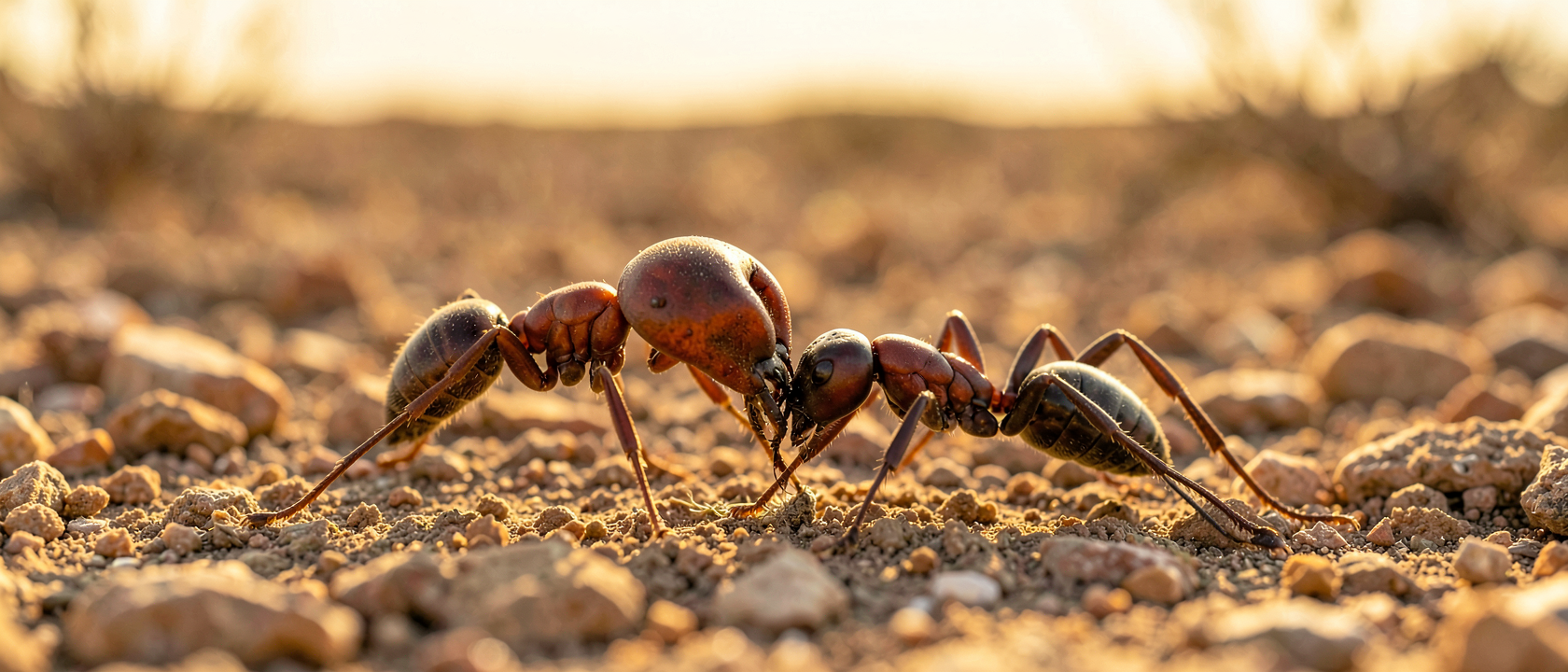
Camponotus fellah is a polymorphic Middle Eastern carpenter ant found across Egypt, Israel, Jordan, Iraq, Iran, and the Arabian Peninsula. Workers range from roughly 0.31 to 0.68 inches (7.8 to 17.2 mm) in total length, with major workers at the large end of that range carrying an outsized, heart-shaped head. The species is not, despite at least one news outlet’s characterization, a “red ant.” It belongs to the genus Camponotus, subfamily Formicinae, and its coloring runs from yellowish-orange in minor workers to reddish-brown or near-black in majors.
Why the right ant is always in the middle of things
Every Camponotus fellah worker moves through a sequence of life phases: early in adult life she tends brood deep in the nest interior; late in life she forages at the outer edge. Between those roles sits a transitional window lasting approximately 20 days, during which a worker crosses the entire nest rather than staying in one zone.
A nursery worker accumulates contact mainly with other nursery workers; a forager meets foragers. The transitional worker, moving continuously from interior to periphery and back, builds antennal-contact and grooming links spanning the whole colony. When an injury happens anywhere in the nest, a transitional worker is statistically the individual with the most prior contact with whoever got hurt, not because anyone dispatched her, but because her movement history made it near-certain. No alarm is broadcast, no role is assigned; social geometry does the selecting.
What those workers actually do, and why it matters for everyone else
What happens when a transitional worker reaches an injured nestmate is not minor grooming. Prior research by Frank’s team documented the full procedure: biting off damaged limbs entirely, amputating at the trochanter, combined with application of antimicrobial substances to the wound site. The amputation is prophylactic, performed even before infection is confirmed, and approximately doubles the survival rate of injured workers.
The stakes extend past the individual. The Camponotus genus lost its metapleural gland over evolutionary time; that gland is what most other ant genera use to secrete antimicrobial compounds. An untreated wound in an enclosed, high-contact colony is not solely the injured ant’s problem. The wound-care system therefore serves two purposes at once: rescuing an individual and closing a potential entry point for colony-wide infection, and the whole system runs without any central coordination, dispatcher, or permanent specialist.
There is no medic ant, and there never was
The standard picture of an ant colony assumes rigid specialization: soldiers soldier, nurses nurse, foragers forage. Applied to wound care, that picture predicts a permanent medical worker assigned to the role and available on demand.
The July 1, 2026 PNAS study directly contradicts that model for Camponotus fellah. No wound-care caste exists in this species. The caregiver is an ordinary worker in a particular life phase, selected by the breadth of her accumulated social connections rather than by any title or training. Wound care here is an emergent outcome, produced by network geometry and life-phase timing, not by job assignment. The fixed-caste assumption was a reasonable inference from other aspects of insect colony organization. For wound care in Camponotus fellah, it is simply wrong.
Two questions the colony hasn’t answered yet
The July 1, 2026 PNAS study leaves two genuine unknowns. The first is the injury signal: somewhere between an ant being hurt and a transitional worker beginning to treat her, the caregiver registers that this nestmate is a patient rather than an ordinary contact. Whether the cue is a change in cuticular hydrocarbon profile, a mechanical signal, or something else has not been identified for Camponotus fellah specifically.
The second is generalizability. The social-spatial logic documented here is specific to Camponotus fellah, native to arid and semi-arid regions of the Middle East. Whether the same mechanism, transitional life phase combined with prior-contact weighting, governs wound care in other carpenter ant species or in ants more broadly is not addressed in the paper. The 2026 study confirms the pattern in six colonies of one species. What holds beyond them is an open question.