
The Number That Looked Fine, and the One That Wasn’t
Nine Italian honey bee colonies (Apis mellifera ligustica) at Arizona State University’s Polytechnic apiary in Mesa, Arizona, held their hive-wide brood temperature inside the textbook-healthy range of 93°F to 97°F (34°C to 36°C) through a three-month summer that regularly climbed past 104°F (40°C). Every colony-wide average, checked again and again, looked exactly like it should. But bees developing at the outer edge of the brood nest spent close to 8 hours of every one of those days outside that same safe window, while bees packed into the dense center of the nest strayed out of range for only about 1.6 to 1.7 hours a day. The numbers come from a study led by Jun Chen, with Jon F. Harrison, Gloria DeGrandi-Hoffman, Jennifer H. Fewell, and seven other co-authors, published in Ecological and Evolutionary Physiology.
Why the Center Holds and the Edge Doesn’t
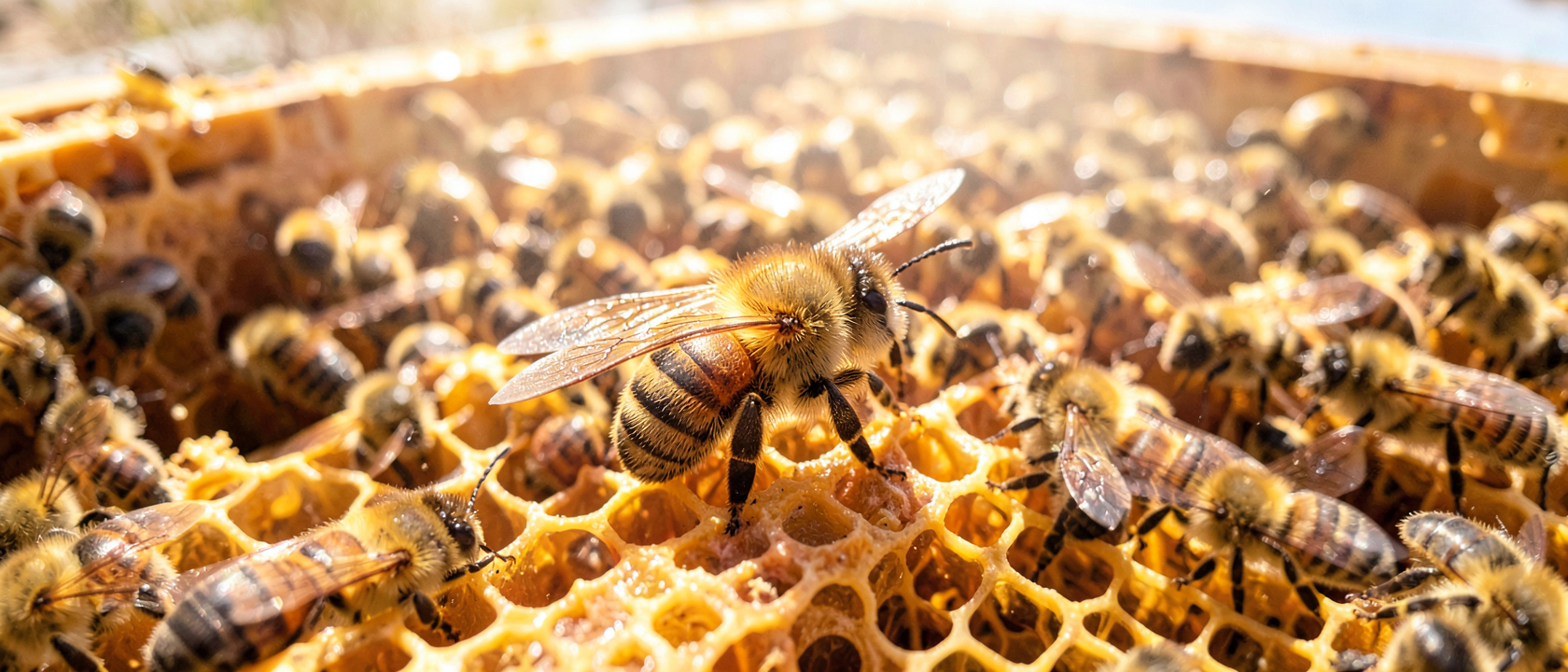
Honey bees cool a hive mainly through evaporation. Foragers haul in water, spread it in thin films across the comb, and fan it with their wings, pulling heat out the way sweat cools a mammal’s skin. In the center of the brood nest, bee bodies pack tightly together, workers can coordinate fanning and water delivery with precision, and the surrounding cluster acts as insulation. At the edge, coverage is patchier. Fewer bees are stationed there to fan or lay down a water film, and there is less bee mass packed around the comb to buffer it. A short physical distance can separate a well-regulated nursery from a spot the colony barely manages to cool.
Colony Size Is the Insurance Policy
The study found that how badly this buffering broke down depended on how many bees were around to run it. In the smallest colonies monitored, brood-edge temperatures swung by about 20°F (11°C) across a single day. The largest colonies, by contrast, held that daily swing to roughly 11°F (6°C). More workers means more bodies free to fan, more foragers free to fetch water, and more insulation wrapped around the vulnerable edge, so population size works less like a headcount and more like a thermal safety margin. The researchers also linked higher peak air temperatures and larger internal swings directly to later colony population decline, which means localized heat stress at the brood edge is not just uncomfortable. It shows up afterward as fewer bees.
The Myth This Kills
Honey bees have a well-earned reputation for handling heat: fanning at the entrance, hauling water, bearding outside the hive in a visible cluster when things get warm. That reputation makes it easy to assume a 104°F day is a problem the colony has already solved. This data says the defenses operate at the colony average, not at every location inside it. A colony can register a perfectly normal brood temperature on any single reading, even while a meaningful share of its next generation develops outside the 93°F to 97°F range for roughly a third of the day. Checking only the overall hive temperature is exactly the measurement that would miss this, because the average is built from a core that is coping just fine and an edge that isn’t.
What Nobody Has Measured Yet
The researchers describe this as the first study to actually define the real limits of honey bee thermoregulation under live heat-wave conditions, rather than in a controlled lab simulation. That absence of baseline data is a large part of why a colony-wide average has stood in for colony health for so long. It leaves most of the map blank. Nobody yet knows how these Arizona numbers translate to other climates, to colonies with different genetics or population structures, or, especially, to humid regions, where evaporative cooling, the mechanism this entire buffering system depends on, becomes far less effective because water simply does not evaporate as readily off a wet comb. Whether brood-edge bees in a humid climate face longer exposure than the nearly 8 hours measured in Arizona, or whether colonies there would need to be sized differently to compensate, is a question the Arizona data cannot answer.