
The Number That Doesn’t Belong in a Spiderweb
A newly described spider living in the rainforests of Australia’s Cape York Peninsula, in Queensland, catapults ants into the air at accelerations of up to 1,367 meters per second squared, roughly 140 times Earth’s gravity. That’s about 15 times the most extreme g-force a trained fighter pilot can survive before blacking out, delivered to an ant by something smaller than a fingernail. The spider doesn’t have a formal species name yet; scientists list it as *Propostira* sp. but the team that found it calls it the ballista spider, after the ancient siege engine that hurls projectiles by releasing stored tension all at once. The discovery, led by Ajay Narendra and a Macquarie University team, was published in *Current Biology* in June 2026.
How You Build a Trap That Fires Itself
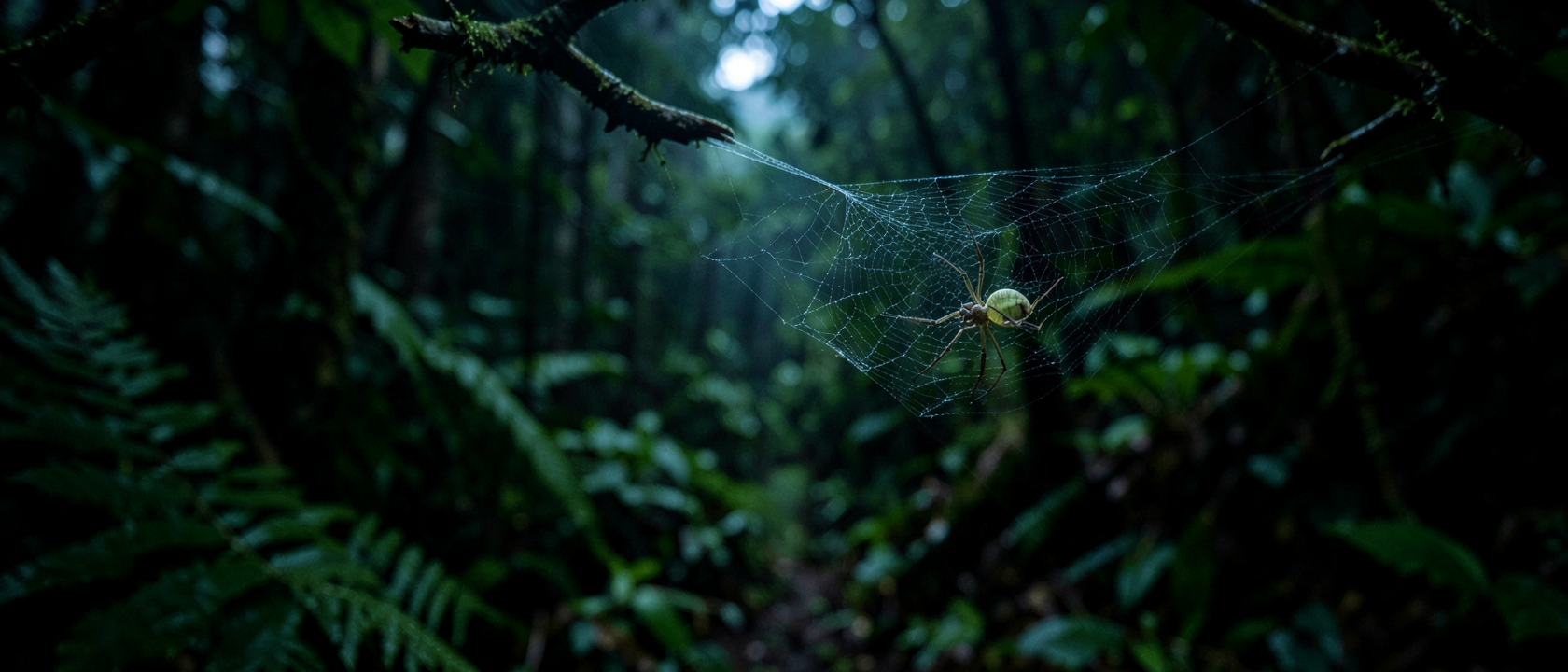
The ballista spider’s body is three to five millimeters long, small enough that researchers describe the whole animal as no bigger than a penny, with a greenish-yellow abdomen and legs so thin they look incapable of holding any tension at all. It belongs to the genus *Propostira*, a group of comb-footed spiders in the family Theridiidae first described by Eugène Simon in 1894. Two other species already carry that genus name: *Propostira quadrangulata*, found in India and Sri Lanka, and *Propostira ranii*, found in Bangladesh. This one, found along the foraging trails of the green tree ant (*Oecophylla smaragdina*) in Cape York’s tree canopy, is new to science.
It was also pure luck that anyone noticed. In 2022, researcher Greg Anderson was walking through a remote stretch of that rainforest when he saw a green tree ant shoot straight up through the air and vanish into a web. A Macquarie University-led team traveled from Sydney to Cape York in 2023 to find out what was doing it, and spent 10 days filming with high-speed cameras. The first attack they captured happened too fast to follow. “By the time we blinked, the ant was caught in the web, so we had no idea what actually happened,” Narendra said.
The slowed-down footage showed a nightly routine. About 30 minutes after sunset, the spider leaves its daytime hideout under a leaf and lowers itself on a silk line to nearby surfaces, sometimes almost 20 inches (50 cm) away. At each landing point, it anchors a line and carries a tension line back to a central hub. Several of these lines converge into a small conical scaffold, coated in a second, much thinner silk. That cone is bait and trigger in one. When a green tree ant bites it, the bite itself is what detaches the cone from its anchor. The stored tension releases, and the ant is hauled backward into the main web, thrown nearly a foot (30 cm) through the air in a fraction of a second. The spider never touches any part of the mechanism. It waits until the ant is fully tangled, then walks over to wrap it in silk and feed.
Why It Needs to Be This Violent
The silk itself performs well beyond what a three-to-five-millimeter spider needs to subdue one ant. Narendra’s team calculated that a kilogram of this silk, scaled up, would theoretically store 78.17 kilojoules of kinetic energy and release it in a burst of 11.73 megawatts, a higher energy output, gram for gram, than any other known silk-based catapult in the animal world.
That kind of force stops looking like overkill once you know the prey. Green tree ants are abundant, live in large tree-dwelling colonies, and are notorious for defending their own: a worker under attack can draw nearby colony members into the fight within moments. Narendra’s team proposes that the trap’s extreme power exists for exactly that reason, to pull a captured ant off the trail and out of reach before reinforcements arrive. It’s a tidy explanation for the physics, but the team frames it as a proposal built on what’s already known about green tree ant defense, not something measured directly in this study.
Not a Slingshot, Not a Net: Something New
It would be reasonable to assume this is a variation on a trick two other spider groups already perform. Net-casting spiders weave a small net, hold it with their front legs, and throw it over prey they’ve spotted. Slingshot spiders load tension into their own web and launch their entire body toward prey they’ve sensed nearby. Both strategies depend on the spider making a call: it detects something, and it acts.
The ballista spider’s trap works on the opposite logic. Nothing fires because the spider decided to fire it, and nothing depends on the spider sensing the ant at all. The cone releases because the ant bites it. Narendra describes this as the only known case of a spider web built around a single prey species, where the trigger belongs to the prey rather than the predator. It flips the usual assumption about ambush traps, that the hunter senses its target and springs the mechanism itself. Here, the ant springs its own capture.
What Nobody Knows Yet
One piece of the mechanism is still a hypothesis. Green tree ants have no obvious reason to bite a strand of silk hanging in a tree. Narendra suspects that during the final stage of building the cone, the spider coats the thin wrapping silk with a pheromone that specifically lures worker ants in and provokes the bite that fires the snare. Nobody has isolated or confirmed that chemical yet.
It’s also unclear why this spider narrowed its entire hunting strategy to one prey species, and a famously dangerous one at that, instead of building a trap general enough to catch whatever wandered past. Neither of the genus *Propostira*’s two other known species, in South and Southeast Asia, has been documented doing anything like this. What pushed one undescribed spider in Cape York toward a trap this specialized, and this violent, is still an open question.
—
**Edits made:**, Italicized genus/species names and journal title for consistency (style, not meaning). No relative-to-today date issues: all time references (“in 2022,” “in 2023,” “in June 2026”) are already absolute calendar years, which is correct and required no changes. No subject–verb agreement, tense, pronoun/homophone, spelling, or capitalization errors were found beyond the italics/formatting consistency noted above; punctuation and quotation marks were already correctly matched.