
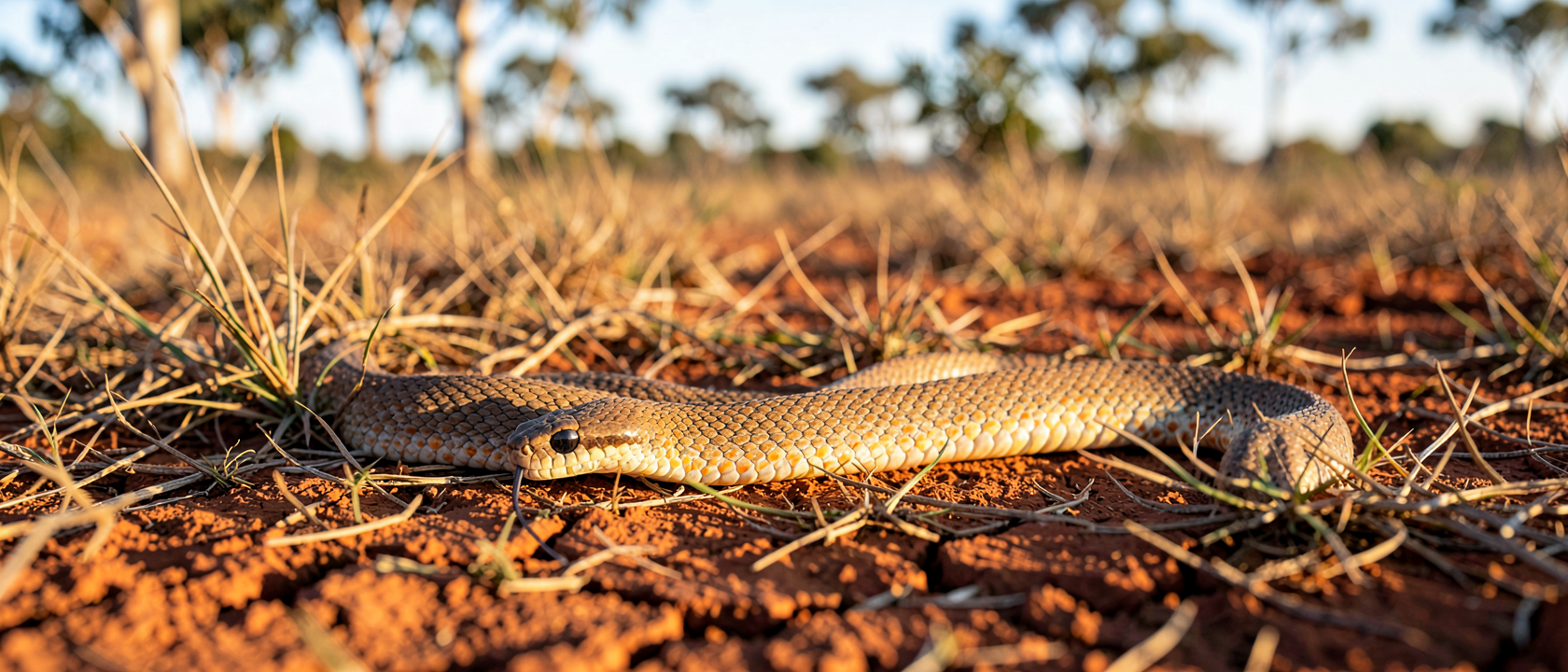
One Snake, Two Kill Switches
The Eastern Brown Snake (Pseudonaja textilis) kills more people in Australia than any other snake, and it does it with two different venoms depending on where it was born. A 2025 study in Toxins, led by Bryan Fry’s team at the University of Queensland, ran venom samples from brown snakes across the country through thromboelastography, a lab test that tracks how a blood clot forms and whether it holds, not just whether clotting happens at all. Venom from southern Eastern Brown Snake populations built a clot that formed and stayed put, the same stable-clot pattern seen in taipan venom. Venom from northern Eastern Brown Snake populations built a clot fast, then watched it fall apart within minutes. Every other Australian brown snake species tested did the shredding version too. Same species, same name on the chart, two different things happening in a vein.
It’s Not One Snake Being Inconsistent: It’s Two Genetic Programs
This isn’t sample noise. The clotting split lines up with a genetic divide inside the species itself. Southern Eastern Brown Snakes, the kind found around Adelaide, Melbourne, the Australian Capital Territory, and parts of New South Wales, carry one venom build. Northern Eastern Brown Snakes, from Queensland and parts of the Northern Territory, carry another. A southern snake and a northern snake are the same animal on paper, running different biochemistry underneath. The team’s sequencing work ties the venom boundary to a population-level split, not a scattering of odd individuals.
Built to Match the Menu
The researchers link the split to diet. Southern Eastern Brown Snakes eat proportionally more reptiles. Northern ones eat proportionally more mammals. A strong, stable clot may do more damage to a reptile’s circulatory system, while a clot that forms fast and then collapses may work better against mammal physiology; that’s the team’s current best explanation, not a settled fact. If it holds, this one species evolved two separate venom strategies for two separate diets in two separate parts of the continent, a pair of distinct tools rather than one tool with regional shading.
The Myth: One Species, One Antivenom
Snakebite treatment runs on a simple assumption: one species name means one venom, and one antivenom covers it. The thromboelastography results contradict that directly. A single species carries two clinically distinct venoms with opposite clotting behavior, strong and stable in the south, fast and fragile in the north, yet Australia’s brown-snake antivenom comes from a pooled venom batch whose geographic sourcing isn’t stated. If that pool leans toward one population’s venom, coverage of the other could be thinner than anyone currently knows. “Same species, same treatment” doesn’t survive contact with the data.
What Nobody’s Checked Yet
Three questions are still open. Whether the existing pooled antivenom neutralizes both venom types with equal strength in practice has not yet been tested. Whether hospital bite records, re-sorted by where the biting snake came from, would show different patient outcomes between north and south is a comparison the team hasn’t run yet, though Fry has pointed to the southern lineage’s isolated range as what makes that re-sorting possible in the first place: no other brown snake species overlaps with it, so any southern case can be identified with confidence. And the exact genetic mutations driving the clotting divergence haven’t been pinned down. The Fry lab has named these as its next research steps.