
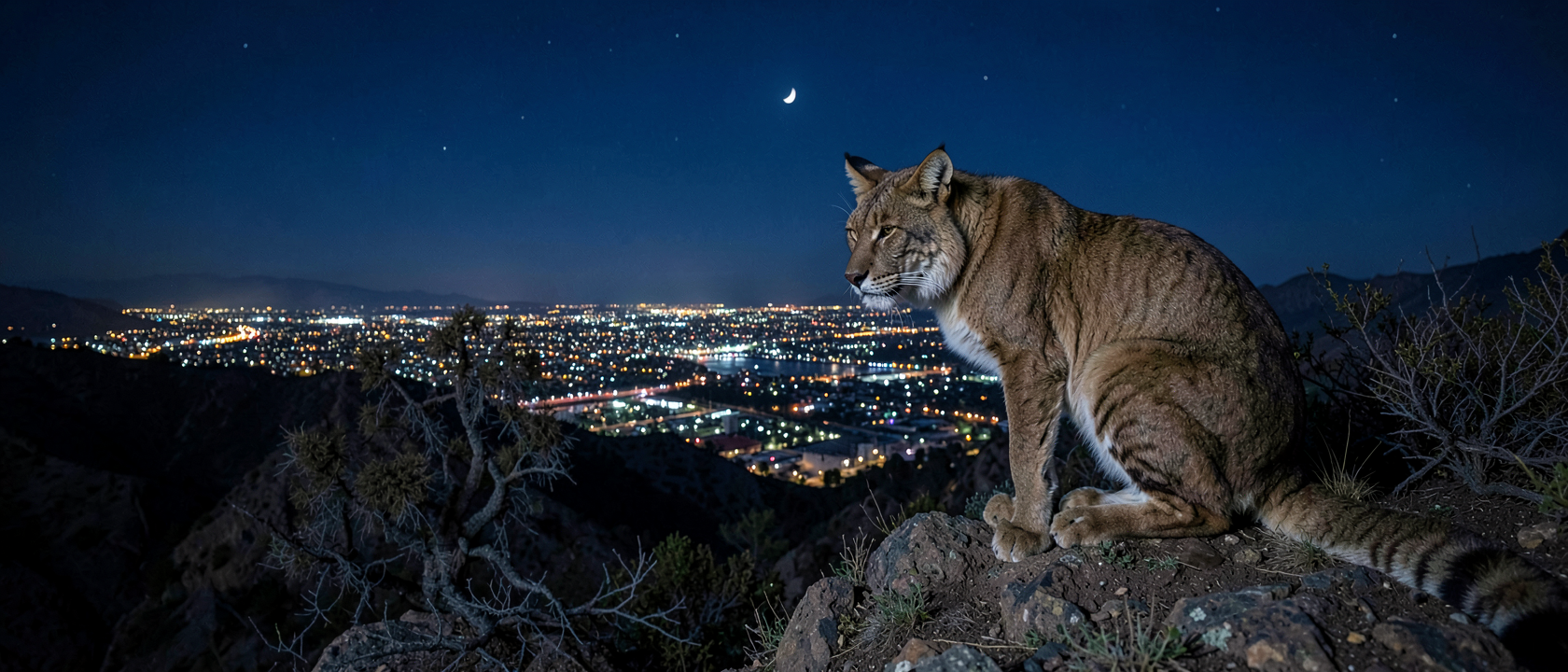
Twenty-Two Collars, Seven Years, and an App Built for Joggers
Between 2011 and 2018, researchers fitted GPS collars on 22 mountain lions (Puma concolor) living in and around the Santa Monica Mountains, the Simi Hills, Griffith Park, the Santa Susana Mountains, and the Verdugo Mountains, a scattering of wild patches stitched into greater Los Angeles. Ellie Bolas, a doctoral candidate at the University of California, Davis, studying mountain lions and mule deer, led the analysis, published in Biological Conservation on November 15, 2024. Her team lined up each cat’s collar data against something nobody built for wildlife research: Strava, the fitness app that logs hikers, joggers, and cyclists down to the trail segment. Where Strava showed heavier traffic, the lions’ active hours slid away from dawn and piled up in the dead of night. An app made to track your morning run ended up mapping a predator’s bedtime.
Crepuscular Is a Setting, Not a Cage
Mountain lions are built as crepuscular hunters, most active at dawn and dusk, hours that run cooler and line up with when mule deer, their main prey, start and stop moving. That part is old biology. What Bolas’s team adds is that the dawn-and-dusk clock bends. Recreation intensity ran highest in Griffith Park and lowest in the Santa Susana Mountains and Los Padres National Forest, and the lions’ schedules tracked it: more foot and wheel traffic in a zone meant less dawn activity and more of the night. Lions in the busiest areas also rested about an hour longer during the day than lions in quieter terrain like the Santa Susana Mountains.
There was a sex split inside that pattern. Females stayed closer to sunrise and daylight hours than males overall, which the researchers connect to a different kind of avoidance: adult male mountain lions are a real danger to females and their kittens, so staying clear of the night, when males range most, may be its own survival math. The least nocturnal cat in the dataset was a female, P-13, holding range across the central and western Santa Monica Mountains. The most nocturnal were two males packed into small, isolated patches of habitat laced with trails and boxed in by development and freeways, each holding one of the smallest home ranges ever recorded for an adult male mountain lion. One of them, P-41, lived in the Verdugo Mountains. Second on the nocturnality list was P-22, the Hollywood Hills male some Angelenos nicknamed the Brad Pitt of mountain lions before his death in 2022; the collar data behind that ranking was gathered while he was alive.
It Wasn’t the Trail. It Was the Voice.
Why would footsteps and bike tires be enough to rearrange a predator’s whole day? A separate study in Ecology Letters in 2019 offers a clue that lands harder than expected: playing recordings of people talking, with no human actually present, suppressed mountain lion activity by about as much as removing the species from the ecosystem altogether. No trail, no bike, no near miss. Just a voice. That result reframes what the Los Angeles-area cats are doing. They are not only dodging foot traffic on specific paths. They appear to be treating the general presence of people, footsteps, voices, scent, the whole human signature, as the thing worth rescheduling a life around.
The Myth: Exposure Was Supposed to Make Them Numb
A reasonable guess going in was that mountain lions living closest to heavy recreation, for years at a time, would get used to it: habituate, tune it out, stop reacting. Bolas’s team tested that directly. “We saw the opposite,” Bolas said. The lions exposed to the most recreation didn’t settle into indifference; they pushed further into the night the more human activity surrounded them. That result also kills a quieter assumption, that a wild predator’s daily rhythm is fixed instinct, wiring installed once by evolution and left running on autopilot. Twenty-two lions of the same species showed measurably different active hours depending on local recreation levels, a shift happening within their own lifetimes, not across generations. It lines up with a wider pattern researchers have tracked in mammals worldwide: many species are turning more nocturnal specifically where humans show up. Crepuscular and nocturnal, it turns out, describe a tendency, not a law.
What Nobody’s Added Up Yet
Hunting at two in the morning is not the same job as hunting at dawn. Mule deer behave differently in full dark than in the half-light mountain lions evolved to work with. Bolas and her colleagues raise the question without answering it: does this rescheduling cost the cats more energy, or lower how often a hunt succeeds? The paper documents that the clock moved. It does not put a price on the move, whether that price shows up in body condition, survival, or how many kittens a female raises. More than 18 million people hike, run, and bike through greater Los Angeles’s mountain lion habitat. The lions seem willing to give up the daylight to keep the distance. Whether that trade is one they can keep making is still an open bill nobody has checked.