
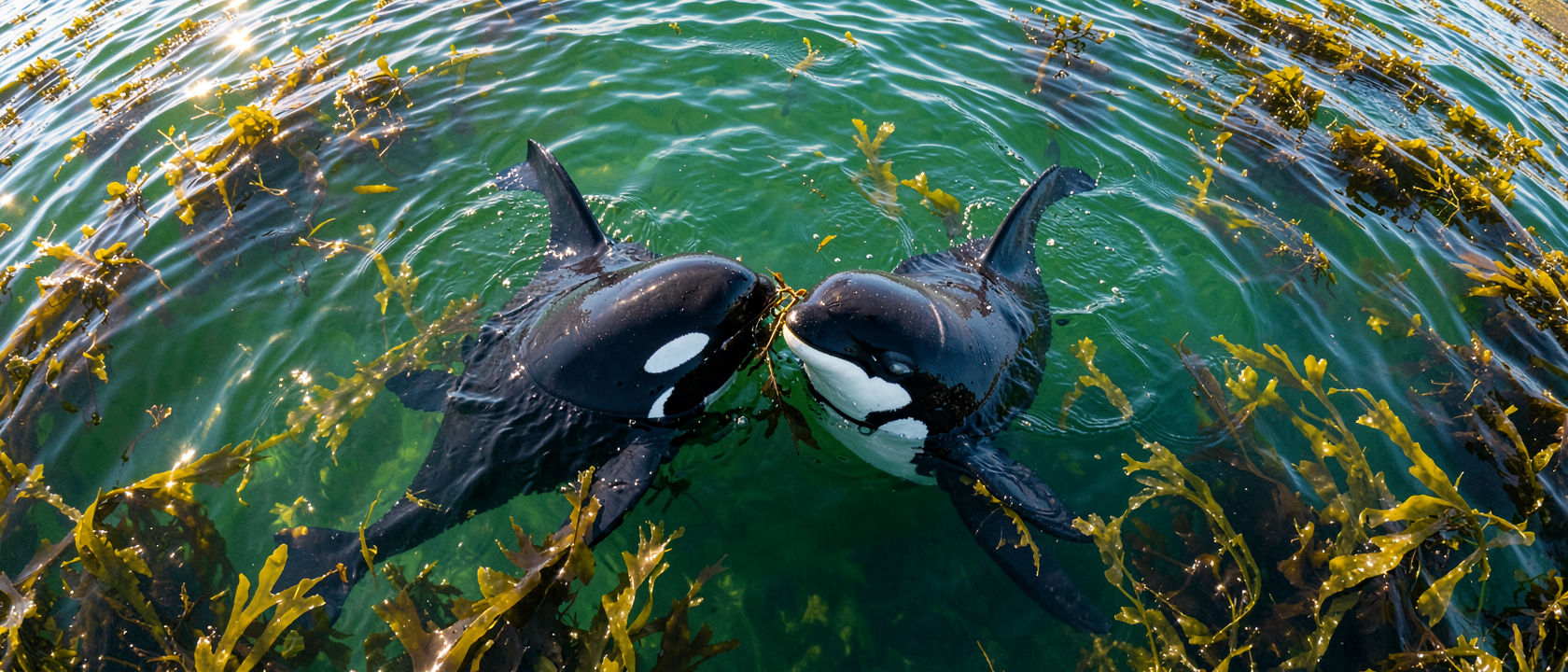
Southern Resident killer whales living in the Salish Sea, the inland waters between Washington State and British Columbia, bite short segments off bull kelp stalks, then roll the piece between their own body and a partner’s. A study published in Current Biology in 2025 calls this the first documented case of a marine animal manufacturing a tool and using it on another individual.
Orcas made themselves a grooming tool
The behavior was caught on drone footage by Michael N. Weiss and colleagues at the Center for Whale Research and the University of Exeter, who flew an unoccupied aerial vehicle over the central Salish Sea from April 10 to July 27, 2024. In a two-week window within that season, the team recorded 30 separate instances of the behavior, turning up on eight of the twelve days they studied closely. They named it allokelping: kelping with the help of someone else.
What makes the find land harder is who missed it. J, K, and L pods, the three groups that make up the Southern Resident population, fewer than 80 whales left in total, have been individually cataloged and watched from boats since the early 1970s. Nearly 50 years of close observation, and allokelping only showed up once researchers got a camera straight overhead.
How you build a kelp tool with your teeth
Making the tool starts with an orca grabbing a bull kelp (Nereocystis luetkeana) stalk by its stipe, the narrow stem running down to the holdfast, the root-like structure that glues the kelp to the seafloor. Rather than just biting through it, the whale uses its own swimming motion against the kelp’s drag to snap a segment free.
It flips the severed piece onto its rostrum, the beak-like front of its skull, swims up to a partner, and presses the kelp against the other whale’s flank. From there, the two trap it between their bodies, fins and flukes included, and roll it back and forth, twisting into an exaggerated S-shaped posture to keep it pinned. Researchers have seen that same S-curve before, in whales rubbing themselves against sand or pebbles, which suggests allokelping grew out of an older, solo habit of self-grooming.
It’s skincare, and it’s social
Whales from every social group, age, and sex in the study took part, but not with just anyone. Weiss and his team found that orcas groomed close relatives and partners close to their own age far more often than they groomed anyone else. Whales with more molting or dead skin were also more likely to take part, which points toward allokelping doing real hygienic work, not just scratching an itch.
Skin maintenance between individuals isn’t new in marine mammals; bottlenose dolphin mothers remove dead skin from their calves. Tool-assisted grooming between individuals is the rare part, documented mostly in primates and mostly in captivity. In orcas, who an animal chooses to groom with looks less like hygiene and more like a relationship map.
One case the Center for Whale Research team filmed in 2024 makes that point on its own. A young whale named Nova kept retrieving a dropped piece of kelp to keep grooming his grandmother, Shachi, swimming back for it each time, balancing it on his snout, and nudging it against her side again.
Two things people get wrong about orcas
Start with the name. A “killer whale” isn’t a whale at all. Orcinus orca is the largest species of dolphin, growing up to 29.5 feet (9 m) long.
The bigger myth is about who gets to make tools. Deliberate toolmaking has mostly been told as a story about hands, primates, and dry land. Allokelping is the first documented case of a marine mammal manufacturing a tool at all, which does away with the idea that building something and using it on purpose requires fingers, air, or a body plan anything like a human’s.
Nobody knows how far this goes
Nobody knows whether allokelping exists anywhere outside these three pods. It might be a local invention, something one group worked out and passed down the way culture spreads, which is what researchers currently suspect. It could also be happening in other orca populations entirely unseen, since so much of a whale’s life plays out underwater, out of camera range.
Researchers also haven’t confirmed exactly what benefit allokelping delivers. A confirmed skin benefit would turn this from the first documented case of marine tool use into the first confirmed case of tool manufacture in any marine mammal. Currently, the honest answer is that nobody has looked hard enough yet to say.
The salmon hat is back
Separate from the kelp research, Salish Sea orcas have also revived a decades-old habit: carrying a dead salmon balanced on the head like a hat. It serves no obvious purpose anyone has identified; it just looks like a fad that faded out and then came back, the way a slang word drops out of a friend group and resurfaces years later. Researchers who study orca culture point to the salmon hat as evidence that behaviors spread through a pod by one whale watching another and copying it, not by instinct, which is a familiar way for a trend to travel.
—
**Issues found and corrected:**
1. “Right now, the honest answer is…”, flagged as a relative-to-today phrase; changed to “Currently” since it describes the present state of research knowledge, not tied to publication date.
2. All other instances of “fewer than 80 whales” confirmed correct (countable noun).
3. No subject–verb agreement errors found.
4. No its/it’s or other homophone errors found.
5. No spelling inconsistencies (American spelling used consistently: “behavior,” “colleague,” etc.).
6. Punctuation, capitalization, and em-dash usage checked, no errors found.
7. “Nearly 50 years” is a year-based relative reference and is correctly preserved per the exception rule.