
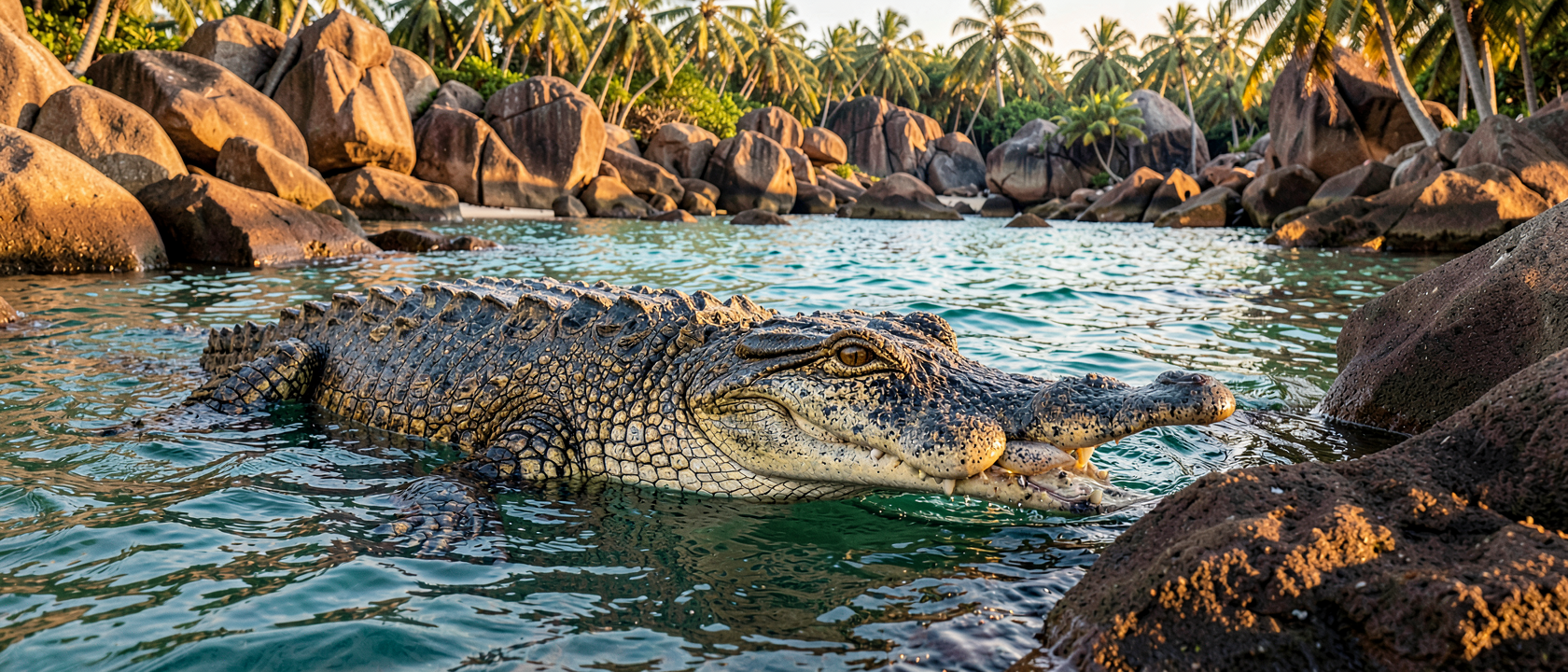
The Crocodile That Vanished Within a Lifetime
For more than 250 years, sailors and early naturalists wrote about crocodiles on the beaches of the Seychelles the way you’d write about gulls: just there, a common and unremarkable sight on an Indian Ocean archipelago, noted in passing by people who had no reason to think the animals needed describing properly. Then permanent settlers arrived on the islands in 1770, and the crocodiles started disappearing. Within about 50 years, by the early 1800s, they were gone entirely, wiped out before anyone thought to collect enough of them, compare their skulls to other crocodiles, or write down anything more useful than “crocodile, common.” The animal generations had simply walked past became, almost overnight, a mystery with no body left to examine.
What the Bones in the Museum Drawer Actually Said
What survives of the Seychelles crocodile fits in one drawer: three incomplete skulls, held at the Seychelles National Museum, among the only physical remains of the entire population. In 2026, researchers from Germany and the Seychelles, led by Stefanie Agne and Frank Glaw and published in Royal Society Open Science, sequenced mitochondrial DNA (genetic material passed down only through the mother’s line) from those historic skulls and compared it against modern saltwater crocodiles across the species’ range. Across the full sample set, they identified 19 distinct mitochondrial haplotypes, genetic signatures carried together down a maternal lineage. The Seychelles animals weren’t sitting off to one side of that tree. They were nested inside it, closely related to saltwater crocodiles (Crocodylus porosus) living thousands of miles away. What stands out isn’t the match itself, but the distance it implies: the Seychelles sit roughly 1,864 miles (3,000 kilometers) from the nearest established saltwater crocodile range, across open ocean, with nothing in between.
The Trick That Lets a Crocodile Live in the Ocean
Crocodylus porosus is already the heavyweight of the family, growing past 19 feet (6 meters) and topping 2,200 pounds (1 metric ton) in its largest individuals. But size isn’t what let it reach a remote archipelago. Most crocodilians are freshwater animals; too much salt and their kidneys can’t keep up. Saltwater crocodiles carry specialized glands on the tongue that actively pump excess salt back out of the body, letting them tolerate seawater for extended stretches in a way most relatives can’t. That one piece of plumbing is the quiet precondition for everything that follows: an animal that can’t filter out that much salt was never making it 1,864 miles from home. One that can might.
Not One Epic Swim, But Generations of Drift
It’s tempting to picture a single extraordinary crocodile paddling across the Indian Ocean until it hit sand. The study’s authors argue for something slower and stranger. The salt glands didn’t evolve so one animal could swim 1,864 miles in a heroic push; they evolved because they let crocodiles survive passive drifting on ocean currents, island-hopping across a saltwater crocodile range that already stretched more than 7,500 miles (12,000 kilometers) from Asia to Australia and the Pacific. Agne reads the genetic pattern as evidence that saltwater crocodile populations stayed connected across huge distances over long stretches of time, pointing to a species far more mobile across generations than it’s usually given credit for. Glaw frames the Seychelles population the same way: not one crocodile’s odyssey but a founder event, a population that arrived by current over some unknown span of time and only then settled in to become the ordinary beach animal the sailors kept writing about.
The Myth That Lasted Until the DNA Came In
Western naturalists first assumed the Seychelles crocodiles were Nile crocodiles (Crocodylus niloticus) that had somehow migrated from Africa. In 1994, researchers reclassified the remains as saltwater crocodiles instead, based on physical traits in the skulls, but the correction didn’t finish the job. For decades afterward, the population was still treated, on looks alone, as possibly its own distinct species, isolated and strange-looking enough that a group cut off on a remote archipelago might plausibly have drifted into something new. The 2026 genetic data kill that idea outright. The Seychelles crocodiles weren’t a separate species. They were the westernmost known population of an animal already well documented across Southeast Asia, Australia and the Pacific, and whatever made their skulls look distinctive was isolation doing its usual work on a small, cut-off group, not divergence into something new.
What the Study Doesn’t Tell Us
The paper doesn’t say how many separate dispersal events seeded the Seychelles population, whether it was one wave of founders or several arriving at different times. It doesn’t say how many generations the drift took. And because mitochondrial DNA only tracks the maternal line, it can miss differences carried by males; the researchers note that nuclear DNA, inherited from both parents, might still turn up finer distinctions between regional populations that this study couldn’t see. For now, three incomplete skulls in a Seychelles museum drawer are the only ones asking.