
The treadmill trick that didn’t work
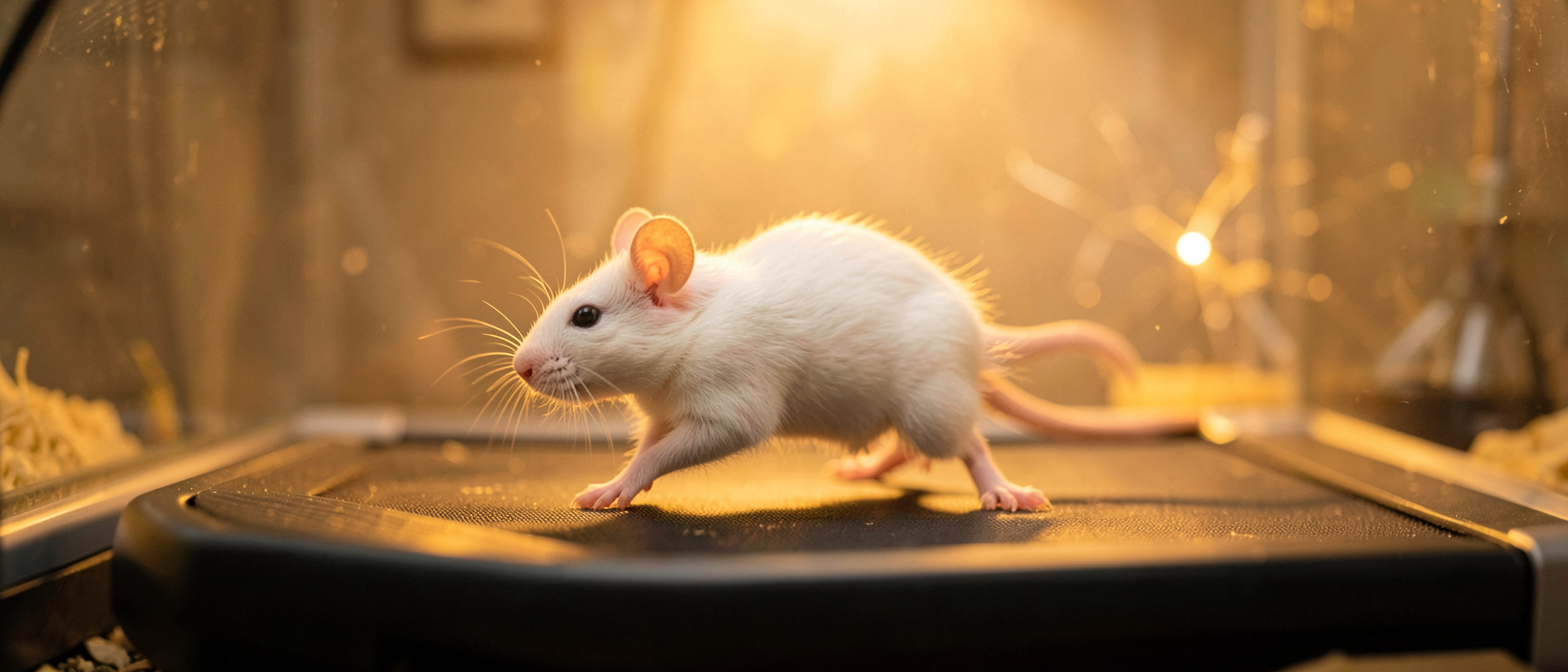
Mice that run on a treadmill daily for two weeks get genuinely fitter: higher top speeds, longer runs before exhaustion. A study led by corresponding author J. Nicholas Betley at the University of Pennsylvania, published in the journal Neuron on February 12, 2026, found a way to erase every bit of that progress without changing a single step of the workout.
The trick wasn’t during the run. Researchers left a cluster of brain cells working normally while the mouse was actually on the treadmill. Then, for one hour after each run ended, they blocked those same cells from firing. Everything else about the training stayed identical for fourteen straight days: same speed, same distance, same muscles doing the same work. As far as the mouse’s legs were concerned, day fourteen looked exactly like day one. At the end of it, the mice showed no improvement in endurance at all. Block the signaling the whole time instead, and the result was just as blunt: the animals tired quickly and never built any stamina either.
What the brain does once the mouse has already stopped running
The cells in question are called SF1 neurons, short for steroidogenic factor-1, and they sit in the ventromedial hypothalamus, or VMH, a brain region already known for managing body weight, blood sugar, and how the body spends energy. Betley’s team saw these neurons switch on while mice ran, which isn’t remarkable on its own; plenty of brain regions respond to activity. What stood out was that the SF1 neurons didn’t quiet down once the mouse stepped off the treadmill. They kept firing for at least an hour afterward. And the longer the daily training continued, the louder that post-run signal got: by the end of two weeks, the same neurons were firing more, and at higher activity levels, than they had on the first day.
That lingering signal turned out not to be a passenger. The silencing experiment proves it’s load-bearing. Block it, and training stops producing any physical adaptation, even though the heart and leg muscles are doing identical work, session after session. In a separate test, the team ran the experiment in the other direction: artificially switching the SF1 neurons on boosted endurance performance, even without the animal doing any extra exercise.
Why a mouse’s brain would bother keeping score after the run is over
The VMH’s regular job is running the body’s energy budget: body weight, blood sugar, where fuel gets routed. Betley’s team suspects the SF1 neurons keep using that same machinery after a run finishes, helping the mouse manage glucose more efficiently while it recovers. If that holds up, it would give muscles, lungs, and heart time to actually absorb what the day’s exercise demanded before the next session starts. The hour after the treadmill stops might be where that day’s training gets written into the body. Betley is careful to call this a working theory rather than a settled answer; by his own team’s account, the exact mechanism connecting the two still remains unclear. Separately, the team found that training itself appears to leave a physical trace on these neurons: repeated exercise seems to make SF1 cells more excitable and to add more excitatory connections onto them, as if the brain were keeping a running tally of how much exercise the mouse has done.
It was never just about the muscle
The usual story about endurance training treats the brain as a messenger: it fires the “go” signal and gets out of the way while muscle fibers, mitochondria, and the cardiovascular system do the actual work. This study says that account is incomplete, at least in these mice. The muscle and heart were doing identical physical labor in every single session. Only one thing changed between the mice that improved and the mice that didn’t: one hour of brain signaling after the workout was over. Block that hour, and two weeks of daily treadmill running produced nothing measurable. The adaptation didn’t fail because the body couldn’t manage it. It failed because the brain never gave the order to keep it.
What nobody’s filled in yet
Betley’s team is upfront about the gap in their own paper: they don’t yet know the actual chain of events between “SF1 neurons keep firing for an hour” and “the mouse runs faster two weeks later.” The published findings also don’t give sample sizes for these experiments, and there’s nothing in them to say whether any of this extends beyond laboratory mice. Betley has said he hopes the mechanism eventually proves relevant to older adults, to people recovering from a stroke, or to athletes rebuilding fitness after injury, but that’s a hope attached to future research, not a result anyone has shown yet. For now, the only animal this has been demonstrated in is a mouse on a treadmill, whose brain appears to keep doing the math long after its legs have stopped.