
Eleven Hours a Day, Three Hundred Days a Year
In the hottest cattle-producing regions of Brazil, Argentina, Colombia, Paraguay, and Uruguay, a beef animal spends more than 11 hours a day, on more than 300 days a year, in conditions that overwhelm its ability to cool itself. That is the headline number from a study of 636 cattle-producing sites across those five countries: in locations classified as high thermal risk or worse, cattle logged between 280 and nearly 2,800 hours a year of moderate to intense heat discomfort. In the most extreme regions, more than 3 of those daily hours fell under what the researchers call severe thermoregulatory effort. In moderate-risk regions, by contrast, the daily average was a comparatively mild 5 hours.
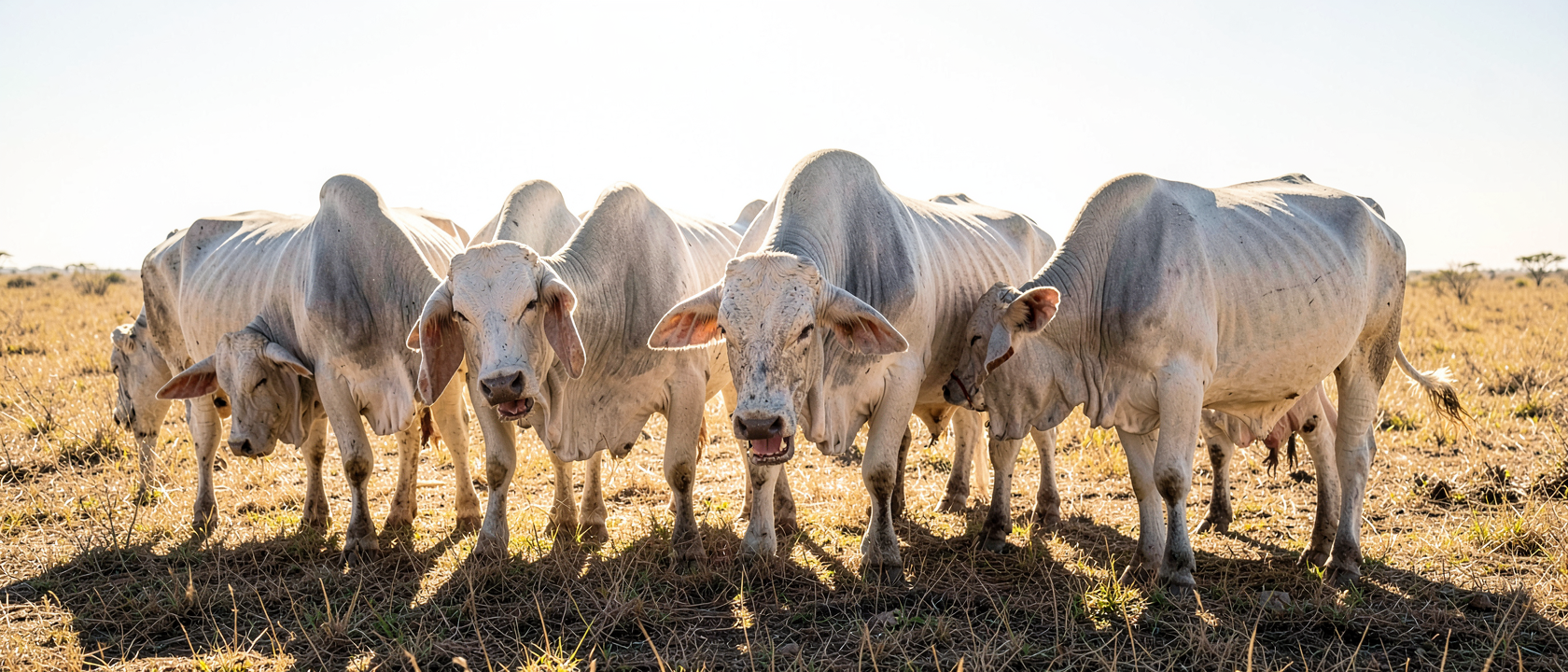
The animals behind these figures are mostly Nelore, a Zebu-type breed (Bos indicus) recognizable by its pale grey-white coat, the hump over the shoulders, and loose, drooping ears, common across Brazilian beef production. Dr. Cynthia Schuck-Paim and colleagues published the first quantification of this burden in the journal Animals on January 13, 2026, built on five years of climate records run through the Welfare Footprint Framework, a method that converts weather data directly into measured hours of thermal discomfort rather than a seasonal estimate.
What a Cow Does When It’s Too Hot to Think
The researchers did not infer suffering from a temperature chart. Under intense heat, Nelore cattle stop grazing, stop ruminating (the repeated re-chewing of swallowed feed that keeps a cow’s digestion moving), and go still for long stretches. They pant, heavily and without letting up, pushing air across the lungs to dump heat the body can’t shed through the skin.
That last part is the physiological hinge. Cattle don’t cool themselves efficiently through sweat, so panting becomes the main route left, which is why the response escalates under sustained heat instead of leveling off once an animal supposedly adjusts. The Welfare Footprint Framework treats this cluster, the halted grazing, the stillness, the panting, as direct behavioral evidence of accumulated negative affective states, not a risk modeled from temperature curves but suffering that was actually logged.
Turning Suffering Into a Number You Can Compare
The framework tallies welfare as cumulative hours spent in defined negative states, mild, moderate, intense, so that heat stress in cattle can be set hour for hour against other welfare harms measured the same way, instead of being treated as a separate, unmeasurable kind of problem. A diffuse, half-visible hazard turns into a number a certification scheme, a regulator, or a ranch’s own ledger can act on.
The authors call their own count conservative, and they mean it literally. It captures only the immediate experience of thermal discomfort. It leaves out the higher disease risk and the mortality that heat stress is also known to raise, so the real welfare toll sits above whatever figure the paper reports, by design, not by oversight.
Heat Stress Isn’t a Heat Wave
The first assumption this kills is that heat stress is an occasional emergency, something tied to a heat wave that passes. In extreme-risk regions, cattle face it on 307 days a year. That isn’t a spike. That’s the baseline climate of the job.
The second assumption dies right alongside it: that protecting welfare costs the producer money. Shade cut time spent in the most intense discomfort category by about 85%, from an average of 578 hours a year down to 83, and it paid for itself within 16 months through better feed efficiency, with net returns of $12 to $16 per animal, even when it was only installed during the finishing phase, the last and shortest stage of a beef animal’s life. A separate trial cited in the paper, run in São Paulo state on Bos indicus cattle given a 32-square-foot (3 m²) shade structure costing $80 and built to last 15 years, found a 17.6-pound (8 kg) gain in hot carcass weight over unshaded cattle in that same high-risk climate. Even the study’s own conservative accounting lands in the same range: an 11-pound (5 kg) gain generating $15 to $19 in extra revenue against a 10-year shade cost of $2.3 per animal.
Nobody Has Measured the Full Payoff Yet
Shade was only tested during the finishing phase, the shortest and final stretch of a beef animal’s life, and the authors say the gains would be “much higher” if shade were available across the whole production cycle. They don’t put a number on how much higher. The figures above also still exclude the disease risk and mortality that heat stress is known to raise elsewhere in livestock science, which means the true scale of harm that shade prevents, and the true scale of the return it generates, is still unmeasured.