
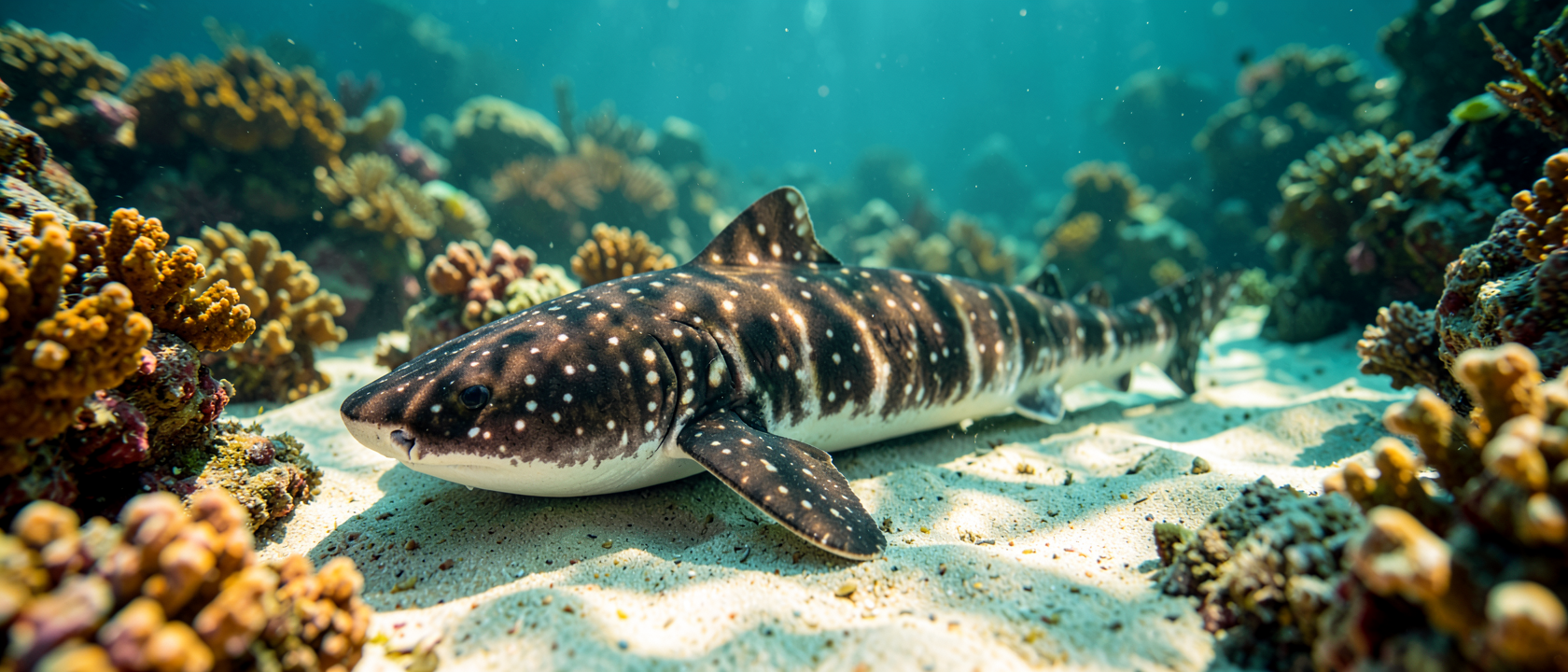
A Shark’s Receptor Reacts to the Same Chemicals Yours Does
The whitespotted bamboo shark (Chiloscyllium plagiosum) and the small-spotted catshark (Scyliorhinus canicula) both carry a working bitter-taste receptor gene, one that fires in response to several of the same compounds that make a human mouth pucker. In 2023, a team from the University of Cologne and the Leibniz Institute for Food Systems Biology, led by Dr. Maik Behrens, Tatjana Lang, and Prof. Dr. Sigrun Korsching, scanned 17 cartilaginous fish genomes, the group that covers sharks, skates, rays, and sawfish, all of which build their skeletons from cartilage instead of bone. They published the results in the Proceedings of the National Academy of Sciences (PNAS). Twelve of the 17 genomes carried a bitter-taste receptor (T2R) gene: nine sharks, one sawfish, and two skates. Every one of those twelve species had exactly one copy. The team named it T2R1. Before this paper, no cartilaginous fish had ever been confirmed to carry a bitter receptor of any kind.
How They Proved the Gene Actually Does Something
A gene sitting in a genome does not prove a working sense; genomes are full of sequences that are broken or silent. So the Cologne team pulled the T2R1 sequence out of the bamboo shark and out of the catshark and inserted each one into immortalized cell lines, a standard way of finding out whether a cloned receptor gene actually responds to anything. Both shark receptors activated when exposed to bitter compounds humans also detect, including colchicine, a toxic plant compound, and bile acid. The researchers then widened the test, screening 94 known human bitter substances against the shark receptor. Eleven of them set it off, among them amarogentin, one of the most intensely bitter natural substances known to the human tongue, which produced the strongest response from both shark receptors. The catshark’s receptor answered to a broader range of these compounds than the bamboo shark’s, whose response turned out to be a subset of the catshark’s, at roughly similar strengths. That gap, between a gene that exists and a gene that answers, is what turns a genome scan into a functional discovery.
One Gene, Doing the Job of Dozens
Humans carry roughly two dozen T2R genes, duplicated and diversified over evolutionary time so that different receptors catch different poisons. Every cartilaginous fish in this study did the opposite: one gene, never duplicated, still doing its job. Korsching has described the finding as a way to look back almost 500 million years, to the molecular and functional origin of the entire bitter-taste receptor family, since that is roughly the age of the last common ancestor shared by cartilaginous and bony fish. The researchers interpret T2R1 as the ancestral form of that whole family, not a stripped-down version of what humans have, but the original design that bony vertebrates later copied and multiplied. The clearest evidence for how old this system is comes from a different fish entirely. Some of the same eleven compounds that trigger shark T2R1 had already been shown, in the same team’s earlier work, to activate bitter receptors in the coelacanth (Latimeria chalumnae), an ancient bony fish. This is not mere resemblance; it reflects a function that has persisted, largely unchanged, across roughly 500 million years of separate evolution between sharks and the coelacanth.
The Myth: Bitter Taste Was Supposed to Be a Bony-Fish Privilege
Before this paper, the standing assumption in sensory biology was that T2R bitter receptors belonged only to bony vertebrates, fish, amphibians, reptiles, birds, and mammals, while cartilaginous fish sat outside that family tree, presumed to lack the apparatus entirely. That assumption was not a guess pulled from nowhere; it rested on the simple fact that no confirmed T2R gene had ever turned up in a shark, skate, ray, or sawfish genome. The 2023 PNAS paper ends it. T2R1 is real, it activates in cell lines exactly the way a working taste receptor should, and it showed up in 12 of the 17 species tested. Bitter taste is not a bony-fish exclusive. It is older than the split that produced bony fish in the first place.
What Nobody Has Shown Yet
Two things remain open, and the researchers do not pretend otherwise. First, every result here comes from isolated cell lines, not from a live animal. Nobody has tested whether a bamboo shark or a catshark moving over a reef actually avoids bitter, potentially toxic prey because of what T2R1 is doing. The receptor fires; whether that firing changes behavior is untested. Second, five of the 17 genomes showed no T2R gene at all, and nobody yet knows whether those species genuinely lost it or whether the gene sits in a stretch of DNA the sequencing simply missed. Cartilaginous fish genomes are notoriously hard to sequence completely, which means an absent gene in the data is not the same thing as an absent gene in the animal. If you have ever assumed a shark just swallows whatever it bites, this is the study that says otherwise: somewhere in that jaw is a 500-million-year-old gene quietly doing taste-testing you never knew to credit it for.