
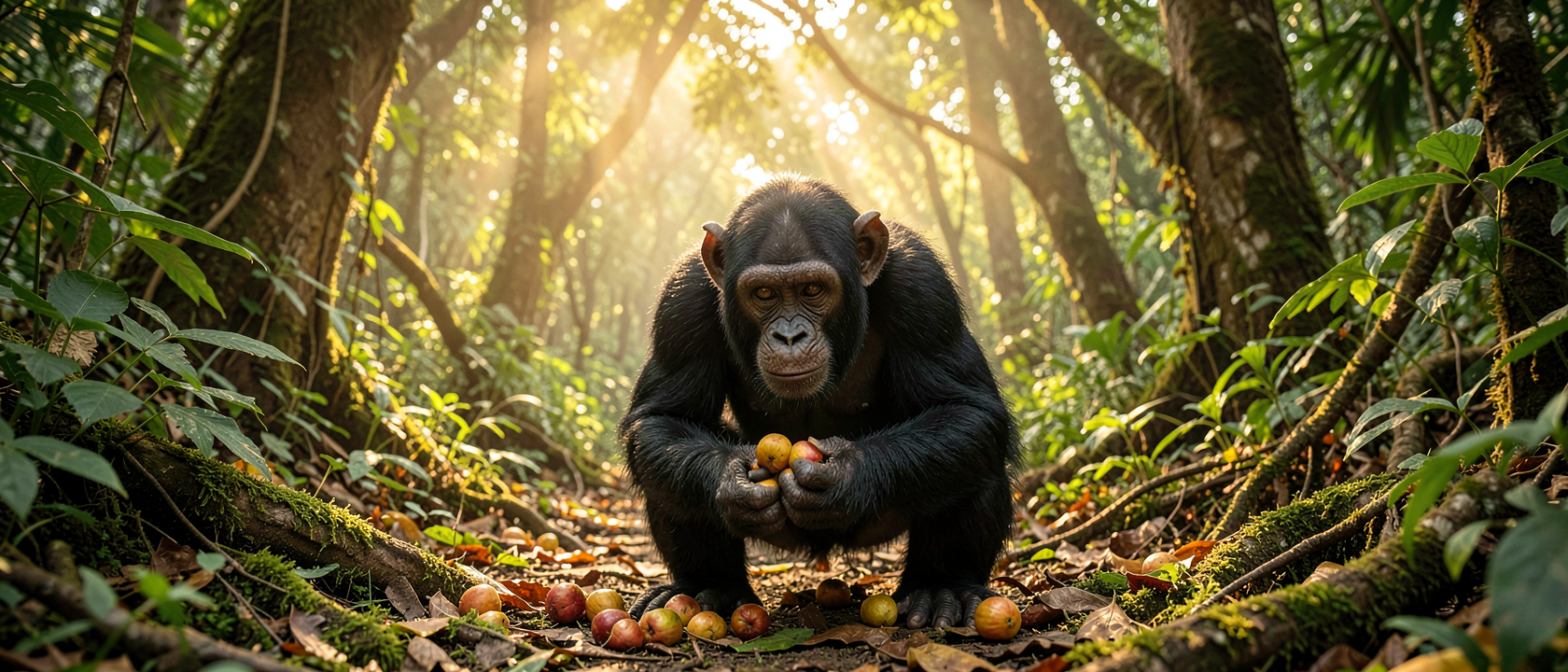
Chimpanzees (Pan troglodytes) eat fermented fruit off the forest floor so routinely that the scientists studying them had to borrow a word for it, because none existed in the scientific literature. A paper titled “Fermented Fruits: Scrumping, Sharing, and the Origin of Feasting,” published online July 31, 2025 in BioScience (Volume 75, Issue 9, pages 774-778), gave the behavior a name: scrumping. The authors, Nathaniel J. Dominy, Luke D. Fannin, Erin R. Vogel, Martha M. Robbins, and Catherine Hobaiter, work out of Dartmouth College, Rutgers University, the Max Planck Institute for Evolutionary Anthropology, and the University of St Andrews. Working from a dataset of 154 fruit species eaten by orangutans, chimpanzees, and gorillas, they found that African apes regularly pick up and eat fruit that has fallen, split, and started to ferment on the ground, a behavior no prior study had set out to measure.
Why the fruit doesn’t knock them flat
Ripe fruit left sitting on the ground ferments naturally, as yeasts break down its sugars into low concentrations of ethanol. Eating it should, in theory, come with both a mild buzz and a real metabolic cost. But African apes carry a variant of an enzyme called ADH4, which clears ethanol from the gut and liver. A 2015 study in PNAS by Carrigan and colleagues traced that variant to the common ancestor of humans, chimpanzees, and gorillas (Gorilla spp.), roughly 10 million years ago, and found it metabolizes alcohol about 40 times more efficiently than the older form of the enzyme still carried by orangutans (Pongo spp.) and other primates. Orangutans split off the family tree earlier and never picked up the mutation. Chimpanzees eat around 10 pounds (4.5 kg) of fruit a day, according to the BioScience paper, so an animal scrumping on the forest floor is taking in a steady, low dose of alcohol that its body happens to be unusually well built to process.
A ten-million-year bar tab
The authors don’t treat the enzyme as a coincidence. An ape efficient enough at breaking down ethanol to eat fermented fruit safely, rather than avoid it, gets two advantages: it can feed on the ground instead of competing with monkeys for unripe fruit still hanging in the canopy, and it skips the risk that comes with climbing for every meal. Because the mutation predates the split between the human lineage and chimpanzees and gorillas, the researchers propose that the appetite for fermented fruit, and the habit of eating it in company, is at least 10 million years old. Hobaiter frames the human angle directly: a core part of how humans relate to alcohol, she says, is drinking it together, whether that’s a pint with friends or a large shared feast. Dominy adds that this tolerance predates intention by a wide margin. Metabolizing alcohol came first; brewing it on purpose came millions of years later, and became, by his account, one of the forces behind the Neolithic Revolution.
What everyone assumed, and what killed it
The working assumption in primatology was that apes mostly avoid rotten, fermented fruit, and that any sighting of the behavior was an oddity for a footnote, not a habit worth naming. The BioScience team tested that assumption against the data instead of against intuition. They cross-referenced feeding events with the known growth height of each fruit species: if a fruit normally ripens in the canopy but turned up eaten on the ground, it got flagged as scrumping. Run across the full 154-species dataset, the split held species by species. African apes scrumped regularly. Orangutans largely did not, matching the exact genetic line between who carries the efficient ADH4 variant and who never evolved it.
What the study doesn’t claim
“Regularly” is the word the paper uses, not a measured rate, and the authors are careful to note that scrumping apes are “probably ingesting highly variable concentrations of ethanol,” anywhere from negligible to moderate, since nobody has yet measured fermentation levels in ground fruit against fruit still hanging in the trees. Dominy says that comparison is the next planned step. Hobaiter’s next step is a different question: whether apes that feed together on fermented fruit build stronger social bonds from it, the way shared drinking is thought to work for humans. That question is still open; the dataset doesn’t answer it.
The word nobody had
Dominy has described the moment the gap became obvious: there was no scientific term for “feeding on fruits gathered from the forest floor,” and without one, the behavior kept slipping past researchers unremarked. The team reached for an English word already doing similar work: scrumping, which traditionally means gathering, or quietly helping oneself to, windfallen apples from an orchard. It traces back to the medieval German schrimpen, meaning shriveled or shrunken, which is exactly the state of a piece of fruit that has gone soft and alcoholic on the ground. Hobaiter has her own way of putting the finding to use: a cold pint of scrumpy cider, she says, is a fairly faithful rerun of something apes have been doing for 10 million years.