
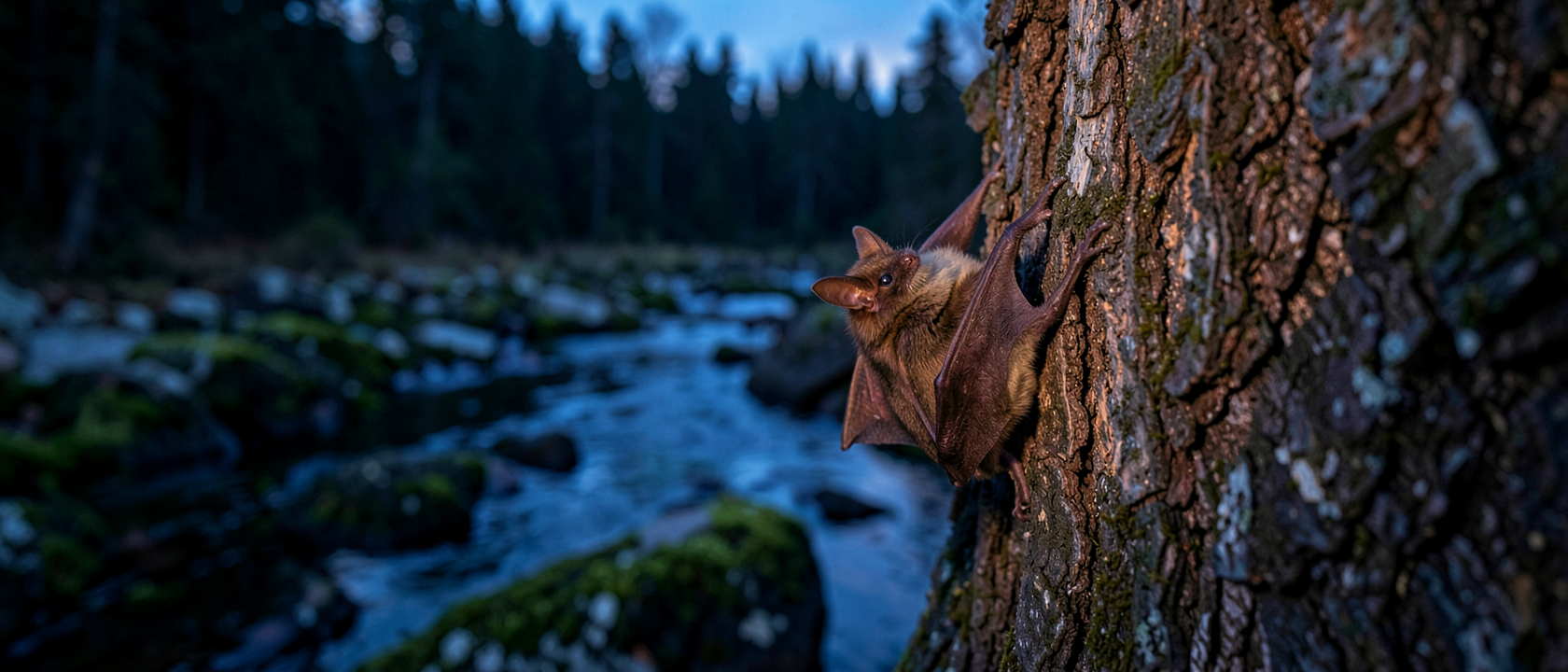
A Brandt’s myotis (Myotis brandtii), a bat that weighs about 0.25 ounces (7 grams), roughly the heft of a two-euro coin, was banded somewhere in Europe and recaptured fifty years later. That recapture, noted in the background materials behind a new genome study, stands as the longevity figure cited in the press materials for the longest-lived bat on record; a separate peer-reviewed field study puts the documented record at 41 years, for a male Brandt’s myotis recaptured in Siberia. Either way, this bat outlives its close relative in the same genus (the taxonomic rank one step above species, meaning these animals share a recent common ancestor) by a wide margin. The black myotis (Myotis nigricans) of South and Central America lives about seven years. Same genus, same basic bat body plan, a sevenfold gap in how long they last. That gap is what the rest of this piece tries to explain.
Eight Genomes and One Toxic Chemical
Juan Manuel Vazquez, now on the faculty at Penn State, and Peter Sudmant, an associate professor at UC Berkeley, led a team that sequenced eight Myotis genomes, the first comparison of its kind across the genus. Working with Elise Lauterbur of the University of Vermont, Lucie Etienne of École Normale Supérieure in Lyon, and David Enard of the University of Arizona, they also ran cell experiments on Myotis lucifugus, the little brown bat, one of the genus’s long-lived species. They exposed cultured lucifugus cells to a DNA-damaging chemical and tracked, gene by gene, what turned on in response. The paper, “Insights into longevity and virus-driven adaptation from Myotis bat genomes,” appeared in Nature during the week of August 26, 2026, with funding from the NIH and NSF.
Kill the Cell, Don’t Fix It
The expected response to DNA damage is repair: enzymes patch the broken strand, the cell carries on. That is not what the little brown bat’s cells did. The genes for DNA repair stayed mostly quiet. What switched on fast was a different set of genes, the ones that order a damaged cell to destroy itself. Mechanically, that means a cell carrying code that could later turn cancerous gets deleted outright instead of stitched back together, so there is no faulty patch job left to pass on the next time the cell divides. Part of the machinery behind this response is a gene called PKR, also known as EIF2AK2, which normally helps a cell sense viral DNA. In Myotis bats, the study found that this gene has been duplicated repeatedly across the genus, with different species carrying anywhere from one to three copies. More copies of a gene built to spot foreign DNA may be doing double duty, flagging damaged DNA inside the bat’s own cells as well, which would help explain why the kill-switch response is so fast and so specific to this genus.
Aging and Infection May Be the Same Fight
Across the eight Myotis genomes, the study found a statistically strong overlap between genes tied to longevity and genes tied to fighting viruses, more overlap than chance alone would produce. Myotis bats carry an unusually large set of genes for proteins that latch onto DNA viruses specifically, the family that includes herpes-type viruses. That is the reverse of most mammals, including humans and other primates, which lean toward defenses against RNA viruses, the family that includes HIV and the virus behind COVID-19. The study authors’ own reading of this is that longevity genes and disease-resistance genes in Myotis bats may not be two separate systems running in parallel. They may largely be the same genes doing double duty: an antiviral toolkit that, as a side effect, also keeps damaged cells from accumulating with age.
The Myth This Kills
The standard assumption about long-lived animals is that they must have superior DNA repair, the better the mechanic, the longer the car runs. The little brown bat’s cells argue the opposite. Faced with damage, repair was not even the first move; killing the cell was. Surviving decades, in this genus, was never about preserving every cell that got hit. It was about not letting a damaged one stick around long enough to cause trouble.
What Nobody Knows Yet
Sudmant’s team still cannot explain the balancing act underneath all this: how a bat builds proteins aggressive enough to attack a virus’s DNA without those same proteins turning on the bat’s own genome. That trade-off is an open question the researchers say they intend to chase next. Vazquez has also said the mismatch between bats’ DNA-virus defenses and humans’ RNA-virus defenses is something scientists “should look into more,” since it may bear on why spillovers from bats to humans turn out the way they do; that link is not established, only flagged as worth chasing. Any talk of a human therapy coming out of this work is, for now, a hope the scientists have voiced, not a result they have shown. No treatment exists. No trial has started. There is a finding and a direction, nothing yet to apply.
Mist Nets at Midnight
None of the genome data existed before someone caught the bats. Starting in 2020, Vazquez spent nights across the western United States, stringing fine mist nets over streams, ponds, and rivers with a rotating crew of undergraduate helpers. A bat would hit the net, get gently untangled, give up a small tissue sample from a wing, and fly off before sunrise. One bat, one biopsy, one release, repeated through months and years. By the time the analysis was ready, that fieldwork had produced cell cultures and tissue from 259 individual bats spanning 32 species. Fifty years, or at minimum a peer-reviewed 41, of one Brandt’s myotis living quietly somewhere in Europe or Siberia, and an unglamorous string of nights with a net over a creek in Arizona: that is the actual distance between a surprising number and an explanation for it.