
Nine Pups, Six Survivors, One Mouse Back From Orbit
A female laboratory mouse spent two weeks orbiting Earth and came home able to have babies.
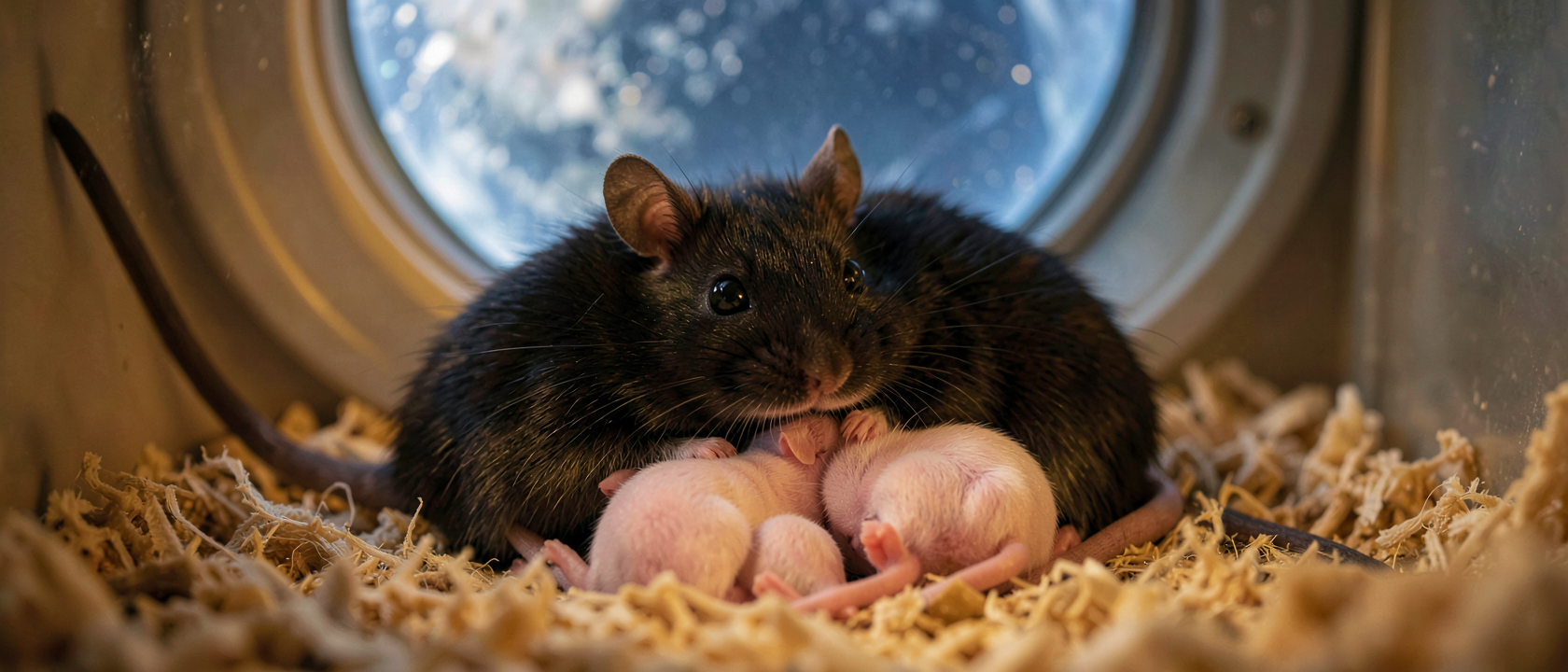
Four black-coated laboratory mice, numbered 6, 98, 154 and 186, two males and two females, launched aboard the Shenzhou-21 spacecraft on October 31, 2025, bound for China’s Tiangong space station, roughly 250 miles (400 km) up. They returned safely aboard Shenzhou-20 on November 14, after a two-week stay in orbit. On December 10, one of the returned females gave birth to nine pups. Six survived to weaning, a rate the research team describes as normal for a litter that size.
The mother is nursing normally, and the pups are active and developing well, according to the Chinese Academy of Sciences’ Institute of Zoology. It is the first time a mouse that herself flew to space has given birth, with the outcome tracked and recorded.
Why Mice Stand In for Us
Mice get to answer a question before humans can safely ask it. Their genes sit close enough to ours that a result in a mouse is a plausible preview of a result in a person. Gestation runs about 19 to 21 days, not nine months, so an experiment that would take a human study a generation to finish takes a mouse colony a season. Their stress physiology, cortisol, inflammatory markers, tends to move the same direction ours does under the same pressure.
That combination is why a mouse, not a monkey or a human volunteer, got the ticket to Tiangong. If short-term spaceflight were fundamentally destructive to mammalian reproduction, a fast-breeding animal would show it almost immediately: pups that don’t survive, a mother that can’t conceive, a litter half its normal size. A mouse surfaces the damage, if there is any, long before a slower-breeding species ever could.
What This Actually Buys Science
“This mission showed that short-term space travel did not impair the reproductive capability of the mouse,” said Wang Hongmei, a researcher at the Chinese Academy of Sciences’ Institute of Zoology. Read that sentence as carefully as she wrote it: one mouse, one short flight, one healthy litter. It’s evidence, not a verdict.
It’s tempting to call this the first birth ever produced by a space traveler, and that overstates it. In an earlier study, sperm collected from mice that had already flown in space was used to fertilize female mice who never left Earth, and those pregnancies went fine too. What’s new here is that the mother herself carried the spaceflight exposure in her own body, not just in a vial of sperm, and still produced a normal-sized litter.
The reason anyone outside a mouse habitat should care: crewed missions keep getting longer, and at some point whether reproduction itself can survive spaceflight stops being academic. The Shenzhou-21 crew spent six months aboard Tiangong and ran 27 experiments total; the mouse study, China’s first look at rodent mammals in orbit, was one line on that list, and the mice themselves stayed for only two weeks. Whatever they answer first, humans are next in line to ask the same question of themselves.
What Nobody Knows Yet
One healthy litter answers one question and leaves several open. This mouse conceived and carried her pups on the ground, after she came home. Nobody in this experiment got pregnant while still in reduced gravity, so the finding says nothing about whether a mammal can conceive and gestate up there, only that a short stay doesn’t appear to break the equipment once she’s back down.
It also doesn’t settle whether cosmic radiation leaves damage in eggs or sperm that stays invisible until a later generation surfaces it, or whether the nine pups born on December 10 will themselves reproduce normally. Researchers plan to track the pups’ growth curves and watch for physiological changes that might trace back to their mother’s two weeks in orbit, and they intend to test whether those pups can have litters of their own. One mouse giving birth doesn’t answer all of that. It answers one of the easier parts.
The Soy Milk Incident
None of this ran on schedule. The Shenzhou-20 return that was meant to bring the mice home got delayed, and ground teams realized the four mice on board were going to run short of food before a new ride showed up. Someone had to improvise a rodent diet out of whatever astronauts actually eat.
The options on the table were compressed biscuits, corn, hazelnuts and soy milk. Soy milk won, judged the safest substitute, and it arrived the same way the mice got their water for the whole mission: pumped in through an external port on the station’s feeding system rather than handed to them directly. It’s a logistics story, not a biology one. Nothing about a mouse’s emergency diet in orbit tells you whether her ovaries work when she gets home. But it’s the detail that survives the retelling, that a scheduling delay in low Earth orbit nearly left four mice without lunch, and the fix was soy milk pumped through a tube.