
900 Acquaintances, Zero Close Friends
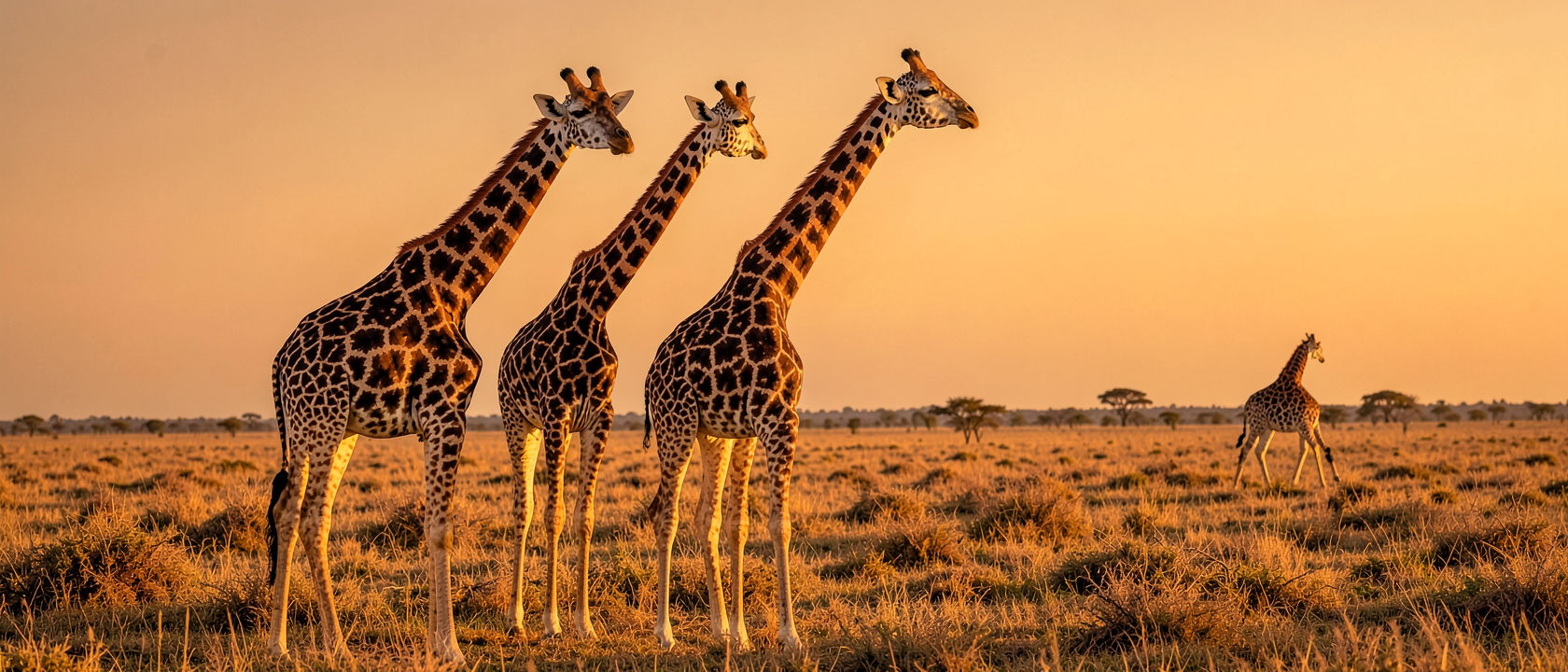
Male Masai giraffes (Giraffa camelopardalis tippelskirchi), an endangered subspecies native to northern Tanzania, collect far more social contacts than females do, and it isn’t close. A five-year study of 1,081 free-ranging giraffes across the Tarangire Ecosystem, an unfenced range of more than a thousand square kilometers, mapped who associates with whom across the entire population. Led by Juan Lavista Ferres with Derek Lee of Penn State, the team published its results in Animal Behaviour on September 27, 2021. Adult males averaged 85 distinct associates each; adult females averaged 47. Even the calves split along the same lines: males around 91 associates, females around 73. Males win on breadth. Females play a different game entirely.
The Long Road to Nowhere in Particular
Two separate male strategies produce that same wide reach. Older males had the highest closeness centrality in the network, a measure of how few steps separate one individual from everyone else: an older bull is usually only a short hop away from any giraffe in the study area. The researchers read this as the signature of a roaming mating strategy, bulls covering ground and checking in on many female groups rather than settling with one. Young males showed the opposite signature with the same effect: the highest betweenness, meaning they sit on more of the shortest paths connecting other giraffes to each other, plus the most ties of any age or sex class, as they shuttle between groups before finally leaving their mothers. Old or young, male giraffes end up loosely linked to nearly everyone. Almost nobody is strongly linked to anybody.
Males Are the Stitching, Not Just the Suitors
Here is what all that wandering actually builds. Adult female Masai giraffes already form roughly a dozen known communities of 60 to 90 animals, tight and stable, each female keeping close to a handful of others whose home ranges overlap with her own. The new finding sits one level up. Clustering the full population, calves and adult males included, the researchers detected four “super-communities”: three holding 800 to 900 individuals apiece, and a fourth, isolated outlier of 155 animals confined to a small area. Each large super-community contains several of the known female communities nested inside it, stitched together mostly by males moving between them. As Monica Bond, a postdoctoral research associate at the University of Zurich and one of the paper’s authors, put it: females keep enduring ties within stable, smaller communities, while males, chasing mating opportunities wherever they can find them, connect those communities into something far larger. Nobody had documented a giraffe society with this second, upper layer before.
It Wasn’t Just Loose Cliques All the Way Down
Giraffe groups have long been filed under fission-fusion, the same label used for elephants, bats, some primates, dolphins, and whales: membership keeps shifting, no two gatherings look quite the same, and that was treated as the whole story. This study does not undo that description; the shifting female-led groups are real. What it overturns is the assumption that fission-fusion was the only layer there is. Sitting above the female communities is a second, much bigger tier, the super-community, held together specifically by male movement rather than by any bond between the females themselves. The myth being retired isn’t “giraffes are social.” It’s “giraffe society has exactly one level.”
Nobody Knows What Holds the Net Together
Two things this data set cannot settle. First, whether the same super-community structure, with males acting as connectors, exists in giraffe populations outside the Tarangire Ecosystem; adult females elsewhere also show the fewer-but-closer bonding pattern, but the wider super-community layer has not been tested beyond this study area. Second, nobody has calculated how many individual males would need to be removed before a super-community actually fractures back into isolated female groups. The researchers flag this as a live conservation concern, warning that moving or relocating even a small number of well-connected animals could destabilize a network built on relatively few males, without offering a number for how small that handful would have to be.
His Away Message Has Been Up for Five Years
From the bull’s side of things, this isn’t a social life gone wrong. He has roughly 85 acquaintances, he’s structurally only a few hops from almost anyone in a population organized into super-communities of 800 to 900 animals, and he still hasn’t found the bandwidth to follow up with a single one of them.