
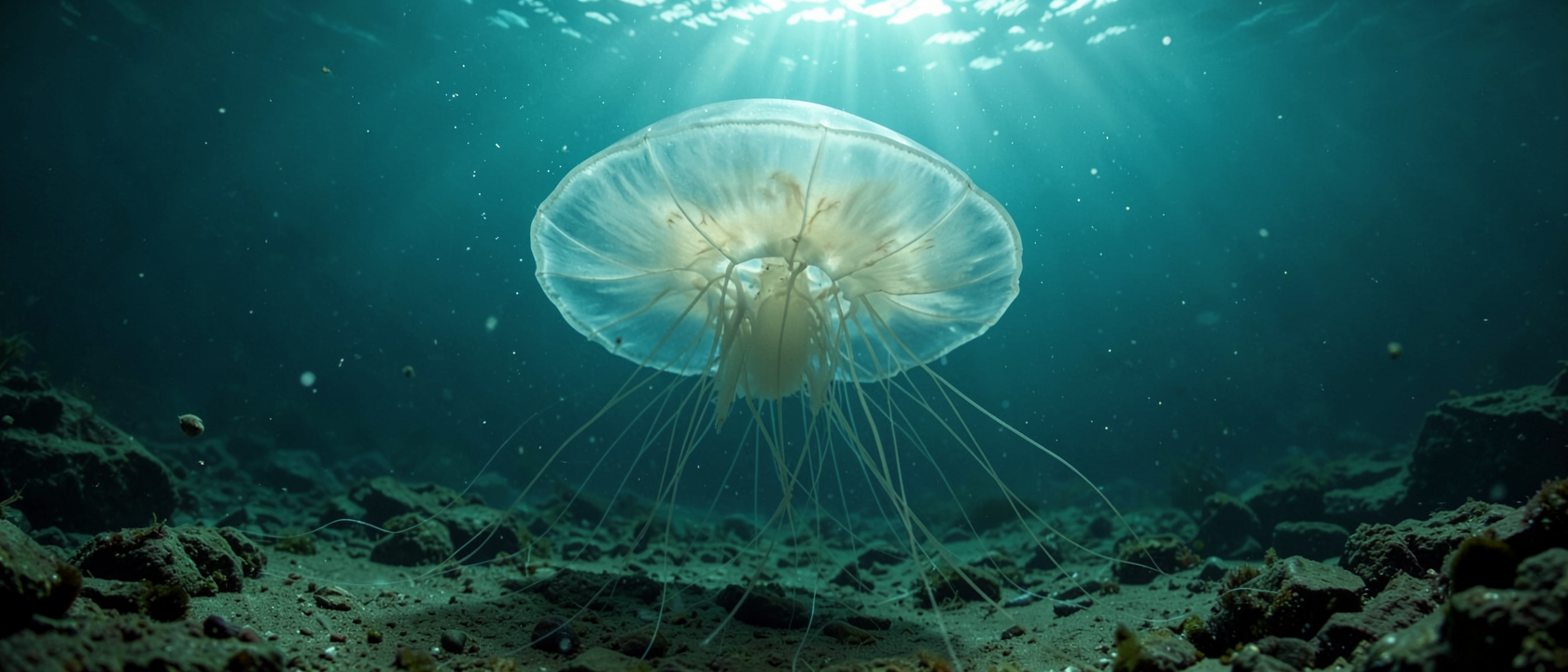
A jellyfish fossil that still has its insides
A creature that was roughly 95 percent water left a fossil detailed enough to show its tentacles and internal anatomy, 505 million years after it died. Royal Ontario Museum researchers Justin Moon, Joseph Moysiuk, and Jean-Bernard Caron named the species Burgessomedusa phasmiformis, describing it from 182 fossils (the museum holds nearly 200 specimens total), some more than 8 inches (20 cm) long. The paper ran in Proceedings of the Royal Society B in 2023. The fossils came from the Burgess Shale, high in the mountains of Yoho National Park, British Columbia, mostly collected in the late 1980s and 1990s under former ROM curator Desmond Collins. A bag of jelly surviving half a billion years in rock, with enough structure left to classify, is the whole premise of this one.
How you fossilize something that is mostly water
The Burgess Shale works because fine volcanic mud buried animals fast, in water too low in oxygen for scavengers or rot to get to them, flattening soft bodies into thin films of carbon that still read as shapes. In Burgessomedusa, that process held onto tentacles and internal anatomy clearly enough to place it as a true medusozoan, the branch of the phylum Cnidaria that includes jellyfish and produces a free-swimming, bell-shaped body stage. That distinction is not cosmetic. Comb-jellies, phylum Ctenophora, can look almost identical to a jellyfish at a glance but belong to a separate lineage entirely, built on different internal plumbing. Telling the two apart from a squashed carbon film is the actual achievement here, not the jellyfish itself.
The Cambrian had more than one kind of hunter
Comparing the fossil’s anatomy to living jellyfish, the authors argue Burgessomedusa was not drifting passively. It was swimming under its own power and using its tentacles to take down sizeable prey, the same role filled today by living jellyfish. It turns up on the same rock surfaces as Anomalocaris, the armored, clawed arthropod that usually gets cast as the one apex predator of the Cambrian. Caron, who worked on the paper, put it this way: Burgessomedusa “adds to the complexity of Cambrian food webs, and like Anomalocaris which lived in the same environment, these jellyfish were efficient swimming predators.” If your mental picture of the Cambrian ocean was one lineup of weird armored bugs, it was missing an entire hunting strategy, one that happens to leave almost no trace when it dies.
The “jellyfish” that turned out to be something else
Earlier fossils reported as Cambrian swimming jellyfish have now been reclassified by this team as comb-jellies instead, a different phylum wearing a convincing disguise. That correction knocks out a bigger assumption too: that jellyfish are essentially ghosts in the fossil record, their evolutionary history stitched together from microscopic larval fossils and DNA-based estimates of when lineages split, rather than from actual bodies. Moysiuk said the group has “been remarkably hard to pin down in the Cambrian fossil record,” and that this find “leaves no doubt they were swimming about at that time.” Burgessomedusa is one of the first cases where a real jellyfish body, not a stand-in or a statistical inference, shows up in the record at all.
What the rock still won’t tell us
Fossilized polyps, the stalked, anchored stage a jellyfish’s life cycle starts in before it ever grows into a free-swimming medusa, go back as far as 560 million years. But exactly how and when that stationary stage gave rise to the mobile, bell-shaped adult is still not understood, because body fossils of jellyfish at any stage remain extraordinarily rare. Most of that evolutionary story still runs through larvae and molecular clocks, not through animals you can actually look at. Burgessomedusa closes some of the distance between the 560-million-year-old polyps and a confirmed swimming predator. It does not close the gap. Fossils of Burgessomedusa phasmiformis are on public display in the Burgess Shale section of the ROM’s Willner Madge Gallery, Dawn of Life, for anyone who wants to look a 505-million-year-old predator in its (water-filled) face.