
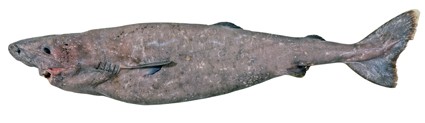
Somniosus antarcticus, the southern sleeper shark, is a large, slow-moving deep-sea shark distributed circumglobally across temperate Southern Hemisphere seas, from the coasts of Chile and Argentina to Namibia, South Africa, Australia, New Zealand, and the sub-Antarctic islands. Formally described by Gilbert Percy Whitley in 1939 from a specimen collected at Macquarie Island, south of Tasmania, it belongs to the family Somniosidae and the order Squaliformes. Despite its wide range, it remains poorly understood: how long individual sharks live is entirely unknown, stomach contents from the Kerguelen Islands showed colossal squid in 66.1% of examined individuals, and a baited camera did not capture footage of any shark inside Antarctic waters until January 2025.
Key facts
- Scientific name: Somniosus antarcticus
- Kingdom: Animalia
- Phylum: Chordata
- Class: Elasmobranchii
- Order: Squaliformes
- Family: Somniosidae
- Genus: Somniosus
- Taxonomic rank: species
Taxonomy and Description
Whitley’s 1939 description was published in Australian Zoologist, volume 9, part 3, page 242, with the type locality recorded as Macquarie Island. The World Register of Marine Species accepts Somniosus antarcticus Whitley, 1939 as a valid species, linking the original description to pages 227 to 262 of that same volume, accompanied by plates 20 to 22. The species sits within the genus Somniosus, family Somniosidae, order Squaliformes, class Elasmobranchii, phylum Chordata, kingdom Animalia.
The body is very large, robust, and cylindrical. The snout is short and rounded. The eyes are small and lack nictitating membranes. Large spiracles sit just behind the eyes, the gill slits are small and set low on the head, and there are two small spineless dorsal fins with no anal fin. Coloration runs uniformly grey to blackish or mottled brown, providing camouflage against the seafloor.
Distribution and Habitat
The species has a circumglobal distribution in temperate Southern Hemisphere seas. Known localities include central Chile, Patagonia, Argentina, Namibia, South Africa, Australia, New Zealand, and sub-Antarctic islands. Within Australian waters specifically, records come from seamounts south of Tasmania, including the South Tasman Rise and the Cascade Plateau.
In January 2025, a baited deep-sea camera operated by the Minderoo-UWA Deep-Sea Research Centre recorded a sleeper shark, most likely S. antarcticus, at 490 metres depth in the South Shetland Trench at a water temperature of 1.27°C. The sighting, discussed further in the Trivia section, was the first time any shark of any species was documented inside Antarctic waters south of 60° latitude.
Diet and Predation Strategy
The diet is dominated by cephalopods, particularly giant squid, and also includes fish, marine mammals, and birds. Stomach content analysis from the Kerguelen Islands found colossal squid (Mesonychoteuthis hamiltoni) in 66.1% of examined southern sleeper shark stomachs, and colossal squid represented 52% of cephalopod prey by weight in those samples.
Colossal squid and other cephalopods are not sluggish prey. The relatively frequent presence of fast, active prey in stomach contents has led researchers to propose that S. antarcticus may employ an ambush predation strategy, lying still near the seafloor until prey approaches close enough to strike, despite its generally sluggish overall locomotion.
Physiology and Sensory Biology
Sleeper sharks of the subgenus Somniosus retain trimethylamine oxide (TMAO) in their tissues at concentrations reaching up to 200 mmol/kg. TMAO stabilizes proteins and enzymes against the combined destabilizing effects of high pressure and cold temperature, a biochemical adaptation to the deep-sea environment.
Deep-sea sleeper sharks possess enlarged, oil-rich livers. These organs serve two functions: providing buoyancy in a fish that lacks a swim bladder, and acting as an energy reserve in an environment where food can be scarce.
Neural studies of close relatives indicate that deep-sea sleeper sharks have a relatively reduced optic tectum alongside enlarged olfactory brain regions. The reduction in visual processing and the expansion of olfactory capacity reflect a reliance on smell and the lateral line, rather than sight, in low-light deep-sea conditions.
Life History and Conservation
S. antarcticus belongs to a genus noted for extremely slow growth rates and late sexual maturity that may take decades to reach. Like other large Somniosus species, it is considered slow-growing, and these life-history traits make the species vulnerable to overfishing and population decline: a population that reproduces slowly recovers slowly from any significant removal.
Actual lifespan data for S. antarcticus does not exist. The closest inferential reference comes from its congener S. microcephalus, the Greenland shark, for which radiocarbon dating of eye-lens nuclei has yielded an estimated minimum lifespan of 272 years. Whether S. antarcticus approaches comparable longevity is unknown; the comparison only establishes that the genus contains vertebrates with extraordinarily long potential lifespans.
Did you know
- In January 2025, a baited deep-sea camera operated by the Minderoo-UWA Deep-Sea Research Centre captured what is believed to be the first-ever footage of a shark in Antarctic waters. The animal filmed was a sleeper shark, most likely Somniosus antarcticus, recorded at 490 metres depth in the South Shetland Trench at a water temperature of only 1.27°C. (divemagazine.com)
- The close relative Somniosus microcephalus, the Greenland shark, has been estimated through radiocarbon dating of eye-lens nuclei to live at least 272 years, making the genus one of the longest-lived vertebrate groups on Earth. Lifespans for S. antarcticus itself remain entirely unknown. (nationalgeographic.com)
- Although S. antarcticus had been known from sub-Antarctic localities such as Macquarie Island and South Georgia for decades, the January 2025 camera sighting was the first time any shark of any species was ever documented inside Antarctic waters south of 60° latitude. (smithsonianmag.com)
Data sources
- GBIF
- Wikidata
- researcharchive.calacademy.org
- shark-references.com
- fishesofaustralia.net.au
- biogeodb.stri.si.edu
- fish.gov.au
- deepseanews.com
- pmc.ncbi.nlm.nih.gov
- grokipedia.com
- a-z-animals.com
- nature.com
- marinespecies.org
Data updated: 2026-10-26