
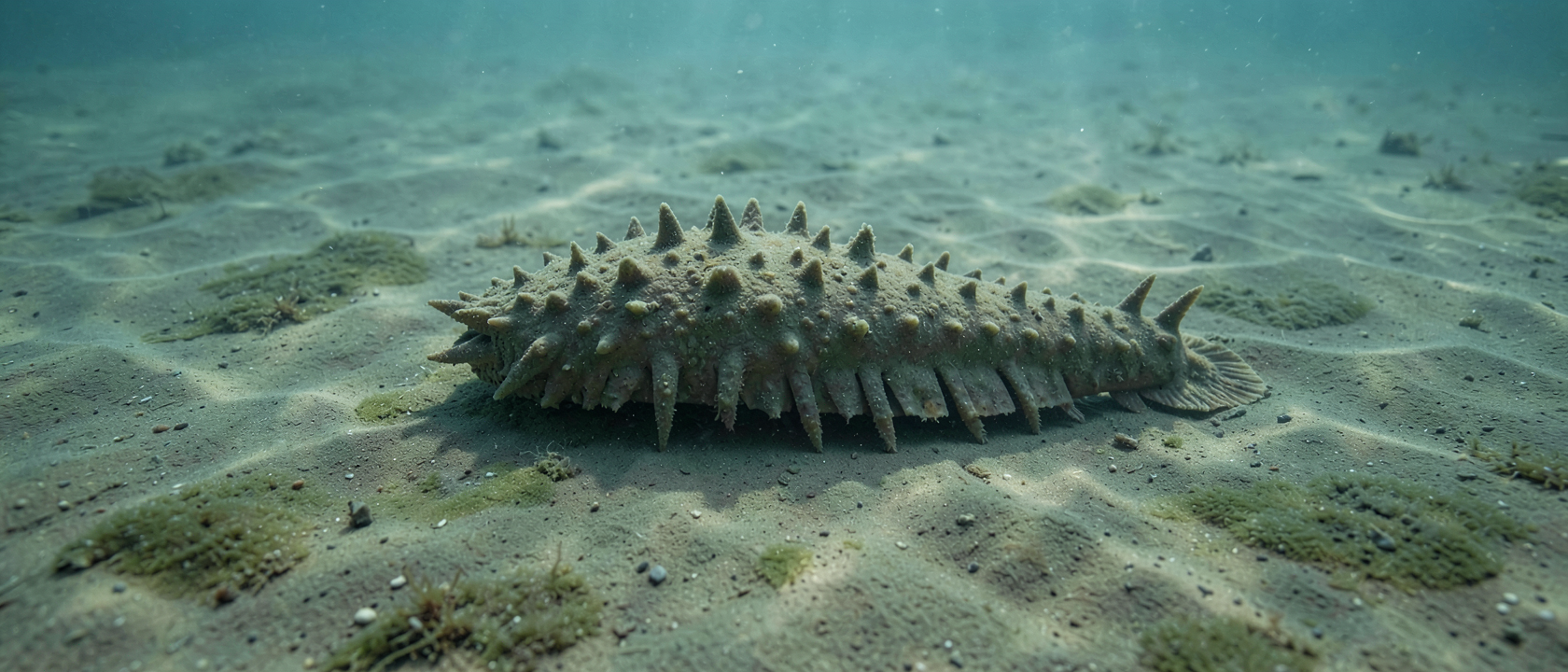
The fossil that shouldn’t have a left and a right
In rocks from the Anti-Atlas mountains of Morocco, dated to the boundary between Cambrian Stage 4 and the Wuliuan, roughly 500 million years old, paleontologists found an echinoderm with a left side and a right side. That should not happen. Every echinoderm alive today, all roughly 7,600 species of starfish, sea urchins, sea cucumbers and brittle stars found in every ocean, has five-fold symmetry and no left or right at all. Of the 2.13 million described species on Earth, about 99 percent are built on a mirror-image, left-right plan. Echinoderms are the famous exception, and this fossil sits exactly where the exception is supposed never to have started.
The animal is Atlascystis acantha, described by Woodgate, Dunn, Thompson, Formery, Zamora and Rahman in Current Biology on July 21, 2025. It had a flattened, spine-covered body and a pair of skeletal structures called ambulacra, the same kind of plates living echinoderms use to move and feed. The fossils caught individuals at different growth stages in the fine mud of a calm Cambrian seafloor, which let the team trace how the body actually changed shape with age instead of guessing from a single snapshot.
Two arms, then one, then three, then five
Dr. Imran Rahman of the Natural History Museum and his coauthors used Atlascystis to work out the order of changes that eventually produced the five-part body every living echinoderm wears as an adult. Rahman describes the proposed sequence this way: echinoderms began with two ambulacra, lost one down to a single ambulacrum, and that single structure then duplicated into three. Only later did a separate doubling push the total up to five.
This proposed order rests on something more solid than comparing distant relatives. Atlascystis carries a feature that lines up directly with the ambulacra of radially symmetrical echinoderms, giving the two groups a shared point of origin on the family tree. A phylogenetic analysis, the statistical method that places species on a tree of likely relationships, put Atlascystis near the very root of that tree, as what paleontologists call a stem-group echinoderm, an early branch that split off before the five-fold plan existed at all.
Why keeping two sides meant skipping the twist
Every living echinoderm starts out as a small, swimming, bilaterally symmetrical larva, then goes through a metamorphosis that rebuilds the body around a new axis, turning a creature with a front, a back, a left and a right into one with none of those. Organs shift position around a new center. Atlascystis kept its bilateral symmetry into adulthood, which tells the researchers it likely skipped that violent reorganization and simply kept its larval body axis, though no larval fossil of Atlascystis itself has actually been found to confirm it.
That placement also settles an older argument. One earlier hypothesis treated bilateral echinoderms in the fossil record as side branches, oddities that split off after five-fold symmetry already existed elsewhere in the group. Atlascystis argues the opposite: bilateral symmetry is not a detour off the starfish plan, it is the starting point the starfish plan grew out of. A starfish larva drifting through plankton is, in a sense, briefly echoing a body plan that predates the five-armed adult by hundreds of millions of years.
The myth: there was no straight line to five
The tidy assumption, including among scientists working before this fossil, was that echinoderms added arms the obvious way: two, then three, then four, then five, climbing steadily toward the number we know. The fossil record argues against that directly. Before any duplication happened, the ambulacra count went down first, from two to one, a step backward nobody had predicted. Evolution did not march to five. It cut once, then doubled twice.
Why five? Nobody knows.
No animal outside echinoderms is built on five-fold symmetry, not insects, not vertebrates, not mollusks. Once the duplication from one ambulacrum to three had happened, evolution could in principle have stopped there, or kept doubling to six, or settled somewhere else entirely. It landed on five and stayed there across every one of the roughly 7,600 living echinoderm species. Rahman has said that the question of why evolution settled on five, specifically, keeps him up at night. Nobody has a good answer yet.