
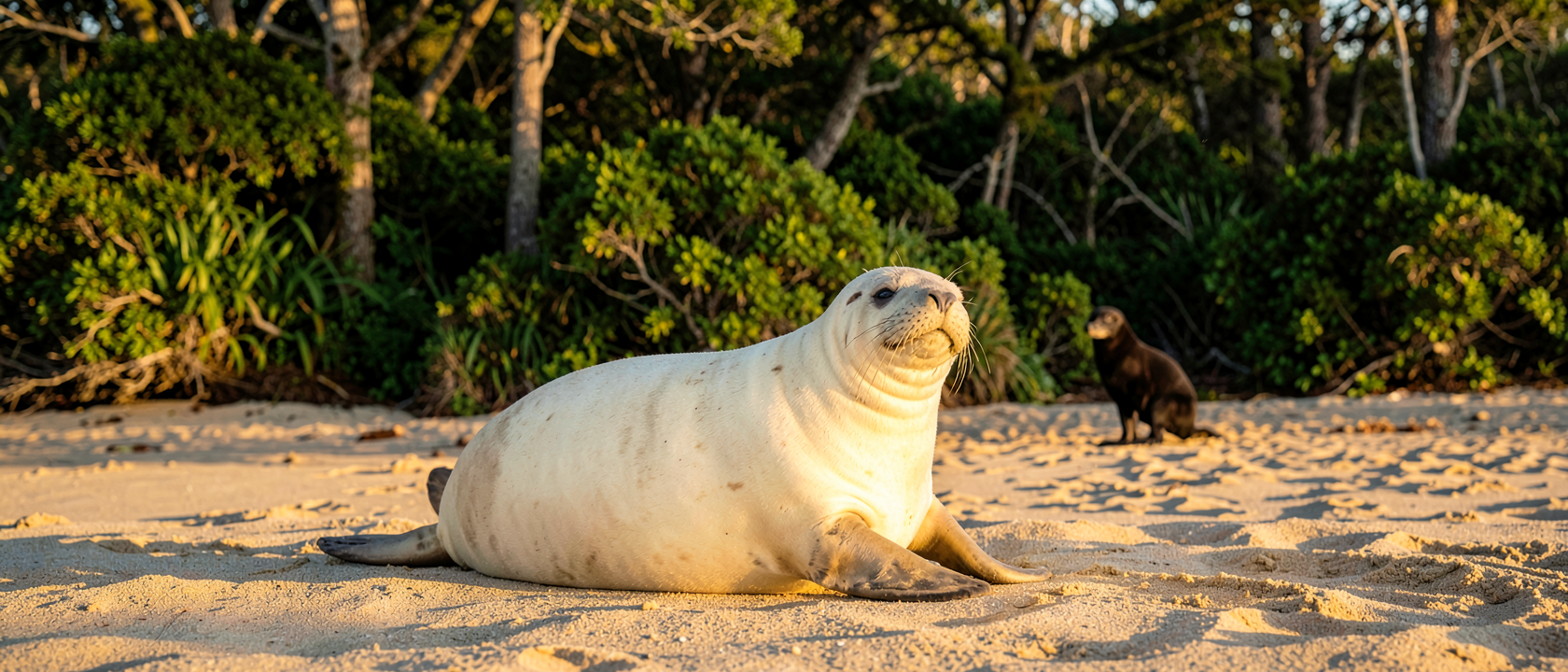
The Sea Lion in the Pine Trees
A female New Zealand sea lion weighing up to 350 pounds (160 kg) can now turn up as far as 1.2 miles (2 km) inland, denned under pine trees or tucked near someone’s back porch, nursing a pup that has never been within sight of the ocean. Researchers are now documenting this as a pattern across New Zealand’s South Island and Stewart Island, and the animal doing it has a precise name: Phocarctos hookeri, the New Zealand sea lion, known in Māori as rāpoka, pakake, or whakahao, and found nowhere else on Earth.
How Scientists Learned Where She’ll Go Next
The question of where she’d turn up next got a formal answer in 2021, when Veronica Frans, then a PhD student at Michigan State University, published a new modeling framework with colleagues from New Zealand, Germany, and Belgium in the journal Methods in Ecology and Evolution. Working alongside New Zealand’s Department of Conservation, the team built what they called an integrated species distribution model database: not one map, but several layered on top of each other.
The ingredients came from tracking data collected on nearby island colonies, combined with everything a pregnant female actually needs to pick a denning site: sand and grass and forest canopy that shifts with the season, the slope of the land and the height of the cliffs she’d have to climb, inland water she might cross along the way. Then came the layer most habitat models skip entirely: roads, farms, fences, and houses, the human infrastructure laid over the same ground. Run the stack together and the output doesn’t just light up beaches. It flags nearly 400 sites across the mainland as suitable for breeding, plenty of them a long walk from the nearest wave.
Why She’s Walking Inland At All
The inland trekking isn’t a navigation error. It’s recolonization. New Zealand sea lions were hunted off the mainland more than 200 years ago, first by Polynesian settlers and then by European sealers, until the only breeding populations left were clinging to the subantarctic Auckland and Campbell Islands. Decades of conservation work rebuilt those island colonies enough that females eventually started pushing back into range their species had abandoned for two centuries.
The scale of that return is still small, and even the baseline number is debated. Some estimates, drawn from fisheries and conservation groups, put the worldwide population at 12,000 to 13,000 animals. New Zealand’s Department of Conservation puts the figure lower, at fewer than 10,000, with fewer than 5,000 of those breeding adults, a drop from more than 15,000 in the early 2000s. However you count it, this is one of the rarest sea lion species on the planet. Only one official breeding colony currently exists on the mainland, with a few other scattered spots where pups have been born and the numbers remain tiny. “There is currently only one official breeding colony on the mainland, and only a few other spots where they’ve had pups, but the populations are still small,” Frans said. Each pine-plantation birth is a small test of ground this species hasn’t held in two centuries.
The Coastal Animal That Wasn’t
Sea lions get filed, by habit, as beach animals: they haul out on sand, bark at tourists, and stay where the surf is. Older species distribution models were built on precisely that assumption, mapping coastline and treating everything past the dunes as irrelevant. Conservation managers kept running into the same problem: the maps didn’t match what they were finding on the ground. Sea lions were showing up on farmland. They were showing up in forest. The 2021 model exists because the coastal-only assumption had already failed in the field, more than once, before anyone built something to replace it.
What Even the Model Can’t Tell You
Nearly 400 flagged sites does not mean nearly 400 answers. The model predicts suitability, not occupancy. A patch of forest can score high on paper and sit empty for years, or never get used at all. Frans and her colleagues are plain about the limit: nobody can say which specific sites an individual female will actually pick, or how quickly the mainland recolonization will unfold from here. The maps mark where she might go. They don’t mark where she will.
The Porch Encounter Nobody Was Ready For
Picture the scenario this mapping project exists to get ahead of: someone walks past a stand of pine on a farm, or steps onto a back porch, and finds a sea lion pup exactly where no sea lion pup should be, with its mother close by and furious. “It’s one thing for wildlife rangers to look out for sea lions on sandy beaches, but it’s another challenge for them to tromp through forests to find baby sea lions hiding under the trees,” Frans said, describing the mismatch rangers now face between where people expect a sea lion and where she might actually be denning. That same mismatch, by general accounts rather than any formal count, has put sea lions in the path of cars and left some killed by people startled to find one somewhere a sea lion wasn’t supposed to be. Whether the mainland recolonization keeps gaining ground, or stalls at a handful of forest dens, is still an open question nobody can answer yet.