
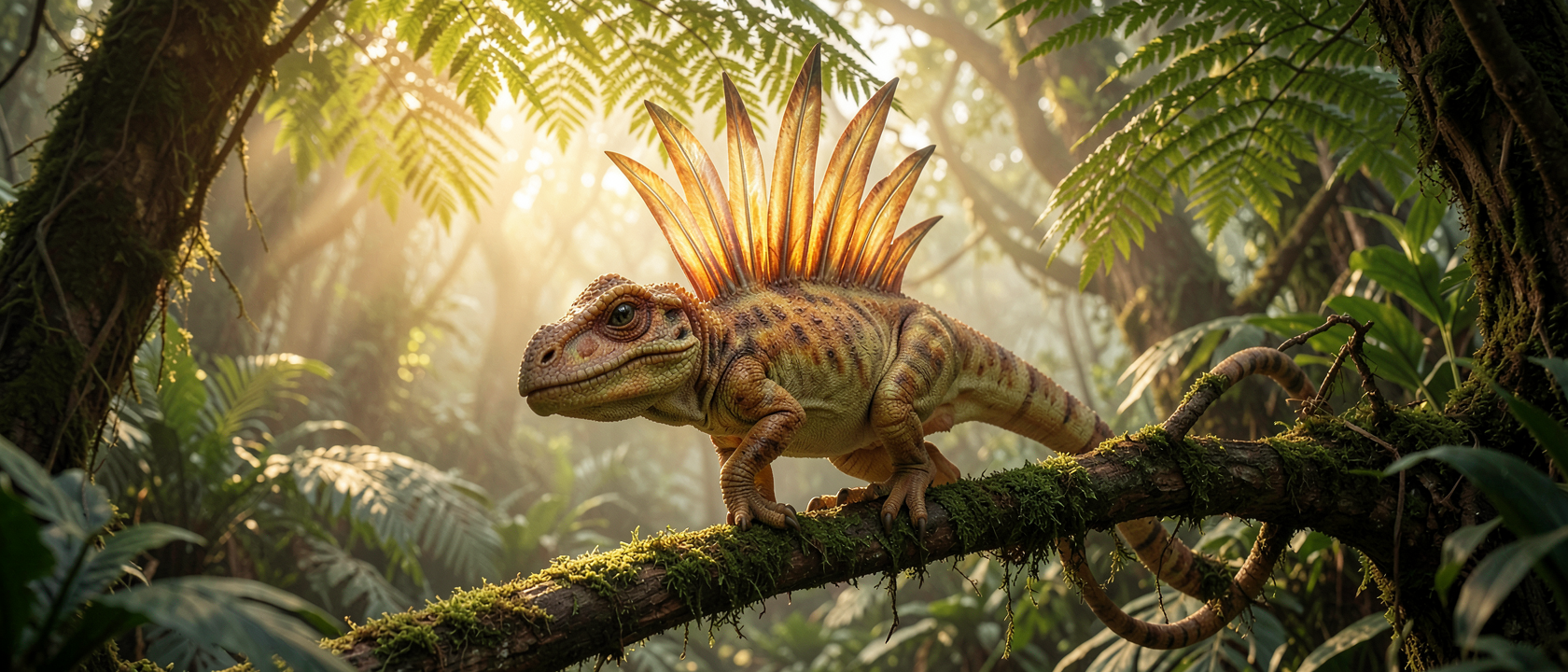
Mirasaura grauvogeli, a tree-dwelling reptile that lived more than 247 million years ago, grew a fan of 16 feather-like structures across its back, a crest longer than its own torso. The longest preserved structure measures nearly 6 inches (15.3 cm), and that one came from a juvenile. Every known skeleton of this species is a juvenile, so an adult’s crest was probably bigger still. The species was described in 2024 by a team led by Dr. Stephan Spiekman and Prof. Dr. Rainer Schoch of the State Museum of Natural History Stuttgart, working from fossils collected in France’s Vosges Mountains.
A structure built to look like a feather, not to be one
Each of the 16 appendages has a narrow central ridge flanked by two curved layers, roughly the silhouette a bird feather has. But a real feather branches into barbs, the fine filaments that give it fluff and let it catch air. Mirasaura’s structures don’t branch. They form a single continuous surface with faint ridges running along their length, closer to a stiff fan blade than a plume. That absence of barbs is the whole finding: this isn’t a feather that evolved into something odd, it’s a separate structure that converged on the same shape from a completely different starting point. The crest sits on top of a bony hump formed by the vertebrae, a feature already documented in other drepanosaurs (an extinct group of Triassic tree-dwelling reptiles). The skeleton already had the scaffolding. Evolution just built something new on top of it.
What the crest was probably for
The paper describing the species rules out a role in flight or camouflage and instead proposes visual communication: deterring predators, signaling to potential mates, or helping individuals recognize their own kind, the same jobs real feather displays do in living birds. That proposal fits the rest of the animal. Mirasaura had a bird-like domed skull, large forward-facing eyes, and a beak-like mouth suited to picking insects out of tree bark. Spiekman has said the closest living analogue for a drepanosaur’s lifestyle is “a pygmy anteater,” not a chameleon. The crest wasn’t a strange accessory bolted onto an otherwise ordinary lizard body. It was one piece of an animal that was independently assembling a bird-like toolkit, tens of millions of years before feathered dinosaurs existed in any numbers.
The myth this kills
The common assumption is that feather-like structures are something birds, and their dinosaur relatives, evolved exactly once: a single lucky innovation passed down one branch of the tree. Mirasaura contradicts that directly. It isn’t a dinosaur. Nor is it closely related to birds; it belongs to the drepanosauromorphs, a reptile lineage that only ever existed in the Triassic. And at the level that actually matters, the barbs that build a working feather, its structures demonstrably are not feathers. Yet it landed on nearly the same external shape and, per the researchers, plausibly the same jobs. Melanosomes preserved in the appendages (the pigment-carrying structures that give feathers and hair their color) even match the geometry of bird feathers rather than reptile skin or mammal hair. Feathers were never a one-time invention. They were an idea evolution found more than once.
What nobody knows yet
Whether other drepanosaurs carried something similar is unconfirmed. One specimen of a related genus shows a dark mark near its own vertebral hump that could hint at a comparable structure, but the researchers call it inconclusive: it could be pigment, preservation, or nothing at all. That leaves open how widespread this trait really was across the group, and a deeper question underneath it. Nobody yet knows whether Mirasaura’s skin built its crest using any of the same genetic switches birds use to build feathers, or whether this is convergence all the way down to the genes. With the fossil material currently available, the researchers describe that question as difficult to test.
The man who collected a mystery for 48 years
Fossil collector Louis Grauvogel gathered these specimens from the Vosges Mountains between 1930 and 1978, decades before anyone knew what animal they belonged to. When the strange fan-shaped impressions first turned up, they were mistaken for the fin of a fish, or maybe the wing of an insect. They sat in his personal collection, unidentified, for the rest of his life. Only after his daughter, Dr. Lea Grauvogel-Stamm, agreed in 2019 to transfer the collection to the State Museum of Natural History in Stuttgart did researchers recognize its reptilian origin. The species now carries his name, informally called “Grauvogel’s Wonder Reptile.” Recalling the moment the team realized what they were looking at, Spiekman put it simply: “This had to be something new.” Grauvogel never got to hear that sentence. He spent nearly half a century holding the evidence for it anyway.