
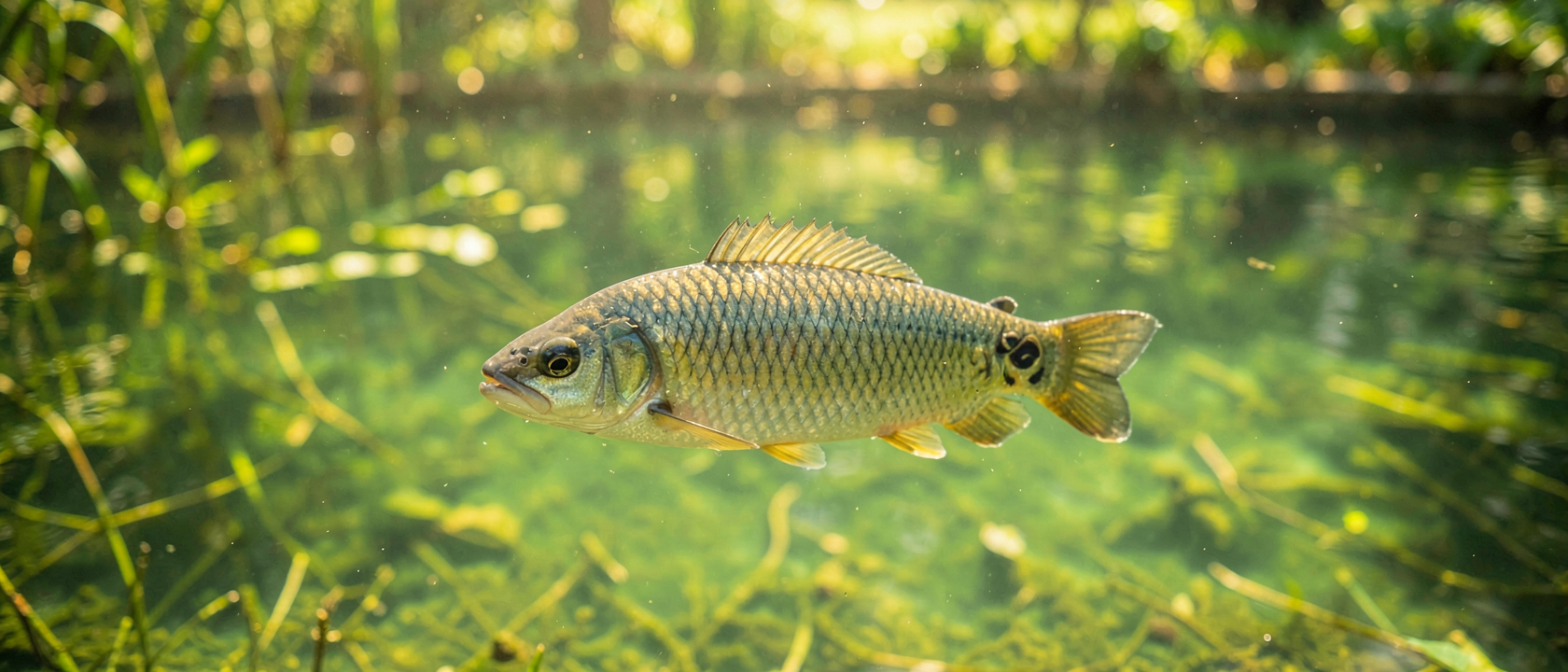
A Bath Instead of a Needle
Take a juvenile mandarin fish (Siniperca chuatsi), genetically female down to the last chromosome, and drop it in water laced with gene-carrying nanotubes. Wait two weeks. Some of those fish will grow testes. No injection, no hormone-laced feed, no surgery, just a bath. Researchers led by Chong Han, with corresponding author Yong Zhang at Sun Yat-sen University, published the work in Water Biology and Security on December 3, 2025. They tested plasmid concentrations of 10, 20, and 40 milligrams per liter in the immersion water, carrying two genes, amh and amhy. At the highest dose, 40 mg/L, a significant proportion of the treated fish went on to develop masculinized gonads, the organs that normally become ovaries or testes depending on which genetic program runs during development.
How the Genes Get Into the Gonad
Carbon nanotubes are tiny tubes of carbon atoms, chemically modified here to carry plasmid DNA, a small loop of genetic material loaded with instructions for a cell to follow. Functionalized this way, the nanotubes are small enough, and chemically tuned enough, to cross from open water into fish tissue, including the gonads. At 40 mg/L, the researchers detected both the plasmid DNA and its transcripts in gonadal tissue, meaning the genes had not just arrived but were actively being read, within 7 to 14 days of the bath.
What happens next looks like a quiet swap of blueprints. Molecular analysis of the treated fish showed the female-pathway genes foxl2 and cyp19a1a getting dialed down, while the male-pathway genes amh and dmrt1 got dialed up. The study’s authors attribute this to the amhrII/smads signaling pathway, a chain of molecular signals through which amh and amhy appear to switch on dmrt1 and set the male developmental program running. The gonad was not overridden from outside. It was handed a different set of instructions while it was still deciding what to become.
Why Anyone Wants a Male Fish That Used to Be Female
In mandarin fish farming, females grow faster than males. That single fact drives the whole exercise, and it explains why the target of this research is not simply “more males.” Farmers want neo-males: fish that are genetically female (XX) but develop as males anyway. Bred with an ordinary female, a neo-male produces all-female offspring by nothing more exotic than basic genetics, and those offspring are the fast-growing kind the industry wants to sell. A separate 2025 study using a hormone-based neo-male protocol found that all-female mandarin fish populations grew 21% faster by 240 days post-hatch than mixed-sex groups. That study is distinct from the nanotube work, but it’s a useful measure of why the industry keeps chasing this particular genetic trick.
Making neo-males has traditionally meant hormone treatments, such as 17α-methyltestosterone or levonorgestrel, or direct injection of plasmid DNA into juvenile fish. Both routes are labor-intensive, and both carry environmental concerns when hormones or genetic material end up in the water a farm discharges. A soak that reliably produces neo-males, with no needles and nothing but a measured bath, is the kind of shortcut an aquaculture industry built entirely around this one genetic swap will pay attention to.
Why Bath Delivery Had a Bad Reputation
Gene delivery by injection became the standard approach in fish research for a practical reason: bath-based delivery kept failing at the hard part. You could dunk a fish in water full of genetic material, and the material would often just wash off, degrade, or fail to get past the outer barriers of the fish’s body before it ever reached a target tissue. That track record is why non-invasive, bath-based gene delivery earned a reputation as a method that sounded appealing and rarely worked.
This study’s contribution is not the idea of a bath; soaking fish in solutions of genetic material has been tried before. What’s new is that the carbon nanotube carriers got amh and amhy expressed inside gonadal tissue, detectable as both DNA and transcripts within that same 7-to-14-day window. Chong Han, the study’s lead author, described this as clearing a hurdle that had specifically held bath-based methods back: getting the cargo past the fish’s own defenses and into the one tissue that mattered.
The Percentages Nobody Published
The study does not state what fraction of the bathed fish actually masculinized at 40 mg/L. “A significant proportion” is the only figure given, and it is doing real work standing in for a number that hasn’t been published. Whether the neo-males produced this way are fertile, and whether they can be bred into working all-female broodstock lines the way hormone-made neo-males already are, is not addressed either. Lower concentrations, 10 mg/L and 20 mg/L, were tested, but the study doesn’t report whether they worked, partially worked, or failed. And there is nothing yet on what happens if nanotube-treated fish, or the nanotubes themselves, end up loose in a working aquaculture pond or beyond one. These aren’t hidden conclusions. They’re simply the parts of the study that haven’t been answered.