
The Comeback Everyone Celebrated
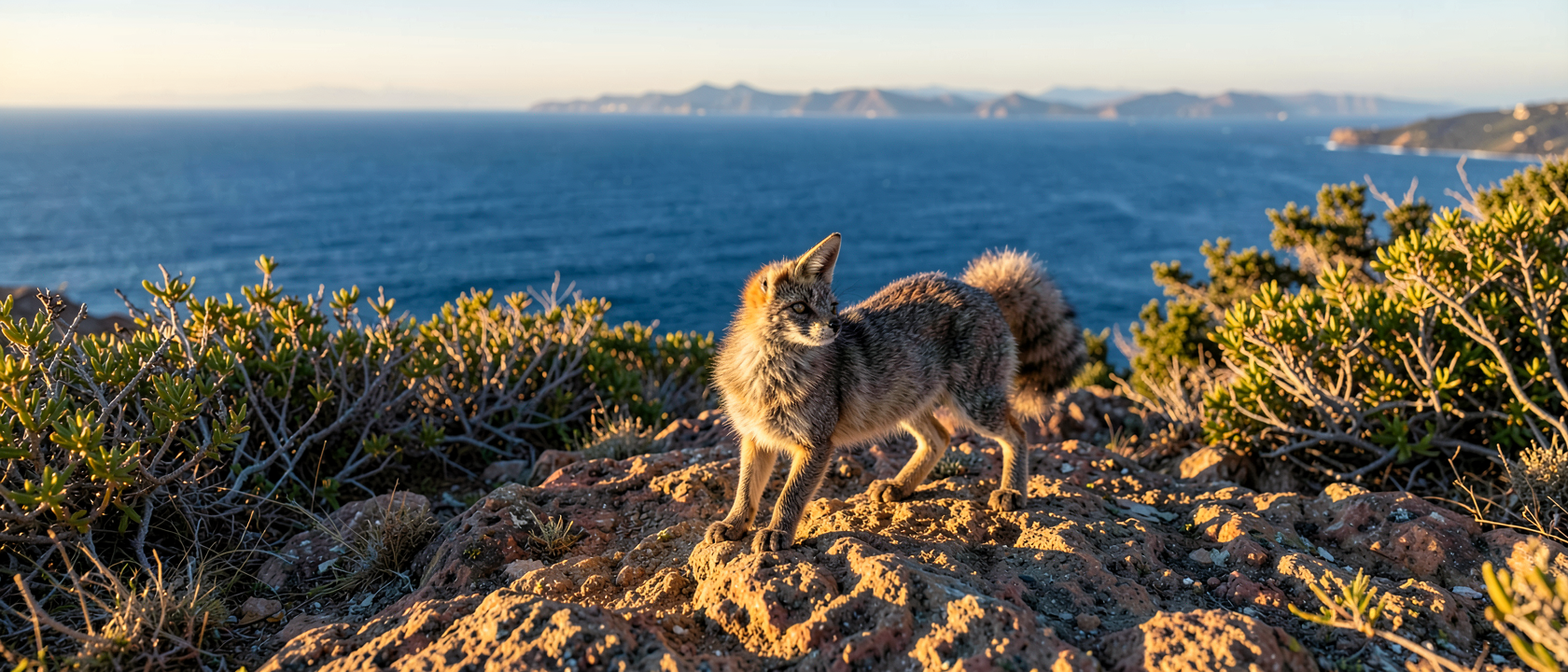
The Channel Island fox (Urocyon littoralis) is barely bigger than a five-pound (2.3 kg) housecat, and it lives nowhere else on Earth but six of California’s Channel Islands, 22 miles (35 km) off the Southern California coast, one distinct subspecies per island. Starting in the 1990s, a canine distemper outbreak and a surge in golden eagle predation collapsed several of those populations. On Santa Rosa Island, the count fell to as few as 15 foxes.
The species was listed as federally endangered in 2004. What followed made headlines: by 2017, Catalina’s foxes had grown from about 100 to more than 2,000, and Santa Rosa’s had climbed from 15 to more than 1,200, a thirteen-year turnaround. The island fox was delisted in 2016. Numbers were up, the crisis looked closed, and most coverage treated it that way.
Then Someone Checked the DNA
Suzanne Edmands and Nicole Adams, both at USC Dornsife, published a very different kind of result in Molecular Ecology in 2023. They compared historic museum specimens against modern blood samples across all six island fox populations, looking not at how many foxes there were but at how much genetic variation those foxes still carried.
Population counts signaled recovery; genetic data showed the opposite trend. Genetic diversity turned out to be lower in 2023 than it had been even before the 1990s crash. San Miguel and Santa Rosa, the two islands that lost the most foxes numerically, also lost the most genetic diversity. Santa Cruz and Santa Catalina, where the decline had been milder, came back with mixed results, some measures down, others holding steady.
Six Islands, Six Different Animals
This sounds like a contradiction, but it isn’t. A bottleneck, the kind Santa Rosa went through at 15 animals, doesn’t just shrink a population. It shrinks the pool of genetic variants those 15 animals happen to be carrying, and it shrinks it permanently. Every fox born afterward gets rebuilt from that narrowed stock, not from whatever variation the island held before the crash.
Each of the six populations went through its own version of this, in isolation, on its own timeline, which is why the study also found that genetic divergence between the six islands has grown over time instead of shrinking. They are not six colonies converging back toward one gene pool. They are six separate survival stories, and each one now has less raw material to draw on than it did before the crisis started.
What This Means If You’re the Fox
A gene pool functions as an inventory of options, not just background detail. Low genetic diversity means fewer individuals happen to carry whatever trait would let a population survive something it hasn’t met yet: a new pathogen, a longer dry season, a parasite that arrives from the mainland. A fox population at 2,000-plus animals on Catalina looks secure by the number most people check. The 2023 study is measuring a different number, and on that one, the fox is still exposed.
That’s the gap the paper puts a figure to: a population can be numerically recovered and genetically fragile at the same time, and those two conditions do not cancel each other out. A chart of fox counts climbing year after year tells you the population survived the last disaster. It tells you nothing about whether it can survive the next one.
Delisted Doesn’t Mean Fixed
Here is the myth, stated plainly: that taking the island fox off the endangered species list in 2016 meant the crisis was over. The delisting decision, like most of the reporting around it, used census numbers: Catalina’s climb from about 100 to over 2,000, Santa Rosa’s from 15 to over 1,200, as the measure of recovery. The 2023 study by Edmands and Adams shows that population recovery and genetic recovery are not the same metric, and in this case the two moved in opposite directions. The fox was declared safe using a ruler that doesn’t measure the thing that actually keeps a species safe over the long run.
What’s Living in Fox Poop
One side-finding in the same study cuts against the gloom. Despite the thin genetic diversity, the island foxes’ gut microbiomes, the bacterial communities living in their digestive tracts, turned out to be reasonably diverse. Researchers have started sequencing bacteria pulled from fox scat as a way to track the animals’ health without trapping or handling a single one.
Whether that microbial diversity can do any of the work genetic diversity used to do, helping the foxes cope with a new disease or a hotter, drier climate, is not known. It’s a possibility the study’s authors raise, not a result they’ve shown. Nobody has demonstrated that gut bacteria can stand in for a missing gene pool, or whether that idea will ever pan out.
The Fix Nobody Wants to Try First
The obvious solution is also the riskiest: move foxes between islands and remix the gene pool directly. But each of the six populations adapted to its own island across generations of isolation, which is exactly why they have been drifting genetically apart rather than together. Pairing a San Miguel fox with a Santa Catalina fox could produce offspring poorly matched to either island’s conditions, not a hardier animal built for both.
The 2023 study raises this as a live dilemma and leaves it there: whether the gain in diversity would outweigh the risk of undoing adaptations built over generations of separation is a question the researchers pose, not one they answer.