
A Chimpanzee Tore Up a Walkway to Make a Beat
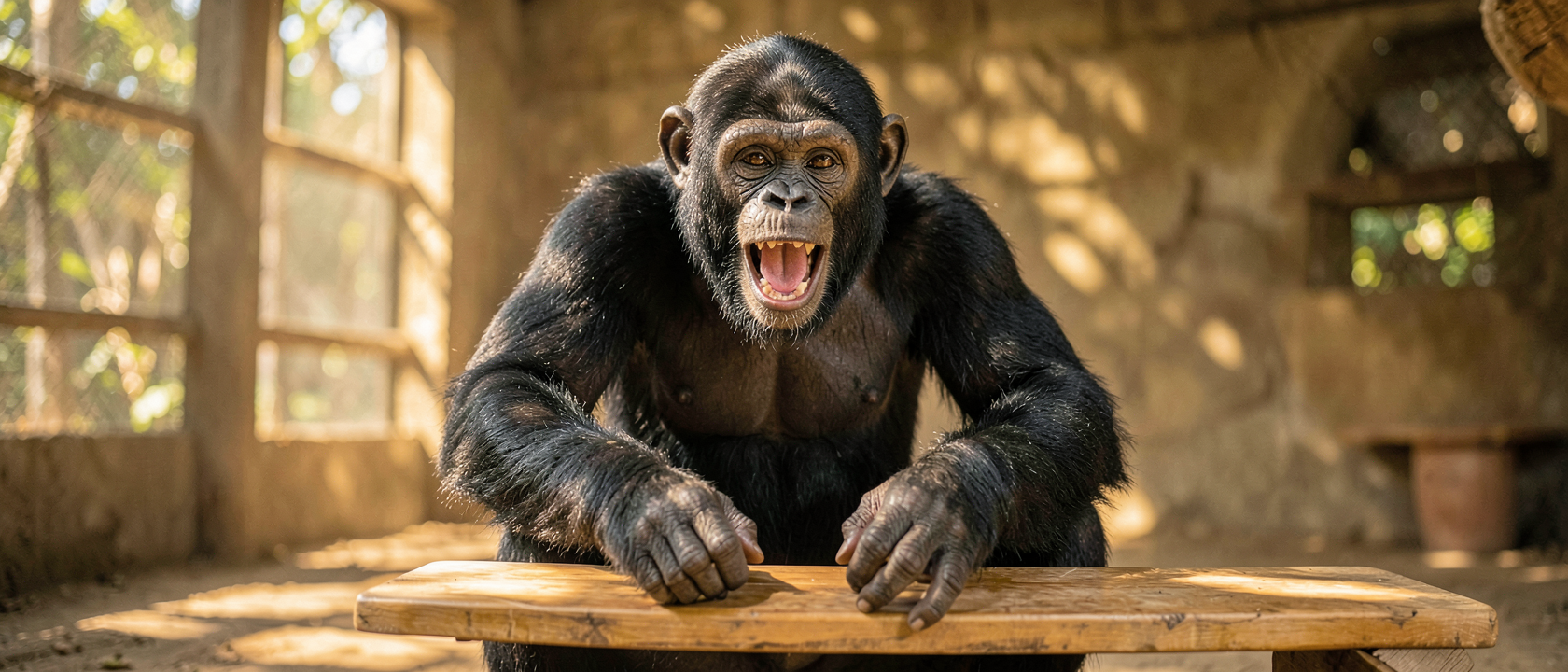
Ayumu, a 26-year-old male chimpanzee (Pan troglodytes) at Kyoto University’s Center for the Evolutionary Origins of Human Behavior (EHUB) in Kyoto, Japan, pried floorboards loose from a walkway in his enclosure and used them as drumsticks. Researchers logged 89 of these performances across 37 days of observation, spread between February 2023 and March 2025. He didn’t just hit the boards; he held a steady beat with them while layering in complex, vocal-like sounds that weren’t quite calls. The study, led by primatologist Yuko Hattori with colleagues Voinov and Uchikoshi, appeared March 25, 2026, in the Annals of the New York Academy of Sciences. Eighty-nine recorded performances is not a fluke caught on a single clip. It’s a dataset.
Why the Tool Beat the Hands
The team split each performance into its building blocks: striking, dragging, and throwing, up to 14 distinct movements chained into sequences that ran several minutes. They ran a transition analysis, a statistical test for whether one action reliably follows another more than chance alone would predict, on the order Ayumu put these together. Drumming tended to lead into dragging, dragging into throwing, a consistent pattern rather than a jumble of actions. Then they measured the gaps between individual strikes and found them isochronous, meaning evenly spaced, the way a metronome ticks rather than a hand getting tired or excited. A tool should, in theory, get between an animal and fine motor control. For Ayumu, the opposite happened: when he struck the floorboard with a tool, his timing was steadier than when he drummed bare-handed or with his feet. The instrument sharpened the rhythm instead of blurring it.
A Play Face, Not a Performance
While he drummed, researchers documented Ayumu wearing what’s known as a play face, an open-mouthed expression normally seen during chimpanzee social play and tied to positive emotion, not to display. Play faces aren’t typically reported during vocal displays at all. That mismatch is what pushed Hattori’s team toward a bigger idea: that the drumming could be an instance of what they call “vocal externalization,” emotion that once had only the voice as an outlet finding a second channel, through an instrument, out into the world. That’s the researchers’ proposed reading of the data, not a settled fact. But it reframes the scene. Nobody was watching him. He may simply have found a new way for a feeling to get out.
What This Wasn’t: Random Banging
Chimpanzee drumming itself is nothing new; they’re well documented hitting stones and old tree trunks, and they’re good at it. The lazy explanation, whether in a zoo enclosure or a viral clip, is that an animal hitting things rhythmically is just noise, or crude copying of something it once watched a human do. Ayumu’s data argues against both. His strike-drag-throw sequences turned out to be statistically non-random, and his strike intervals held a constant tempo instead of drifting. Flailing doesn’t produce that pattern, and neither does imitation, since nobody handed him a drum or showed him how to use one. He pried the board off the walkway himself, an act researchers classify as tool detachment, an early stage of tool-making. The rhythm was his own invention, not an echo of something he’d seen a human do.
Music’s Missing Fossil Record
Ancient drums were wood and animal skin, and wood and skin rot. There is no archaeological record of when rhythm-making on purpose actually started in our lineage, because the material simply didn’t last. That gap is exactly why one chimpanzee pulling boards off a walkway matters this much. He’s one of the only indirect windows left into how instrumental rhythm might have gotten started in a great ape, ours included. Whether this is something unique to Ayumu or something other chimpanzees could pick up is still open. Hattori’s team says the next step is watching how the rest of Ayumu’s social group reacts to his performances, to see whether the behavior spreads or stays a one-chimpanzee act. Nobody has that answer yet.
The Afternoon It Started
In February 2023, researchers at EHUB were watching Ayumu on what looked like an ordinary day. Nothing in his record suggested what came next; he had never been seen doing anything like it before. A board came loose in his hands. He started to drum, and at the same moment, complex, structured sounds began coming out of him too, not quite any call anyone recognized. Hattori later told Mongabay she was surprised: chimpanzees hitting stones or tree trunks had been reported before, but a chimpanzee using something like a stick to play something that resembled a drum had not. One chimpanzee, one afternoon, and nobody saw it coming, including the people whose job is to watch him.