
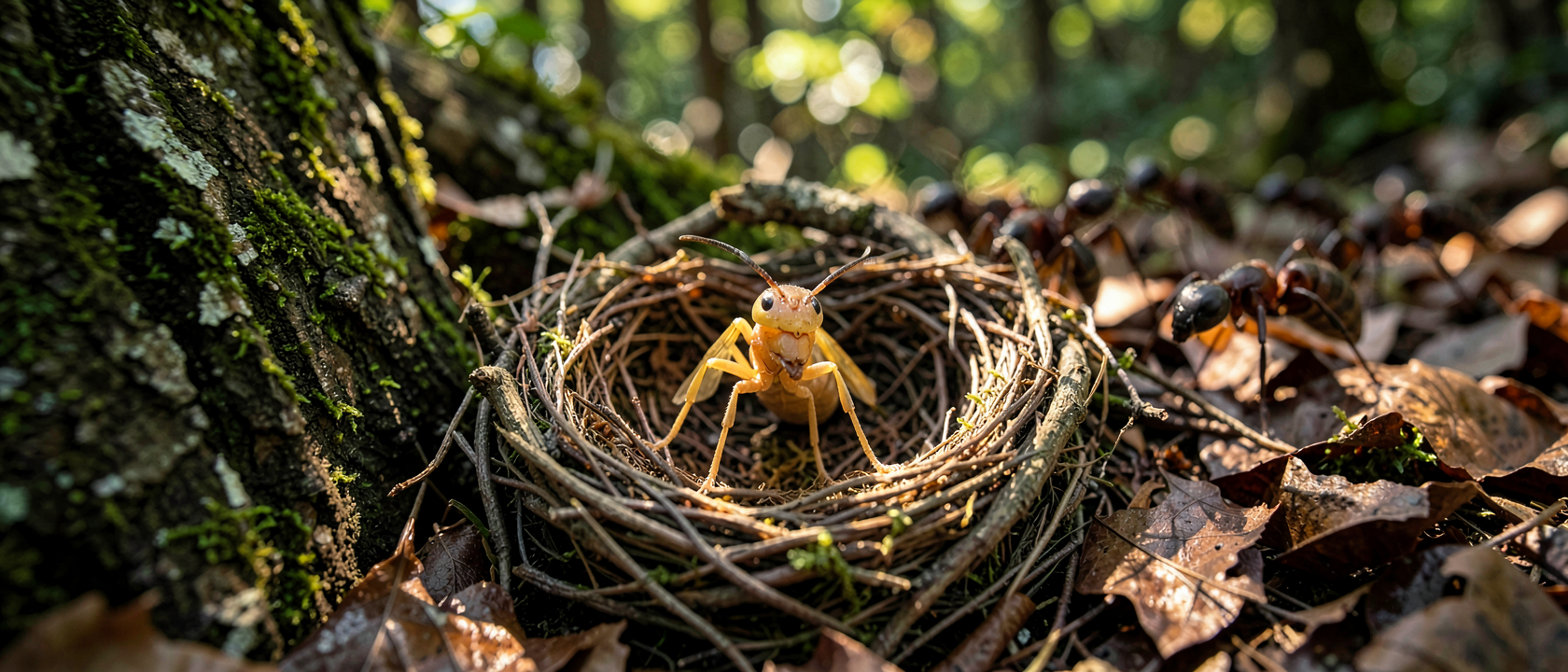
Forty-three ant offspring hatched in a laboratory in Japan, and researchers checked every single one under a microscope. All forty-three turned out to be queens. No workers. No males. Not one.
The Colony With No Workers
Keiko Hamaguchi of the Kansai Research Center in Kyoto and colleagues, including Jürgen Heinze of the University of Regensburg, collected six field colonies of the rare Japanese ant Temnothorax kinomurai and reared their offspring in the lab. To sort the ants into castes, the team examined their genitalia. The count, published February 23, 2026, in Current Biology: 43 queens, zero workers, zero males. Seven of those virgin queens went on to found colonies of their own, which produced 57 more offspring, again every one a queen. The species has been recorded at only nine sites in Japan, which is part of why nobody had managed to confirm this before. This study found a single caste, over and over, and nothing else.
How a Queen-Only Species Gets Anything Done
A new T. kinomurai queen does not build a nest. She takes one. Her target is a colony of a related species, Temnothorax makora, and her method is not subtle. She stings the resident host queen and the workers defending her, overwhelming the colony’s defenses rather than sneaking in. The T. makora workers who survive the takeover then raise her brood as their own. The invader herself never mates. She reproduces by parthenogenesis, a form of asexual reproduction in which eggs develop without fertilization, so every daughter she makes is, genetically, a copy of her.
Why Outsource Everything
This is not a shortcut bolted onto a normal ant life cycle. T. kinomurai has no worker caste to fall back on at all, which means it cannot forage, cannot build, and cannot feed its own larvae. Heinze told Live Science that the species needs the host workers for both foraging and brood care and simply cannot reproduce without them. Every job a typical ant colony splits between queens and workers, this species hands off entirely to a colony that isn’t even its own species. Remove T. makora from the picture, and there is no version of T. kinomurai that gets by on its own.
Nobody Knows Why It Went This Far
Daniel Kronauer, an evolutionary biologist at Rockefeller University who had no part in the study, offered Live Science a way to think about how this might have happened. Sexual reproduction usually pays off through genetically diverse workers, useful for fighting off disease and dividing up labor. A species that has already stopped producing workers has nothing left to gain from that payoff. Kronauer suggested that could tip the balance toward asexual reproduction, and eventually toward losing males entirely. That’s an informed guess, not a finding. Live Science also reported that the paper itself goes only as far as calling the pattern “quite unusual,” and that researchers had merely suspected, for almost four decades, that T. kinomurai might be queen-only, without proof. How a lineage sheds an entire caste and an entire sex is still an open question.
The Myth This Kills
The textbook picture of an ant colony treats its three-part split, queens laying eggs, workers doing the labor, males existing briefly just to mate, as close to a rule of the group. T. kinomurai doesn’t bend that rule. It has no caste system of its own at all, just queens, genetically identical, running the whole operation on borrowed labor.