
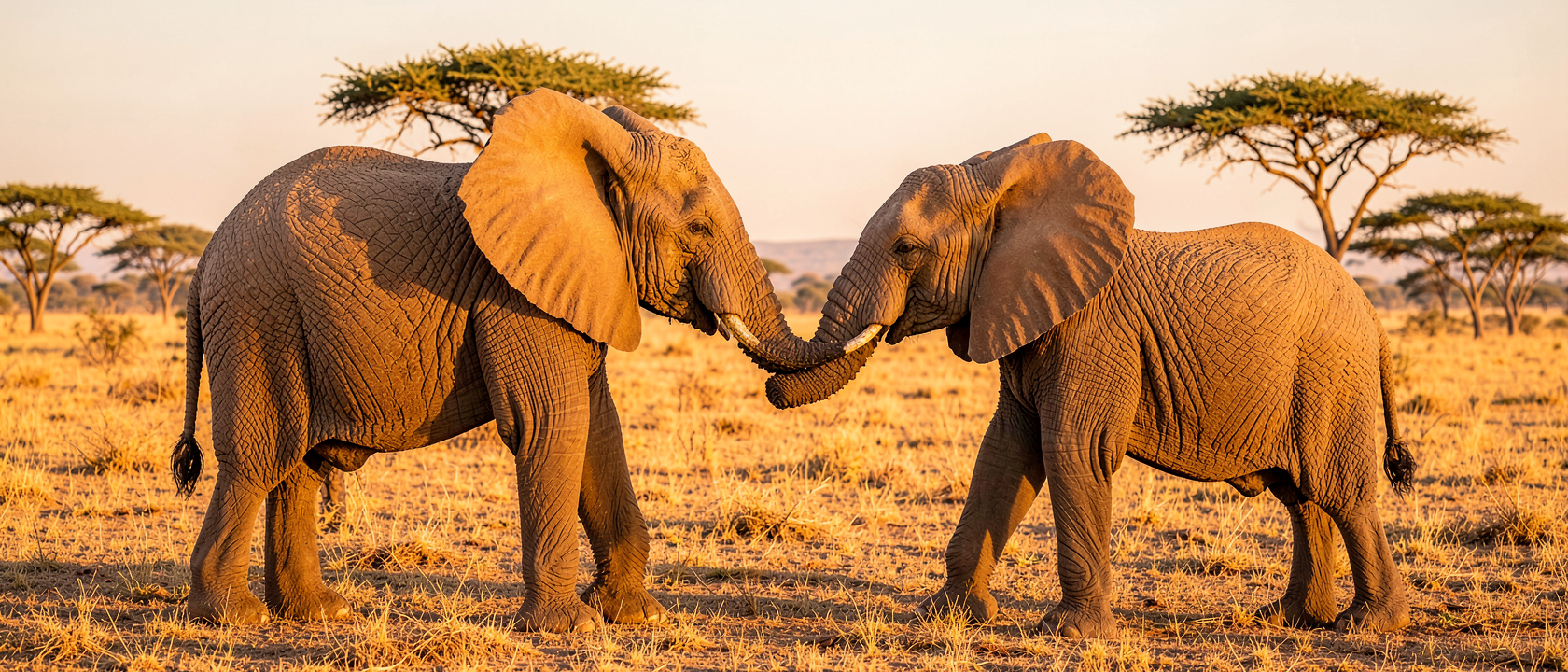
The Fact: Elephants Call Each Other By Name
Wild African savanna (bush) elephants (Loxodonta africana) in Kenya’s Samburu National Reserve and Amboseli National Park address specific herd members with individual, name-like vocal labels, according to a study published June 10, 2024, in Nature Ecology & Evolution. Researchers from Colorado State University, Save the Elephants and ElephantVoices, led by Michael Pardo, spent four years on the project, including 14 months of intensive fieldwork, and analyzed about 470 low-frequency rumbles from 101 individual callers directed at 117 different receivers. A machine-learning model trained only on the acoustic structure of each rumble could predict which elephant it was meant for, with no information about who was actually standing nearby. Labeling another individual this way, with a sound that isn’t just an echo of that individual’s own call, has barely been documented anywhere else in the animal world.
The Mechanism: How a Computer Heard a Name in a Rumble
Elephant rumbles sit mostly in the infrasonic range, below what human ears register, and the parts people can hear tend to sound close to identical from one call to the next. Kurt Fristrup, one of the study’s authors, built a signal-processing method that pulls apart fine structural detail inside each rumble, detail no human listener can reliably catch. That structure is what fed the machine-learning model, which learned to link particular acoustic patterns to particular addressees, rather than matching a call to the receiver’s own vocal signature the way earlier researchers might have expected.
The real proof came in the field. Researchers played a recorded rumble back through a hidden speaker, once to the elephant it had originally been directed at and once to other elephants standing around. The elephant that had been “named” called back or walked toward the speaker far more often than the elephants the call wasn’t meant for, who mostly ignored it and went on with what they were doing. That gap in response is what turns a statistical pattern in a spectrogram into evidence of an actual, functioning label.
The Second Why: What Names Are For
The name-like rumbles turned up more often over long distances and when an adult was addressing a calf, as the study’s authors note, in the situations where a generic call is most likely to get lost or draw the wrong response. Elephant families split apart and regroup constantly inside a herd, and tracking down one specific relative in that shifting arrangement is exactly the kind of problem a name solves. The researchers propose that this social complexity, the pressure to locate and address particular individuals inside a large, mobile family unit, may have pushed elephants toward something functionally close to naming on its own, independent of whatever shaped naming in humans.
They frame this as evidence for a capacity for abstract representation: a sound standing in for an individual without resembling that individual at all. That’s the study’s interpretation of its own data, not a closed case on what elephants understand.
The Myth: Elephants Aren’t Doing the Dolphin Thing
Dolphins and some parrots are already known to address each other by name, and they do it by copying the receiver’s own signature whistle or call back at it, essentially saying someone’s name using a version of their own voice. This study found elephants working differently. The model could tell which elephant a rumble was addressed to no matter how similar or dissimilar that rumble was to the receiver’s own vocal style, which means the “name” isn’t built out of the receiver’s sound at all. It’s arbitrary, assigned, closer to calling someone “Sam” than to a nickname made of imitating how Sam actually talks.
What Nobody Knows Yet
Nobody has pinned down exactly which part of a rumble does the work of a name, whether it’s a single acoustic feature or several stitched together; the researchers say more recordings are needed to isolate it. It’s also unknown whether elephants apply this kind of labeling to anything beyond individuals, to a water hole, a feeding spot or a patch of ground, the way a human name wouldn’t normally stretch to cover a place. And the appealing idea of someday playing an elephant’s own “name” to call it away from a road or a poacher has not been tested or shown to work. It stays a hope, not a method.
The Anecdote: The Prank Call
During the playback trials, lead author Michael Pardo described one moment that stuck with him: broadcasting an elephant’s own “name” at it from a hidden speaker, with no elephant attached to the voice. He joked that the animal was probably briefly thrown by being addressed by a sound with no visible source, before it shook off the strangeness and went back to whatever it had been doing. That’s a researcher’s joke about an odd field moment, not a measurement of what the elephant actually felt, and it’s a good reminder of the gap between a clip that looks charming and the four years of fieldwork it took to show what was really going on underneath it.