
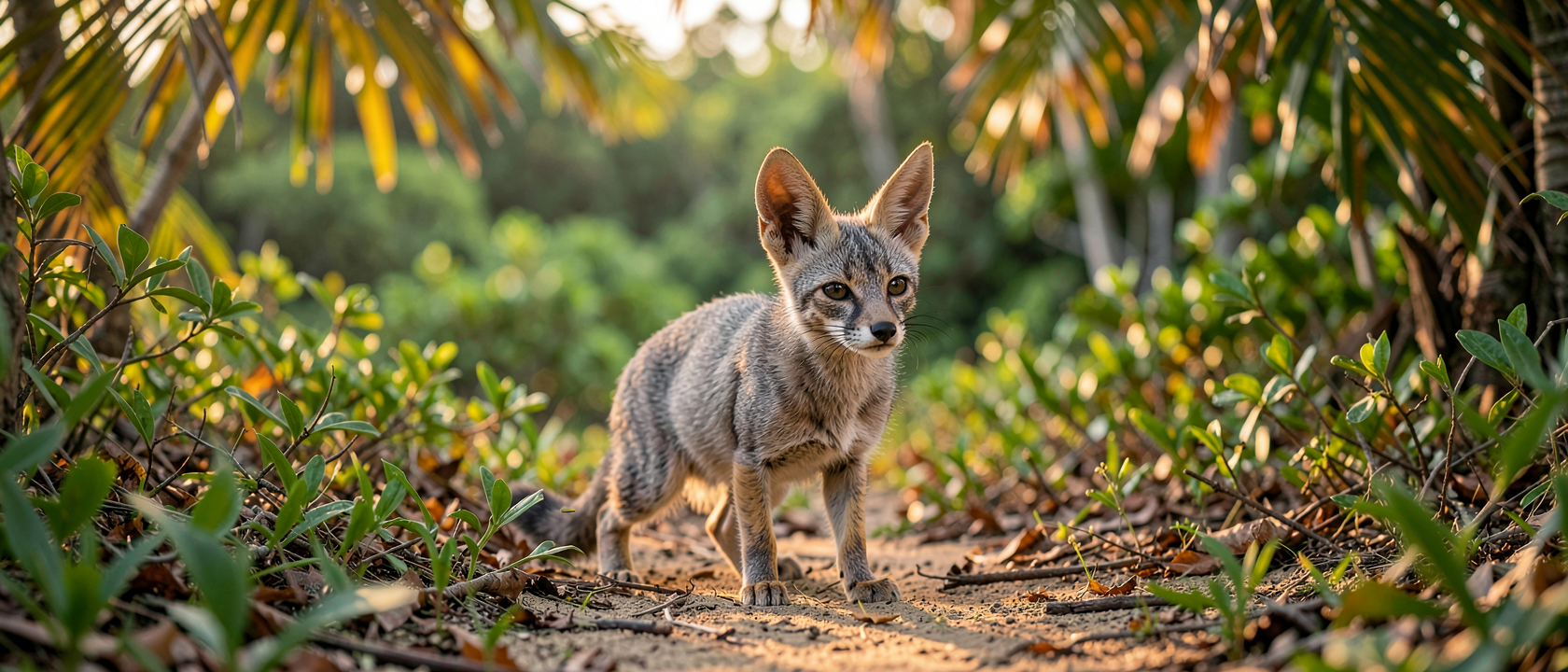
The Photograph That Shouldn’t Exist
A wild fox has lived on Cozumel, a Mexican island of beach resorts, dive shops, and cruise ship piers, for longer than anyone has had a camera trained on it. A short communication in Neotropical Biology and Conservation, published in 2026 by Travis D. Bayer, Maggie A. McGreal, and A. Rafael Chacón D. carries the first photographs ever taken of a live Cozumel dwarf fox (Urocyon sp.), a wild canid closely related to the mainland gray fox. Before that paper, the entire physical record of this fox’s existence was bone: subfossil remains, too recent to count as true fossils, dug out of the island’s soil. Nothing with a pulse had ever been confirmed. A population had spent its whole existence a short drive from snorkeling tours without once being seen by anyone equipped to recognize it for what it was.
Shrunk by an Island
The fox in the photographs is small, roughly the size of a house cat, with ears that look a size too big for its head. The paper estimates it at 60% to 80% the size of its mainland relative, the gray fox (Urocyon cinereoargenteus). That is not a separate species doing its own thing; it is the same lineage, run through a process called insular dwarfism. Cut off on an island with limited food and no large predators worth outrunning, isolated populations tend to shrink over generations, since a smaller body is cheaper to keep fed on a resource-poor patch of land. Archaeological evidence cited in the paper puts this fox on Cozumel for millennia, with its presence possibly predating even the island’s earliest Mayan settlement. It had been quietly getting smaller for longer than Cozumel has had a written history.
What It Means to Be Invisible
The charm of a tiny fox photographed for the first time sits on top of a colder fact. This is not a rare animal that simply dodged a few photographers; it is a population that lived alongside people for thousands of years without ever being formally described, the process of assigning a species a name and a type specimen so it officially exists on the scientific record. No description means no conservation status, no baseline count, no established range. A population can be sliding toward zero, and nobody with the authority to flag it would know to look. This fox was never confirmed extinct, because it was never confirmed as anything at all. That gap, not the fox, is the real finding: a species on its way out can look, from the outside, exactly like one that was never worth worrying about.
The Myth of the Vanished Fox
For more than two decades, the only account of a Cozumel dwarf fox anywhere was a secondhand sighting from 2001, no photo, no specimen, nothing a museum could file. Two decades of silence like that gets read, reasonably, as a population collapsing or already gone. The photographs taken in September 2023 contradict that reading directly. The fox had not died out. It had simply never been seen by someone positioned to document it, which is a very different thing from not existing. Twenty-plus years without a confirmed sighting turned out to mean exactly that, and nothing more.
One Roadside Rescue
On the morning of September 14, 2023, members of the public near kilometer 29 of Cozumel’s coastal highway reported a fox acting disoriented. Staff from the Fundación de Parques y Museos de Cozumel went out and recovered the animal, and photographer Rafael Chacón photographed it on the spot, the first image of its kind ever taken. The foundation held the fox for observation, ran a full health assessment, and released it into the Laguna Colombia State Reserve on September 17, 2023, where it lingered near the release point long enough to be photographed again before wandering off. That sequence, start to finish, is the entire physical basis for the rediscovery of a species: no expedition, no grid of camera traps, just one wandering adult male and a handful of people who happened to notice and make a call.
What Nobody Knows Yet
Everything past that single roadside encounter remains unknown. The paper’s authors state plainly that population size, geographic range, and basic ecology, including diet, denning habits, and when the fox is active, are essentially undocumented. Its taxonomic status has never been formally assessed either: no genetic or detailed morphological study has ever been run on it, so whether it is distinct enough from the mainland gray fox to count as its own taxon is an open question, not a settled one. Researchers are now planning a dedicated camera trap survey to work out how many of these foxes exist and where. Until that survey is done, a critically endangered status already applied to this population rests on evidence gathered from exactly one disoriented fox, caught once, on one morning, near one highway marker.