
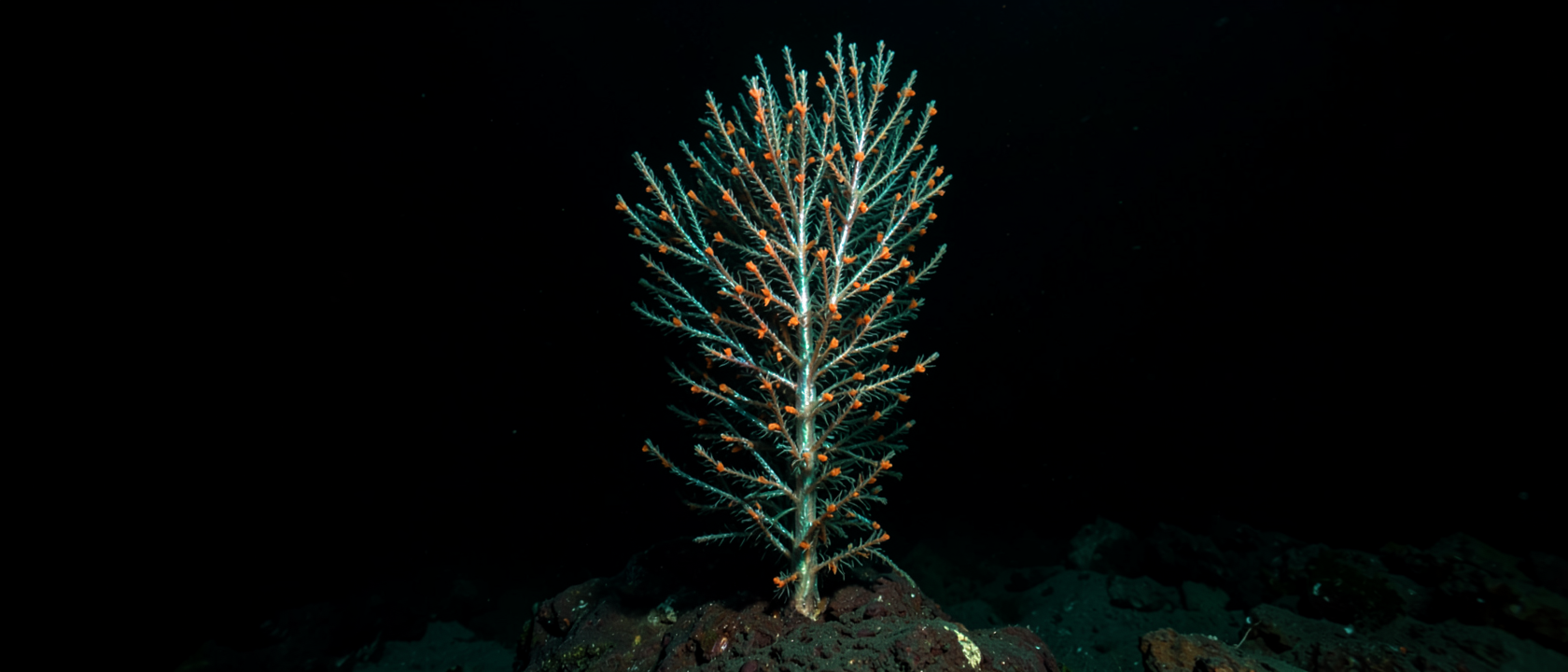
A Wookiee at 2,175 Feet
In September 2006, a remotely operated vehicle (ROV) surveying the seafloor off Molokaʻi, Hawaiʻi, filmed a coral colony standing about 4 feet (1.2 meters) tall at a depth of 2,175 feet (663 meters). A decade later, in 2016, a second specimen turned up on an unnamed seamount near the Mariana Trench: a partial colony, incomplete, measuring about 20 inches (51 centimeters), with an axis roughly a quarter inch (6 millimeters) wide at its base. Genetic and physical analysis eventually tied the two finds to a single new species, formally named Iridogorgia chewbacca.
It’s Not One Animal
Iridogorgia chewbacca is not a single creature. Like every octocoral, a group of soft corals whose polyps carry eight tentacles apiece, unlike the six-sided stony corals that build reefs, it is a colony: thousands of genetically identical polyps, each one its own small animal with a mouth and tentacles, fused onto one shared, branching skeleton. The whole structure is fixed to the seafloor by a holdfast, the base that anchors the colony in place, and spirals upward from there as a single, tightly coiled axis with a metallic sheen.
The branches growing off that axis are whip-like, up to 16 inches (40 centimeters) long, flexible, and lined up along one side of the stem, which is what produces the shaggy, bristling silhouette. Freshly collected, the polyps are bright orange; preserved in a jar, they fade to pale yellow or white. None of it is fur, and none of it is a body in the usual sense. It is an iridescent skeleton carrying thousands of mouths, built in a shape that made a research team reach for a Wookiee instead of a bottlebrush.
Why a Name Like This Matters
The formal description was published in 2025 in the journal Zootaxa, authored by Yu Xu, Les Watling of the University of Hawaiʻi at Mānoa, and Zifeng Zhan and Kuidong Xu of the Chinese Academy of Sciences. The team worked through twelve Iridogorgia specimens collected across the tropical western and central Pacific, relying on genetic sequencing alongside detailed anatomical comparison, because a widely used field clue, the direction a colony’s spiral twists, turned out not to reliably separate one species from another. That work produced two new species, Iridogorgia chewbacca and its sister species Iridogorgia curva, and the paper’s broader review catalogs ten other Iridogorgia species recorded across the tropical western Pacific, two of which had never been documented in that region before.
That kind of bookkeeping is how biologists reconstruct the history of parts of the ocean almost nobody has seen directly: which species live where, how closely related they are, how far they have spread. A playful species name does not loosen any of that. Iridogorgia chewbacca comes with a type specimen, the reference example biologists use to formally define a species, a genetic sequence, and a full morphological writeup, the same apparatus attached to any new species, pun or not. Watling, who retired from UH Mānoa two years before the paper came out, has now had a hand in identifying close to 100 new species over hundreds of dives and expeditions with NOAA.
What Nobody Knows Yet
How old an Iridogorgia chewbacca colony gets, how far it ranges across the Pacific, and how it reproduces are all still unknown. Watling has pointed out why that matters now rather than later: the deep water around Hawaiʻi is estimated at 500 to 1,000 years old, having traveled north from sources near Antarctica, which may mean it warms more slowly than the ocean surface above it. Slower is not the same as unaffected. Shifts in ocean chemistry or current patterns tied to a warming planet could still reshape these deep seafloor habitats before researchers have finished describing what lives in them.
Watling’s Unforgettable Find
Les Watling has spent decades working the deep sea from submersibles and ROVs. He calls his first look at Iridogorgia chewbacca “unforgettable,” and says that even after a career built on seafloor surveys, a find like this still makes him stop and take notice. That is one researcher’s account of one moment, not a measurement of anything, but it is the moment that, years later, turned into a species with a Star Wars name and a full genetic workup behind it.