
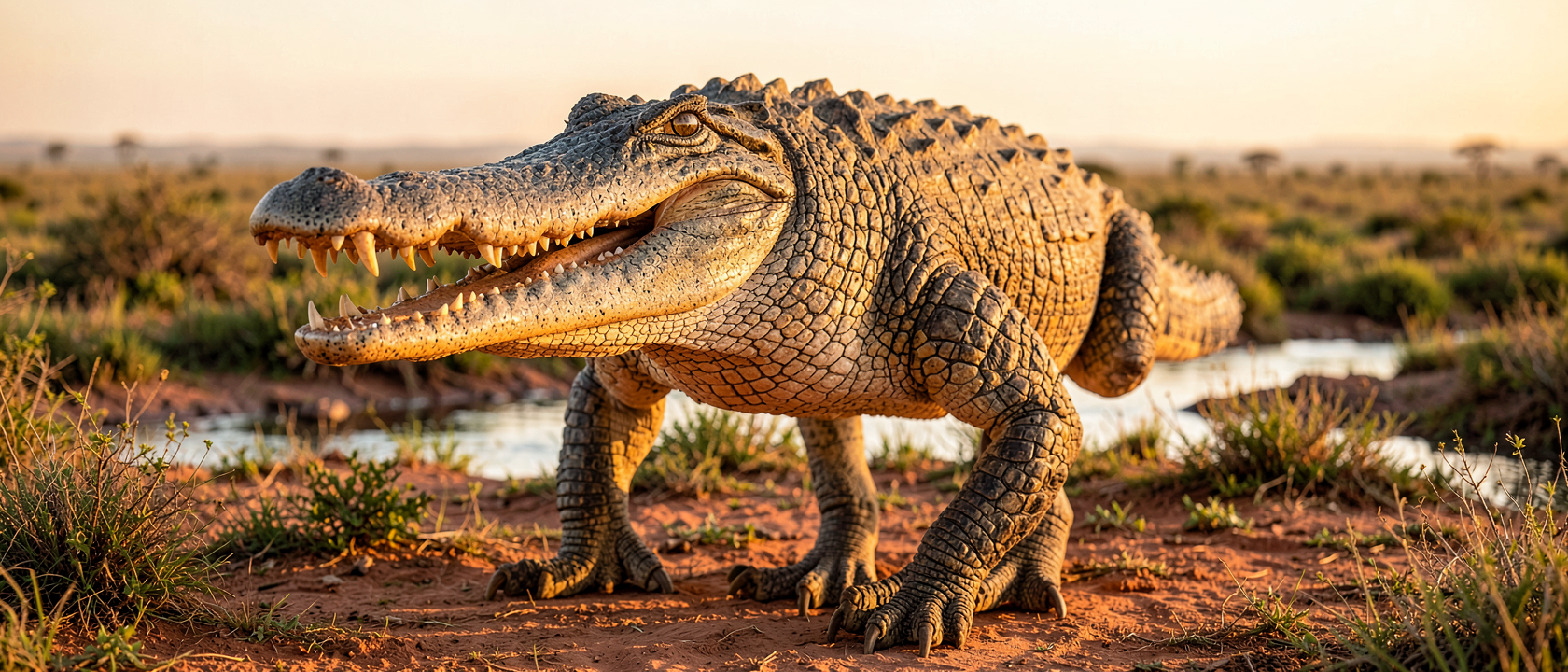
A Crocodile Relative With Fifty Steak Knives for a Mouth
Kostensuchus atrox carried more than 50 conical, serrated teeth, some nearly 2 inches (5 cm) long, in a jaw strong enough that the paleontologist who described it put it bluntly: it could “break a person into two pieces with a single bite.” Diego Pol and colleagues at the Bernardino Rivadavia Argentine Museum of Natural Sciences in Buenos Aires, working with researchers from Brazil and Japan, described the species on August 27, 2025, in the journal PLOS One. It lived in Patagonia roughly 70 million years ago, measured about 11.5 feet (3.5 m) long, and weighed around 551 pounds (250 kg). It is a peirosaurid, a crocodile relative and not a crocodile itself, the most recent and the southernmost member of that family ever found in the fossil record.
Why the Skull Reads “Hunter,” Not “Ambusher”
The skull alone runs about 19.7 inches (50 cm) long, and its attachment points for jaw muscle are oversized, the kind of hardware built for a crushing, repeated bite rather than a single snap-and-hold grip. Pol’s team also points to the forelimbs, longer and held more upright than in a modern crocodile, built to carry the body off the ground instead of sprawling beside it. Put the two together and the researchers argue for an animal that could stand, move, and chase prey on land, something closer to running a meal down than floating in wait for one. Their candidates for that meal are small-to-medium plant-eating dinosaurs, possibly small ankylosaurs and hadrosaurids, animals a predator would have had to catch, not surprise in the shallows.
What the Bite Cost: Scars From Its Own Kind
The spine of the fossil carries healed fractures, and Pol’s team reads them as a sign that Kostensuchus individuals fought each other, maybe over territory, maybe over a kill. Healed means survived: whatever caused those breaks did not end the fight, it just left a mark the animal carried afterward. The team’s reconstruction imagines two Kostensuchus rearing up and slamming into each other, a style of combat they compare to how Komodo dragons wrestle today. It is a rare glimpse of violence within a species, in a predator whose whole lineage vanished alongside the rest of the non-avian dinosaurs 66 million years ago. The same bite built for killing prey, it seems, also got turned on rivals.
The Myth This Kills: Crocodiles Were Not Always Swamp Lurkers
A crocodile lying motionless in murky water, waiting for something to wander too close, is the picture most people carry, and it is a modern snapshot, not a rule the group has always followed. Paleontologist Stephanie Drumheller-Horton of the University of Tennessee, who was not involved in the study, points out that the Cretaceous and earlier periods held crocodile relatives that were herbivores, giant land-hunting carnivores like this one, and even armored, armadillo-like forms. Peirosaurids, the family Kostensuchus belongs to, were part of that wider experiment in body plans. Today’s ambush hunters are just one surviving branch of a tree that used to try on far more shapes than the one word “crocodile” now calls to mind.
What’s Still Open: Did It Actually Walk Upright?
Whether Kostensuchus truly stood and moved on upright hind limbs is unresolved, and it may stay that way. No hind limb bones survived in this skeleton, so the entire argument for an upright, land-running gait rests on the pelvis and the forelimbs alone. Eric Willberg of Stony Brook University, who was not part of the study, reads that same pelvis differently: its shape suggests the hind limb may have sprawled out to the side the way a modern crocodile’s does, rather than standing fully upright like a mammal’s. Adam Cossette of the New York Institute of Technology, also outside the study, puts it plainly: without the missing bones, exactly how this animal moved and subdued prey stays genuinely open, not just debated. Even the body-mass estimate leans on modern caimans and alligators as a stand-in, a comparison Pedro Godoy of the University of São Paulo warns may not match the proportions of an extinct, land-adapted relative.
Found at Sunset, Finished on a Terrace
In early March 2020, museum paleontologists Fernando Novas and Marcelo Isasi were searching for a team member who had wandered off near sunset when Isasi spotted black bone poking out of beige rock, inside a crack shaped unmistakably like a skull. Days later, COVID-19 lockdowns stranded the whole team at the site for ten days before they could finally drive the fossil roughly 1,491 miles (2,400 km) to Buenos Aires on empty highways. When they arrived, the museum lab was closed under the same restrictions, so Novas asked Isasi to prepare the fossil at home instead. Isasi’s family hauled the heavy rock block onto their terrace, and for six months Isasi worked it free with pneumatic tools while his wife and children helped clean the bone by hand. An apex predator with 50 serrated teeth spent half a year of its second life on a family terrace in Buenos Aires before anyone outside that household ever saw its face.