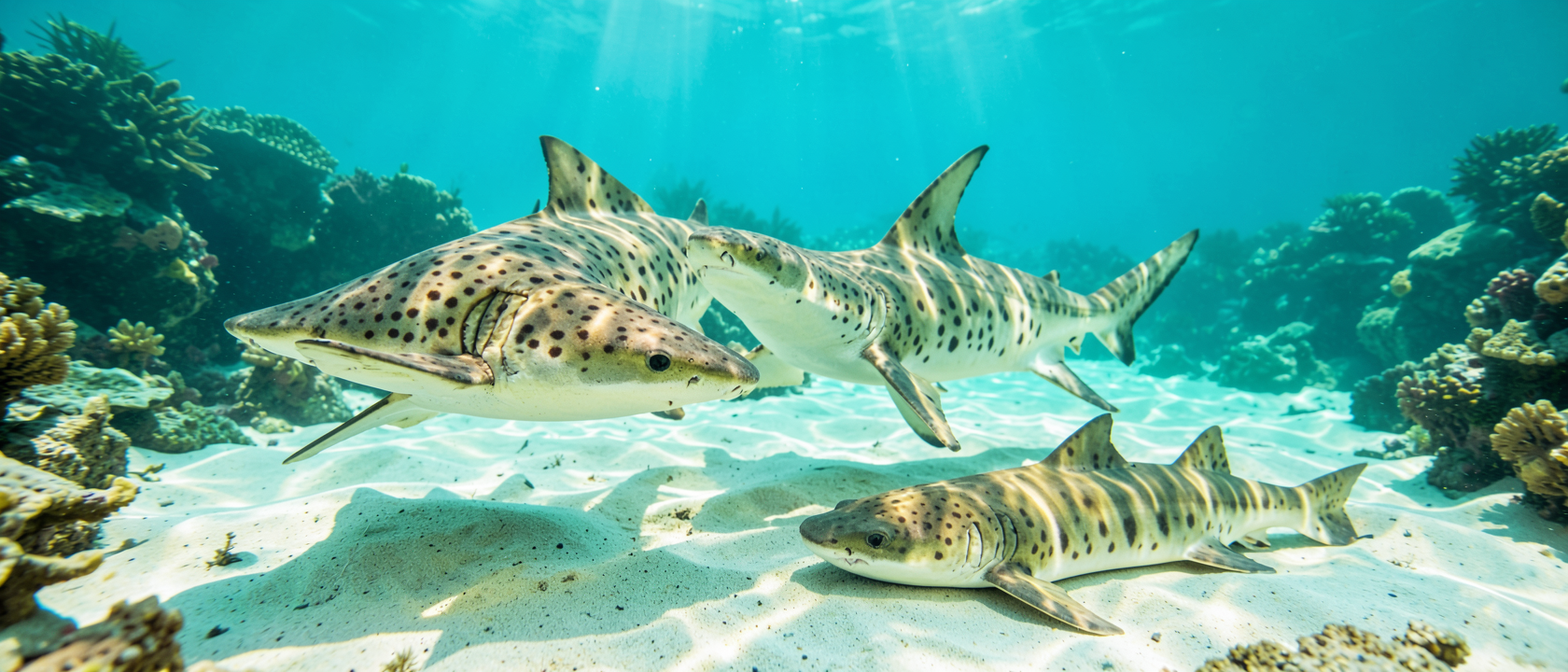
One Female, Two Males, 110 Seconds, and a Battery That Had One Job
On July 12, 2024, postdoctoral researcher Hugo Lassauce was snorkeling above Abore Reef, roughly 9.3 miles (15 km) off the coast of Nouméa, New Caledonia, when three zebra sharks (Stegostoma tigrinum) arranged themselves on the sandy seafloor below him and mated. The footage, published in the Journal of Ethology on September 18, 2025, co-authored by Lassauce and colleagues from the University of the Sunshine Coast and the Aquarium des Lagons, is believed to be the first scientifically documented wild mating observation for S. tigrinum in recorded history.
A quick note on the name: adult zebra sharks do not have stripes. The bold black-and-white vertical bands appear only on juveniles under roughly 20 to 35 inches (50–90 cm) in length; adults are pale with dark brown spots, which is why the same species is called the leopard shark in Australia and the UK. The species is listed as Endangered on the IUCN Red List.
How Two Male Sharks Coordinate Without Throwing a Single Punch
All three sharks were approximately 7.5 feet (2.3 m) long. A pre-copulation positioning phase lasting approximately 90 minutes played out on the sandy seafloor, with each male grasping one of the female’s pectoral fins, the broad, paired fins extending from either side of the body, holding her between them. Then, sequentially, each male mated with her: the first for approximately 63 seconds, the second for approximately 47 seconds. At no point did the males direct aggression toward each other. When it was over, both rested immobile on the seafloor for several minutes. The female swam away.
The sequence the authors describe, dual fin-grip, cooperative restraint, sequential copulation, is the mechanism behind the paper’s main finding: this female mated with two males in a single event. That is polyandry, and for S. tigrinum it had never been confirmed in the wild before this footage.
Why It Matters That She Chose Two
Zebra shark numbers have declined by more than 50% over the past 50 years, driven by overfishing and habitat destruction. Polyandry tends to increase the genetic diversity of a single clutch of offspring, because different males contribute different genetic material. For captive breeding programs working to maintain a genetically healthy population, knowing that females naturally mate with more than one male changes how pairings should be structured, managing a female with a single male could produce a less diverse clutch than her biology is built for. The Journal of Ethology paper notes this implication directly. The authors also identified Abore Reef as critical reproductive habitat and called for formal marine protection there.
Shark Mating Is Not Always a Blood Sport
The prevailing picture of shark mating involves males biting females aggressively to restrain them, leaving visible wounds, and competing through direct physical confrontation. That pattern is real and well documented in other species. It is not a universal rule. The S. tigrinum event Lassauce recorded was described by the authors as relatively calm and gentle: the female showed no bite-wound injuries, and the two males cooperated rather than fought. The myth is not that violent mating exists in sharks, it does, in the species where it has been documented. The myth is that all sharks default to it.
The Two Things Nobody Has Ever Seen
This observation closes one gap and immediately opens two more. Where S. tigrinum females lay their eggs in the wild has never been established. The species is oviparous, it reproduces by releasing egg cases rather than giving birth to live young, but the specific deposition sites remain unknown. Where juveniles spend their first years is equally uncharted. Lassauce identified both unknowns as the next critical targets for conservation-focused research. Science now has the 110-second center of this species’ reproduction and very little of what surrounds it.
The Universe Was Apparently Paying Attention to His Battery Level
Lassauce had been snorkeling at Abore Reef every week for approximately one year, monitoring these sharks. On July 12, 2024, he spotted two males grasping a female’s pectoral fins on the sandy bottom and waited at the surface for approximately one hour, long enough for his body temperature to drop, while the pre-copulation positioning phase, which lasted roughly 90 minutes in total, played out below him. When the moment came, he filmed the entire copulation sequence on a GoPro whose battery was nearly gone: 110 seconds, split across two males. Both settled back to the seafloor, spent. The female turned and swam away.
The camera died on the frame she left the shot.