The Spider That Runs a Firefly Trap
A sheet web spider in a Taiwanese conifer forest has been filmed catching fireflies and then deliberately not eating them.
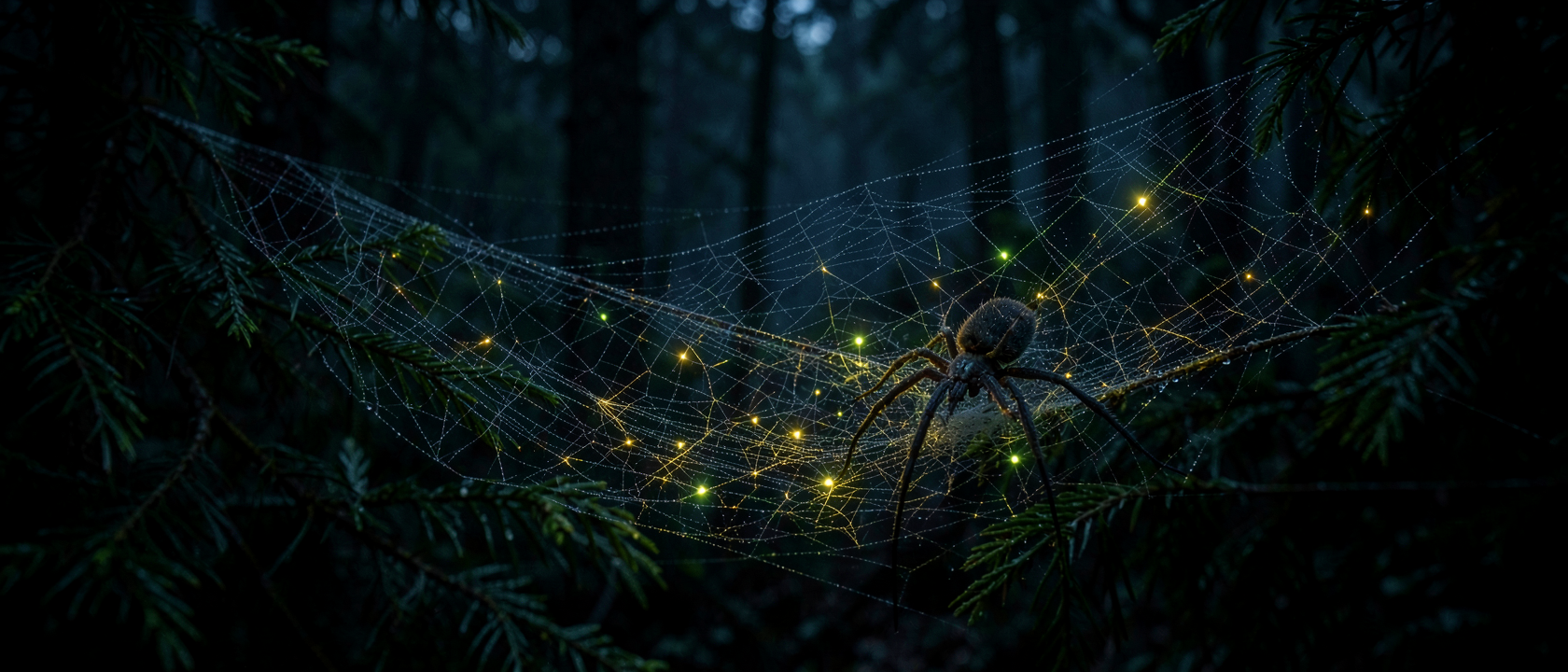
Psechrus clavis, a nocturnal sit-and-wait predator native to subtropical East Asia, was documented at National Taiwan University’s Xitou Nature Educational Area doing something that had not been recorded in any sheet web spider before: capturing winter fireflies (Diaphanes lampyroides) and leaving them alive in the web for up to an hour while the fireflies continued to emit bioluminescent light. Field observers from Tunghai University noted the spider periodically returning to the captured fireflies rather than consuming them, behavior the researchers interpreted as consistent with monitoring, though it was not experimentally controlled.
The result was measurable and stark. Researchers from Tunghai University, led by Dr. I-Min Tso, published the finding on August 27, 2025, in the Journal of Animal Ecology. A web running a live, glowing firefly drew three times more prey overall than an unmodified web. Firefly captures specifically increased tenfold.
How a Mating Signal Becomes a Murder Weapon
Diaphanes lampyroides is a winter firefly whose bioluminescent signal is continuous and non-flashing. That steady glow is a mating advertisement: males broadcast it while searching for receptive females. Once a male is caught alive in a Psechrus clavis web, the signal does not stop. It keeps transmitting. Other males in the vicinity read it exactly as intended, flying toward what they interpret as a female’s response, and into the silk.
To confirm the mechanism wasn’t coincidence, the Tunghai University team placed LED lights calibrated to approximate Diaphanes lampyroides bioluminescence directly into real P. clavis webs in the field, comparing catch rates against unmodified control webs. The result matched the natural observation: LED-equipped webs drew three times more total prey and ten times more fireflies than controls. The fireflies that flew in were predominantly male. That sex bias is not incidental. It is precisely what a deception-by-mating-signal hypothesis predicts, since it is males actively searching for glowing females who follow that cue toward the web.
The firefly’s love signal is the weapon. The spider simply positions it.
The Spider Knows Which Prey to Keep
What separates this from passive web-and-wait predation is the discrimination. Video footage from the same study shows Psechrus clavis consuming moths immediately upon capture. Fireflies, caught in the same web on the same night, are not eaten. They are left intact and luminous, a distinction the study’s authors interpret as the spider treating the firefly as something other than immediate prey, though what sensory or behavioral mechanism drives that choice has not yet been established.
The payoff is asymmetric. The firefly’s own evolved signaling system does the prey-attraction work; the spider invests nothing metabolically while the glow draws in the next catch.
The anglerfish comparison is structural, not evolutionary: an anglerfish lures prey with a bioluminescent organ it evolved over millions of years, grown from its own body at considerable biological cost. Psechrus clavis produces no bioluminescence. It cannot generate a single photon from its own tissues. It arrives at the same functional outcome by walking into a forest and catching a lantern.
This is also not the first spider documented exploiting firefly bioluminescence as a lure. A study published in Current Biology in August 2024 described the orb weaver Araneus ventricosus manipulating the flash pattern of captured Abscondita terminalis fireflies to draw in additional males. The P. clavis case involves a different spider, a different firefly, and a different mechanism. Diaphanes lampyroides needs no manipulation: its signal is continuous and unchanging, and the web is simply in the way.
The Parts the Study Cannot Answer
Three things remain genuinely open after this research, and the authors are specific about all three.
First: how Psechrus clavis identifies a captured firefly as a firefly at all. Dr. I-Min Tso’s team suspects the bioluminescent signal itself is the cue that triggers the decision to withhold consumption rather than eat immediately. Whether the spider is responding visually to the light, to a chemical signature, or to something else entirely has not been tested. It is a plausible hypothesis, not yet a confirmed finding.
Second: the LED experiment used lights matched to Diaphanes lampyroides bioluminescence in wavelength and intensity, but the researchers acknowledge the match was approximate, not a perfect spectral replica. How precisely the deception needs to be calibrated, whether a cruder or finer signal would produce the same effect, remains an open question the LED methodology cannot close.
Third: the behavior has been documented at one field site, in one Psechrus clavis population, in one forest in central Taiwan. Whether other populations of this species, or any of the other sheet web spider species sharing its range across East Asia, do anything comparable is entirely unexamined.
A Lighthouse Built from Someone Else’s Screams
Psechrus clavis has no lantern organ. No bioluminescent tissue of any kind. No capacity, by its own biology, to produce light.
And yet, on any given night at Xitou, a P. clavis web may be glowing. Steady, continuous, precisely the wavelength that male Diaphanes lampyroides have been reading as “female, here, now” for longer than the spider has been using it against them.
The spider assembled this lighthouse one captured firefly at a time. It costs the spider nothing.
The firefly is not prey. The firefly is infrastructure.