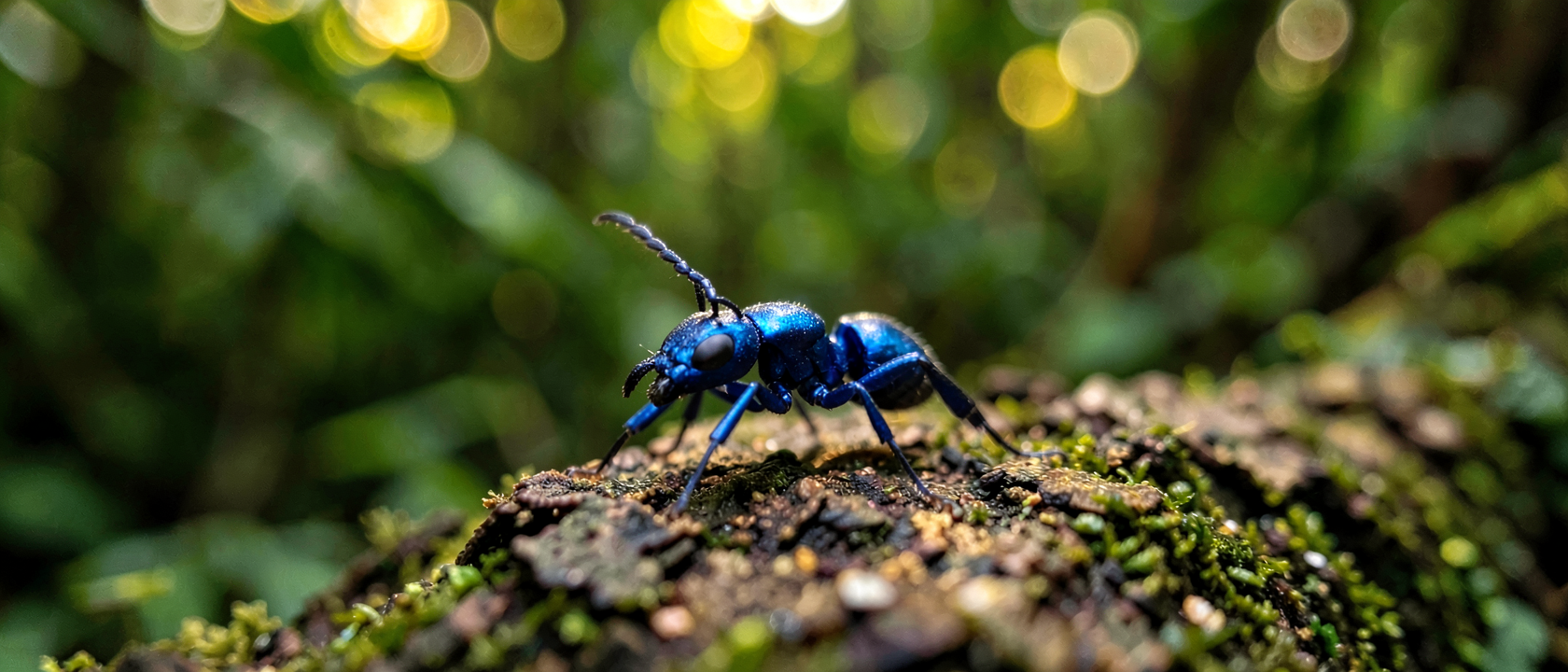
In Yingku village, in the East Siang district of Arunachal Pradesh, entomologists have described an ant colored like polished sapphire, a shade almost unheard of among the world’s 16,724 described ant species and subspecies. Paraparatrechina neela measures about a sixteenth of an inch (roughly 1.6 mm, under 2 mm by total length), and its blue is not paint. It is physics.
Something Sparkled in a Tree Hole
In May 2022, a team surveying ants for the Siang Expedition, a resurvey of the Siang Valley’s biodiversity a century after the 1911-1912 Abor expedition, funded by a National Geographic Society wildlife-conservation expedition grant, was working a steep cattle track near Yingku village, at roughly 2,635 feet (803 m) in a patch of secondary forest. One evening, checking a tree hole about 10 feet (3 m) up, they later wrote that “something sparkled in the twilight.” In the near-dark they had no idea what they were looking at, so they drew it into an aspirator, a small hand tube entomologists use to suck insects gently into a collection vial without touching them. Only later, under a microscope, did the sparkle turn out to be two worker ants, members of the caste that forages for the colony and never reproduces.
The species was formally described in 2024 by Priyadarsanan Dharma Rajan and Sahanashree R, both at the Ashoka Trust for Research in Ecology and the Environment (ATREE) in Bengaluru, with Aswaj Punnath of the University of Florida, in the open-access journal ZooKeys, volume 1203, pages 159 to 172. They named it Paraparatrechina neela, from a word for blue in several Indian languages, and it is more than a pretty name: it is the first new species in the genus Paraparatrechina reported from the Indian subcontinent in 121 years, since P. aseta was described in 1902. Until neela turned up, aseta was the only member of the genus known from the region.
Blue Without Blue Pigment
The color covers the whole body except the antennae, mandibles, and legs, which stay ordinary insect brown. The head is subtriangular, the eyes are large for an ant this size, and the mandible carries five teeth. Sahanashree R, one of the paper’s authors, described the hue as “a deep sapphire shade.”
In insects, a blue this saturated is almost never a pigment. True blue pigment is unusual across the animal world generally, and in insects specifically, blue is typically produced instead by the physical arrangement of nanostructures in the cuticle, the hard outer shell, an effect called structural color. Microscopic ridges or thin layers in the cuticle bend and interfere with light waves so blue wavelengths bounce back to the eye while other wavelengths cancel out. It is the same optical trick behind a Morpho butterfly’s wing and a peacock’s feather. The ZooKeys description does not include an electron-microscope image of this ant’s cuticle, so the paper does not directly confirm a nanostructure sitting inside it. The blue is inferred from how it behaves, that metallic, faintly shifting shine, which is why “almost certainly structural” is the honest way to put it, not “confirmed.”
What Nobody Knows Yet
Structural blue does real work elsewhere in the animal world: it can signal a mate, warn off a predator, or blend an insect into a particular background. Whether Paraparatrechina neela’s blue does any of that is not established. The paper describing the species reports its color and the circumstances of its discovery, not its function. The researchers raise the question themselves rather than answer it, asking whether the color aids communication, camouflage, or something else entirely. Blue ants have turned up before in Australia, the Philippines, and Thailand, and in every case they are noted as highly unusual, not a hidden pattern waiting to be spotted. How this particular blue evolved, and whether it tracks the species’ elevation or anything else about its biology, sits on the list of open questions for future fieldwork, not a mystery the authors pretend to have closed.
The Myth: Ants Only Come in Red, Black, or Brown
The usual mental picture of an ant tops out at rust, black, and the shades between. Measured against the record, that picture is mostly right and occasionally, spectacularly wrong. Of the 16,724 described ant species and subspecies on record, only a few show blue or iridescent coloring, by the researchers’ own account. Inside the genus Paraparatrechina alone there are 38 valid species and four valid subspecies, 14 of them known from the Indomalayan region, and for 121 years the Indian subcontinent had exactly one, P. aseta, colored like any ordinary ant.
So the myth is not that ants are never blue anywhere, full stop. Blue ants exist. The myth is that most people do not know blue is on the table at all, and the ant found in a jar from a cattle track in Yingku village is exactly rare enough to prove it.