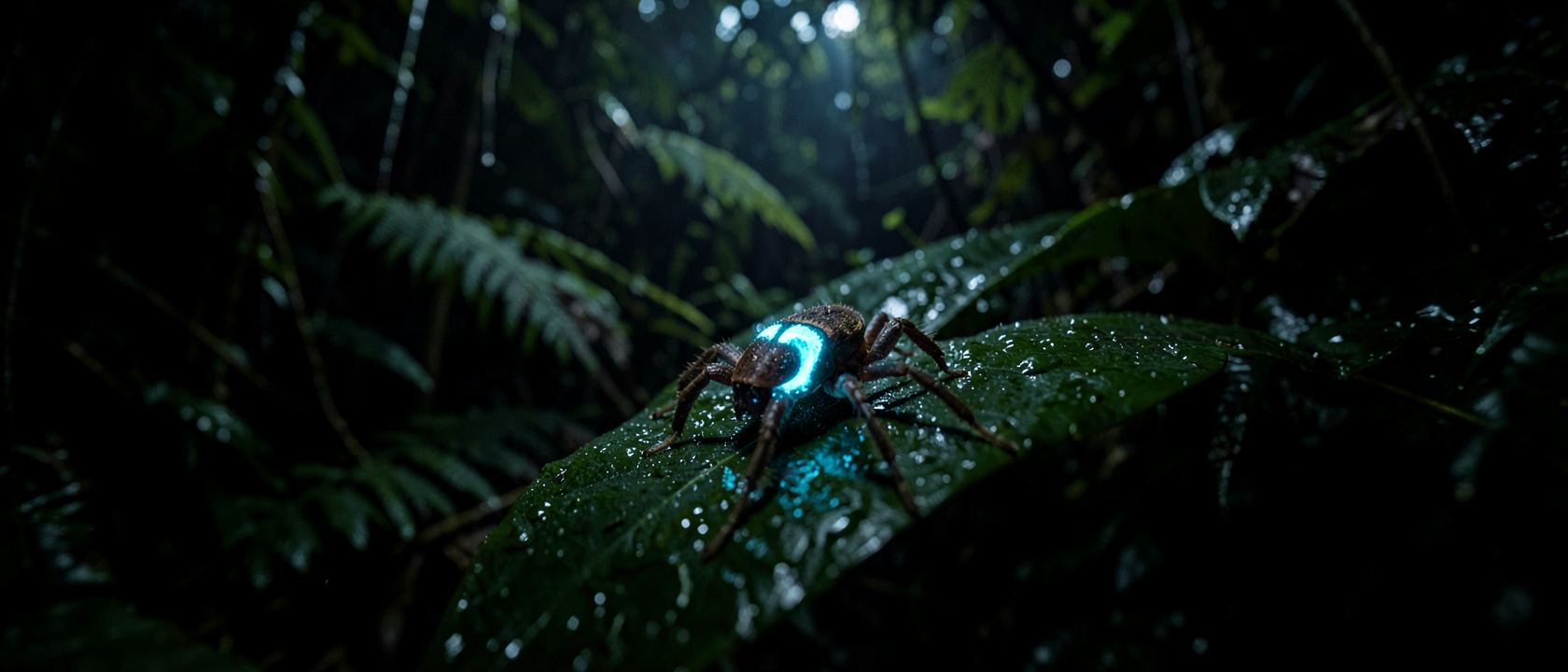
Five Harvestmen Walk Into the Same Rainforest…
At the Panguana Biological Research Station in the Peruvian Amazon, five harvestman species share the same patch of forest floor, the same nocturnal hours, and roughly the same body plan. Under a normal flashlight, telling them apart takes a trained eye. Under a UV light, it takes no training at all: each species lights up in its own distinct blue-green pattern across its back, and that pattern is the same, animal after animal, within a species, and completely different from its neighbors’.
Harvestmen (order Opiliones) are arachnids related to spiders, though not spiders themselves; they belong here to the family Cosmetidae. Between 2013 and 2017, researchers collected and observed five such species living syntopically, meaning not just in overlapping ranges but in the exact same spot, at the exact same hours, at the Área de Conservación Privada Panguana in Peru’s Huánuco Department. Two of the species now have names, Vononana adrik and Taito friedrichi; three others remain undescribed. Vononana adrik turned out to be the most commonly encountered of the five. The study, led by Stefan Friedrich with the Bavarian State Collections of Natural History, LMU Munich, and Munich University of Applied Sciences, appeared in Scientific Reports on January 21, 2026.
Under the Cuticle: A Built-In Mirror
The glowing structure has a name: the equuleus, a pale patch on the dorsal scutum, the hardened shield-like plate on the harvestman’s back. In ordinary light it already reads as a white-to-yellowish shape against dark brown. Under UV, that contrast turns into intense blue-green fluorescence.
Microscopy traced the glow to the outer cuticle, the hardened surface layer of the exoskeleton, sitting above something more interesting: a multi-layered crystal structure made of guanine that behaves like a built-in mirror. It reflects the UV light hitting it from outside, and it reflects the fluorescence being emitted from within, doubling down on a signal that would otherwise be faint. This is not a stray chemical accident. It is architecture, an optical system built into the animal’s own skin. And it is not wasted on eyes that can’t use it: earlier work on related harvestmen has already shown their simple eyes are tuned to pick up short-wave light, which means these animals are physically equipped to see this glow on each other, at close range, in the dark.
Why Bother Glowing If You Already Look Different Enough (To a Human)?
Here is the researchers’ working hypothesis, and it is framed as exactly that, a hypothesis, not a closed case. Five closely related species crammed into one niche and one activity window have a real problem: mistaking a near-identical neighbor for a potential mate. Pairing with the wrong species is a dead end, in the strict evolutionary sense, no offspring, no genes carried forward. The study authors suspect the equuleus solves this with a private channel: a species-consistent UV signature, amplified by that guanine mirror, readable by eyes built for exactly that wavelength, that lets one harvestman confirm “same species” before any courtship investment goes further.
Friedrich and his co-authors put it plainly in describing the anatomy behind this idea: a fluorescent surface paired with a reflective underlayer that is that consistent and that well-built looks less like noise and more like a deliberate signal, built for communication in dim light rather than left over from something else.
The Myth Fluorescence Usually Gets Away With
Glowing under UV light is common across the animal world, in scorpions, in certain parrot feathers, in assorted fish. The usual writeup for these cases ends with a shrug: fluorescence gets reported as a curiosity, and the question of what it is actually for goes unanswered. The default assumption in that gap is that it is a biological byproduct, not a message.
This harvestman case pushes back on that default, and it does so with a specific combination rather than a vibe. Three things stack together here that coincidental fluorescence rarely offers all at once: the pattern is species-specific and consistent within each species, the animal has dedicated reflective anatomy, that guanine layer, built to amplify exactly this glow, and the animal’s own visual system is documented as capable of detecting it. That stack is what moves this from another unexplained glow to a genuine candidate for a functioning signal.
What Nobody Has Actually Seen Yet
The hypothesis has a real hole, and the authors say so themselves. No experiment has yet shown a harvestman changing what it does, approaching, avoiding, choosing to court, based on seeing another individual’s UV pattern. Until that experiment happens, “glowing name tag” is a well-built hypothesis resting on anatomy and eyesight, not a demonstrated fact about behavior.
The authors also flag the questions their own anatomy work can’t answer: why the equuleus holds such a fixed shape within a species and yet diverges so sharply between species sharing the same patch of forest, and why the fluorescence is so intense in the first place. The next step is the obvious one: put the pattern in front of a live harvestman, in the dark, at Panguana, and see what it actually does with what it sees.