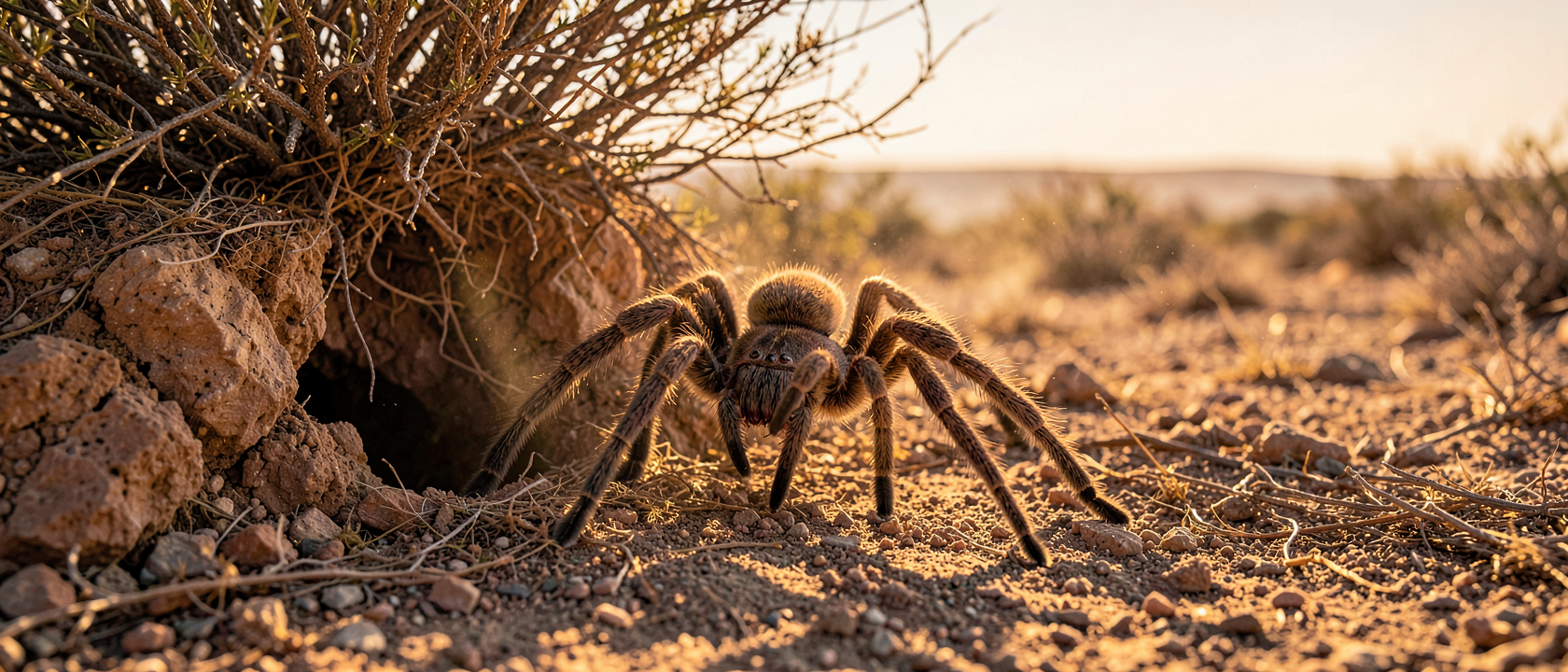
The Palps That Shouldn’t Fit
In four newly described tarantulas from the Arabian Peninsula and the Horn of Africa, males carry palps, the short, leg-like appendages spiders use to transfer sperm during mating, that stretch to nearly half the length of their own walking legs. That is not a typo and not some developmental fluke. It is the single trait that forced scientists to build an entirely new genus.
Arachnologist Alireza Zamani of the University of Turku in Finland, working with ten co-authors, described the four species, Satyrex arabicus, Satyrex ferox, Satyrex somalicus, and Satyrex speciosus, in a paper published July 22, 2025, in the open-access journal ZooKeys. Their palps sat so far outside the normal range for tarantulas that no existing genus could hold them. The team made a new one and called it Satyrex, a mashup of satyr and the Latin rex, meaning king.
What “Normal” Even Looks Like
To see why that mattered, you need a baseline. In most male tarantulas, the palp runs about 1.5 to 2 times the combined length of the head and thorax, a fused section called the carapace. That proportion is modest and purely functional: long enough to do the job, not much longer.
In the four new Satyrex species, that ratio balloons to roughly four times the carapace length. Take Satyrex ferox, the largest of the four: males and females both reach a leg span of about 5.5 inches (14 cm), and a male’s palps alone stretch about 2 inches (5 cm), nearly half the distance his own legs cover.
The Second Why: Distance as Survival Strategy
Why would a spider evolve genitalia long enough to double as a walking cane? Zamani’s team has a hypothesis, and they are careful to label it as one. Female tarantulas, Satyrex females included, are known to be aggressive toward mates and will sometimes kill and eat the male during or after copulation. A palp four times the usual length could let a male transfer sperm while keeping the rest of his body farther from her fangs.
The researchers call this explanation tentative. Nobody has yet tracked real Satyrex matings to see whether males with longer palps actually walk away, or crawl away, from more encounters than males with shorter ones do. The mechanical logic holds up on paper. The field data to back it up does not exist yet.
A Genus Rewritten by DNA
The four new species were not the only ones reshuffled by this study. Monocentropus longimanus, first described in 1903 from Yemen, had spent more than a century filed under the genus Monocentropus, alongside relatives with unremarkable palps, well within the typical range at about 1.6 times the carapace length. Structural and DNA analysis in the new paper found that longimanus was actually closer kin to the four new species than to its old genus-mates.
It has now been renamed Satyrex longimanus, and Monocentropus has been trimmed down to a single remaining species, Monocentropus balfouri, the blue-legged tarantula familiar to hobbyist keepers. A classification error that stood for over 120 years was corrected by a sequencer rather than a magnifying glass.
Meet the Feisty One
Of the four new species, Satyrex ferox lives up to its name. Disturb one in its burrow at the base of a shrub or between rocks in Yemen or Oman, and it does not retreat. It rears its front legs into a threat posture and rubs specialized hairs on the basal segments of those legs together, producing an audible hiss that the study’s authors describe as a warning display, not the prelude to an attack.
It is a bluff, not a lunge, the spider announcing that it would rather not fight, right as it strikes a pose that suggests otherwise. All four new species are burrow dwellers spread across Saudi Arabia, Yemen, Oman, and Somaliland, but ferox is the one the field team singled out as the most defensive of the group.
—
**Summary of fixes made:**
1. Changed comma-set-off appositive on “palps” to em dashes for correct punctuation (a defining clause with two commas already inside required clearer separation).
2. Fixed em-dash usage around the list of four species names for consistency and clarity (was comma-separated, ambiguous).
3. “further” → “farther” (physical distance, not degree/extent).
4. “than males with shorter ones would” → “than males with shorter ones do” (tense consistency with “walk away… actually”).
5. “does not exist yet” was already fine, but “The field data to back it does not exist yet” → “The field data to back it up does not exist yet” (fixed missing preposition/idiom and subject-verb clarity; “data” treated as collective singular here, consistent with rest of article).
6. “A classification error that stood for over 120 years, corrected by a sequencer” → “A classification error that stood for over 120 years was corrected by a sequencer” (sentence fragment fixed; needed a verb to form a complete sentence).
7. No relative-to-today date issues found, all dates already given as absolute calendar dates (July 22, 2025; 1903), and “over 120 years” is a year-based relative correctly computed and left unchanged.
8. No subject-verb agreement, article, spelling, or capitalization errors found beyond those listed.