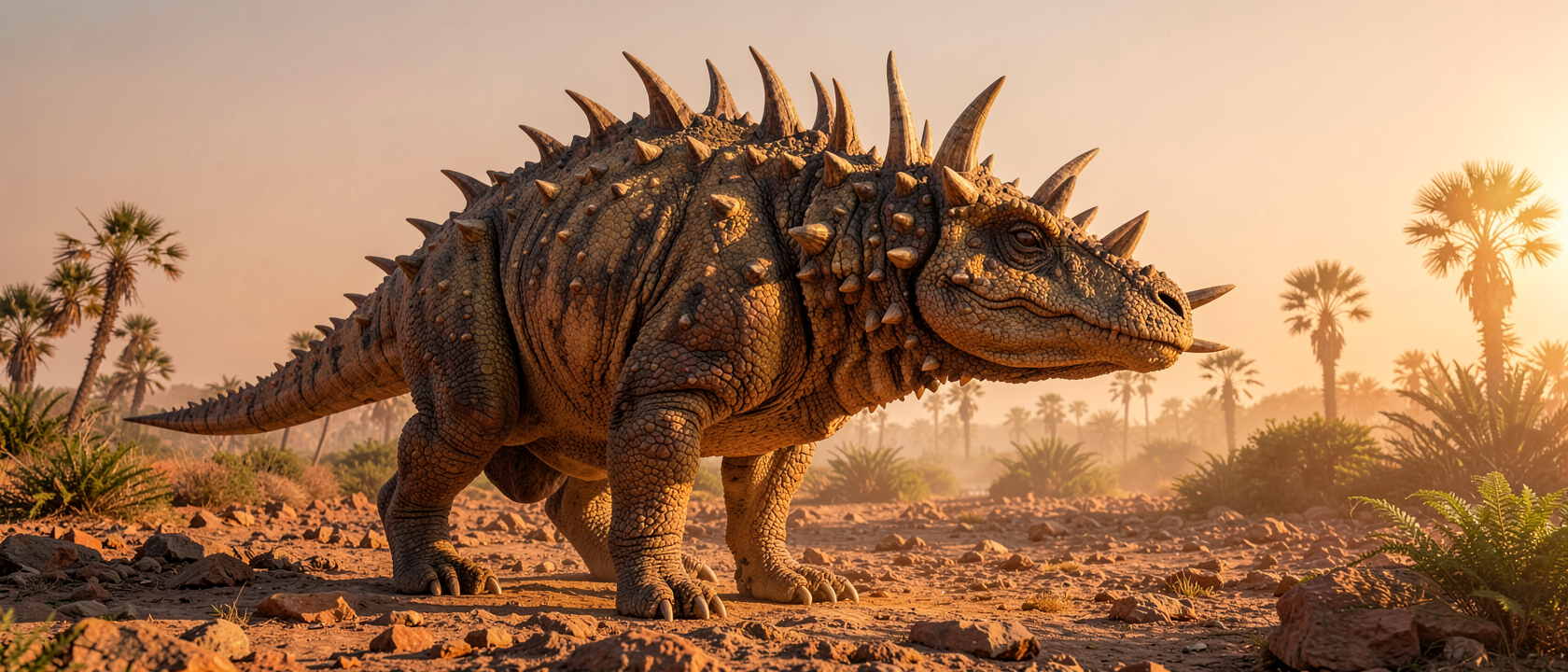
A Spike Nearly a Yard Long, Growing Out of a Rib
Spicomellus afer lived more than 165 million years ago in what is now Morocco, and it is the oldest known ankylosaur, the group of armored, plant-eating dinosaurs best known for the tail club some of them carried later on. New fossils, described in a Nature paper published August 27, 2025, by Prof. Susannah Maidment (Natural History Museum, London, and University of Birmingham) and Prof. Richard Butler (University of Birmingham), working with a Moroccan team led by Prof. Driss Ouarhache (Université Sidi Mohamed Ben Abdellah), show bony spikes fused directly onto every single rib the animal is known from. One spike on its neck collar measures 34 inches (87 cm) in the fossil itself. That is a spike almost a yard long. The spike is not attached to the rib; it grew as part of it.
Armor That Isn’t Armor, It’s Skeleton
In every other armored animal on record, plates and spikes sit in the skin, on top of soft tissue that the animal grows and repairs separately from its skeleton. Spicomellus’s spikes are fused straight onto the bone of its ribs and neck collar, which the fossils show directly rather than something paleontologists have had to infer. The same skeleton also carries large spikes pointing straight up over the hips, blade-like spikes running down the sides, paired long-spike elements, and shoulder plates. No other vertebrate, living or fossil, has been documented growing weaponry as part of its rib cage itself, rather than bolted onto it.
The species was first named in 2021, from a single rib bone Prof. Maidment acquired from a fossil dealer in Cambridge in 2019. One account of that discovery, told secondhand and not independently confirmed, has her suspecting a forgery at first, before CT scans settled the question. A 2023 dig turned up far more material, including the neck collar with the 34-inch (87 cm) spike, and it’s that fuller skeleton the 2025 Nature paper is built on.
Then What Was It Actually For?
The researchers argue that this array makes a poor defensive weapon. It is asymmetric, top-heavy, and elaborate in ways no other ankylosaur species ever repeats, before or since. What it fits much better, in their reading, is display: mate attraction, rival signaling, biology built to be looked at rather than to survive a bite. Later ankylosaurs went the other way, evolving flatter, simpler, more clearly defensive armor, a shift the authors link to the rise of bigger, more dangerous Cretaceous predators. The oldest known member of the “armored dinosaur” club may have been armored for show, not for survival.
The Myth This Kills
The standing assumption was that ankylosaur armor evolved in one direction: starting simple and defensive, then getting more elaborate as an arms race with predators escalated over time. Spicomellus runs that story backward. The oldest known ankylosaur has the most extravagant, least defense-shaped armor in the whole group, and things get plainer and more practical from there. Separately, the fossils show fused tail vertebrae forming a rigid handle, the same structure later found in ankylosaurs that carried a bony club at the end of the tail. That pushes the known origin of tail-weapon anatomy back by more than 30 million years. The hardware for the group’s signature weapon existed long before any actual club has ever turned up.
What Nobody Has Found Yet
The tip of Spicomellus’s tail has never been recovered. Whether it carried an actual club, or just the handle, the precursor structure with nothing on the end of it, is unknown. The 34-inch (87 cm) figure for the neck spikes is a fossil measurement, and the authors think the spikes may have been longer in life, possibly sheathed in keratin the way horns are in living animals, though that is unconfirmed. And the display argument itself, however well it fits the anatomy, remains an interpretation rather than a proven function. All three are open questions. None of them come with a guess dressed up as an answer.