The Finding
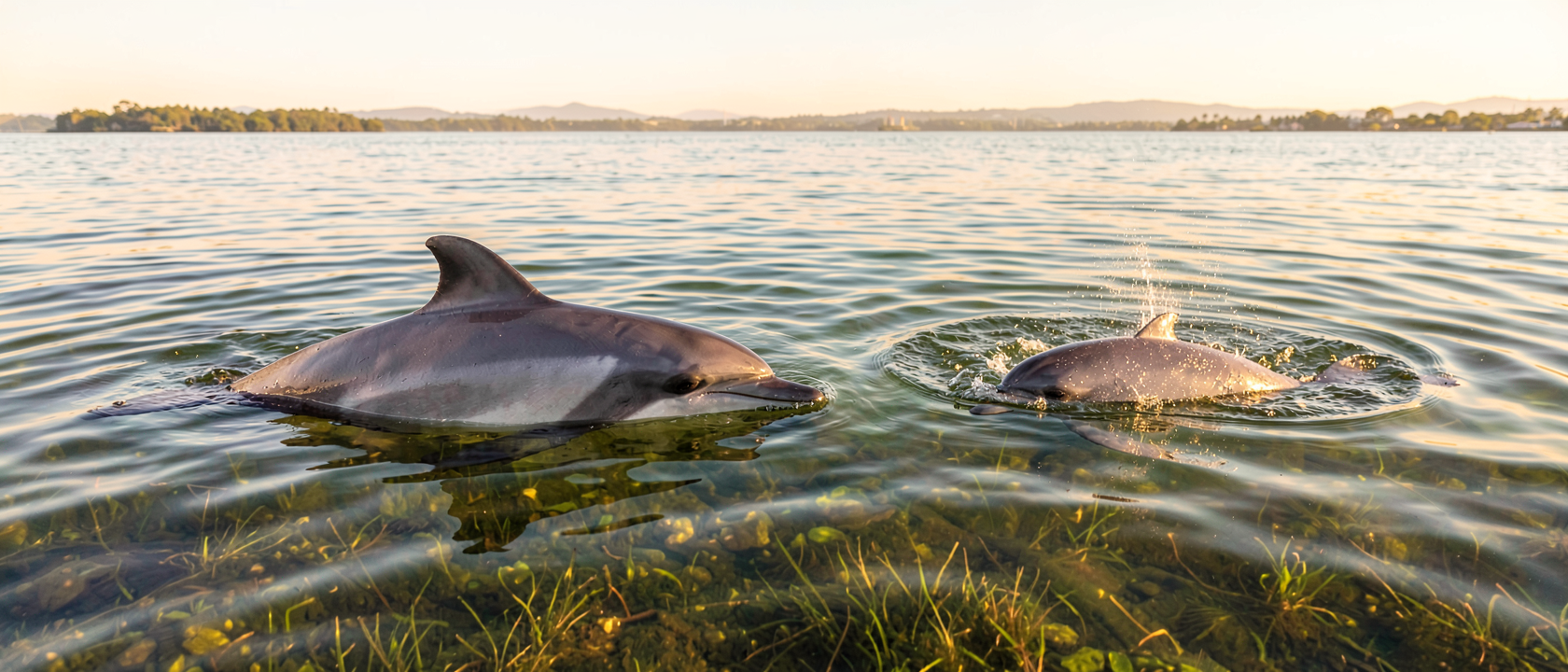
In Sarasota Bay, Florida, bottlenose dolphins (Tursiops truncatus) that steal bait off fishing lines or scavenge fish from boats don’t just share a bad habit. They spend their lives with the other dolphins who share it. A study led by Kyra Bankhead of Oregon State University, with coauthors Mauricio Cantor, also of Oregon State University, and Katherine McHugh and Randall Wells of the Sarasota Dolphin Research Program (run by Brookfield Zoo Chicago), tracked individually identified dolphins in the bay from 1995 through 2012, seventeen years of consistent observation, and published the results in the journal Animal Behaviour on April 29, 2026.
The dolphins who engage in what the researchers call human-centric foraging, taking bait or catch from gear, picking through discarded fish, hanging near boats for handouts, associate with each other more than chance would predict. That held even after the team controlled for sex, age, and how much of the bay each animal actually uses, the ordinary reasons two dolphins might just happen to cross paths. This population doesn’t even keep fixed groups; bottlenose dolphins live in a fission-fusion society where who travels with whom shifts by the day. Against that constantly reshuffling backdrop, a pattern this stable, over this many years, is the headline: the habit itself sorts the friendships.
Why It Spread: The Mechanism
In the early 2000s, a severe red tide, a bloom of toxic algae, killed off large numbers of the fish this population normally hunts. Less food in the water pushed dolphins to forage more widely, and that put them in direct competition with people fishing the same dwindling stock. Boats and gear stopped being background noise and became a shortcut.
The numbers track the crisis in order. Before the intense red tide period, 12 percent of the studied dolphins engaged in human-centric foraging. During the bloom, that rose to 22 percent. Afterward, with fish stocks still not fully recovered, it reached 41 percent. Scarcity came first; the shift toward people came second.
The Second Why: A Bond That Loosened, Then Maybe Spread
Here is the part that doesn’t fit the obvious story. If the habit was spreading, you’d expect it to bind its practitioners tighter together as more dolphins picked it up. Instead, during and after the red tide, the statistical link between sharing this foraging tactic and choosing each other’s company weakened, even as the tactic itself climbed toward four in ten dolphins. That weakening is a measured result, not a guess.
The researchers’ explanation for it is not. Their proposal is that during the worst of the scarcity, dolphins clustered around whatever pockets of natural prey were left, rather than around each other’s foraging style, a survival scramble that would blur the tactic-based clustering right when it might otherwise have sharpened. Then, once that immediate pressure eased and human-centric foraging kept climbing anyway, the team floats a second idea: the tactic itself might be moving dolphin to dolphin through the social network, something closer to a habit picked up from an associate than a trick each animal works out alone. The paper is explicit that this second part is a suggestion, not a demonstrated mechanism.
The Myth This Kills
The easy assumption is that a dolphin working a fishing line is a private shortcut: one animal’s opportunism, with consequences that stop at its own stomach and its own well-documented individual risks, boat strikes, hooking, entanglement, and a reduced reproductive success already linked to human-centric foraging in earlier work. The Sarasota data say the consequences don’t stop there. The habit appears to reorganize who a dolphin swims, rests, and hunts alongside for years at a stretch. This is not a diet quirk. It restructures a slice of the population’s actual social fabric.
What’s Still Unknown
Two things the paper doesn’t settle. First, why the link between the foraging tactic and social bonding went slack specifically during the scarcity years is explained only by the researchers’ proposed reshuffling toward scarce prey patches, not confirmed by any direct test. Second, whether these foraging-based cliques make the wider dolphin community more or less resilient as red tides grow more frequent and severe is described only as a possible implication. Nobody has measured it yet.
—
**Changes made:**, Added missing em-dashes (in place of commas) around parenthetical asides for clarity and correct punctuation (“seventeen years of consistent observation,” the list defining human-centric foraging, “a bloom of toxic algae,” “rather than around each other’s foraging style,” and “its own well-documented individual risks”). Changed comma splice “Scarcity came first, the shift toward people came second” to a semicolon: “Scarcity came first; the shift toward people came second.”, No factual, numerical, or stylistic changes beyond punctuation corrections; spelling, tense, agreement, articles, and capitalization were already consistent and correct; no relative-to-today date references were present.