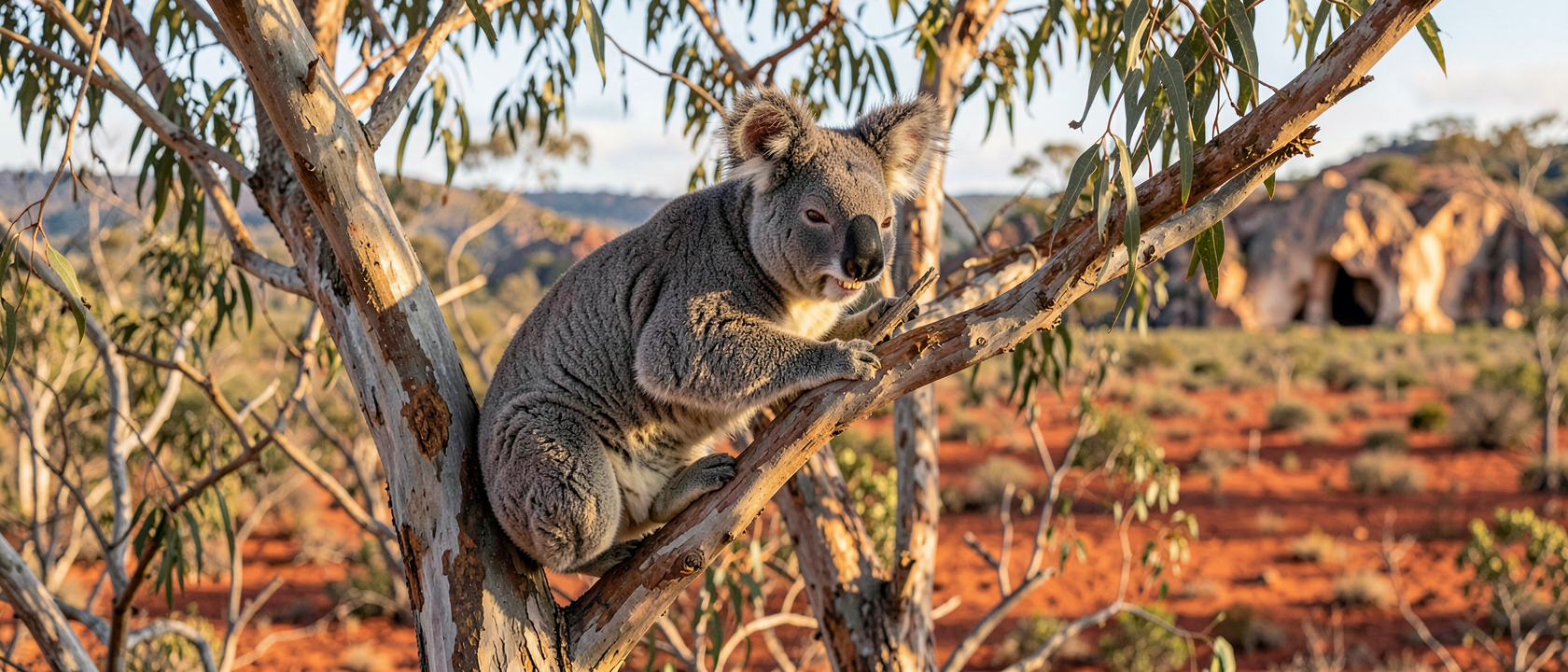
The skull that shouldn’t have fit
A koala skull with a strange dimple in its cheek turned out to belong to a species science had never named, after sitting misidentified in Western Australian collections for more than a century. In 2024, the family of caver Lindsay Hatcher, described by the museum as an avid caver, donated a skull he had pulled years earlier from Moondyne Cave, near Margaret River in southwestern Western Australia, to the Western Australian Museum. Researchers compared it against cave fossils collected since 1910, most of them just isolated jaws and teeth, and found it did not match the modern koala, Phascolarctos cinereus, on the measurements that matter. The skull, and others like it, has now been formally described as a new extinct species, Phascolarctos sulcomaxilliaris, in a paper led by Dr. Kenny Travouillon, curator of mammals at the WA Museum, published in Royal Society Open Science. The name comes from a deep sulcus, a groove, carved into the cheekbone below the eye socket, a feature no living koala has ever shown.
How they knew it wasn’t just a weird koala
One odd groove would not be enough on its own to justify a new name. The case for Phascolarctos sulcomaxilliaris rests on several traits lining up at once. Its skull was shorter and more heavily built than that of Phascolarctos cinereus, even though the animal was roughly similar in overall body size to koalas from Victoria. Its ear-bone region was shaped differently, and its teeth ran broader. Its limb bones, by contrast, were longer and thinner, pointing to a leaner build than the modern koala’s stocky frame. Researchers measured these features against the full known range of variation in living koalas, and the fossils fell outside that range on multiple independent traits, not one strange measurement. Set against a previously known extinct species, Phascolarctos yorkensis, the new koala was about 50% smaller, with more crenulation, or ridging, on its lower molars. Stacked evidence, not one dimple, is what moves a fossil from “unusual koala” to a species of its own.
What the groove might have been for
Nobody can test what that groove actually did; no soft tissue survives on any of the fossils. The study’s authors propose that the exaggerated sulcus made room for larger lip or nose muscles, the same muscles that anchor in roughly that spot in living koalas, and that this may have given Phascolarctos sulcomaxilliaris a more mobile upper lip for stripping tough leaves, or a sharper sense of smell. That is a proposed function, not a confirmed one. It is one of the two open questions this fossil leaves behind: nobody has put a number on how long or how heavy this koala actually was, either. All the study offers are comparisons, shorter, more robust, roughly the size of a Victorian koala, not a tape-measure figure.
The species’ disappearance is dated with more confidence. Uranium-thorium dating on the newest fossils and radiocarbon dating on older specimens, work carried out in part at the University of Queensland, put the extinction at around 28,000 years ago, during a major climate shift that shrank the region’s eucalyptus forests to about 5% of their current extent, according to Dr. Travouillon. With that much forest gone, Travouillon says, koalas in the region likely faced food and shelter losses severe enough to make local extinction hard to avoid.
The myth these bones just killed
For decades, the working assumption was simple: fossil koalas from Western Australia were the same species as the living koalas of eastern Australia, a population that had once ranged farther west and later disappeared. The new study overturns that. Detailed skull and tooth measurements, backed by broader comparative anatomy, show the Western Australian fossils fall consistently outside the shape range of Phascolarctos cinereus. They were a separate lineage that went extinct, not a displaced population of the living species. Fossils place that lineage from the Margaret River region north to Yanchep and east to the Roe Plain near Madura, a range where no koala has lived for tens of thousands of years; koalas are regionally extinct across Western Australia today. Phascolarctos sulcomaxilliaris is now one of four koala species known to have existed in Australia over the last few million years, alongside the living Phascolarctos cinereus and the giant Pleistocene species Phascolarctos stirtoni, nearly double the size of a modern koala. The modern koala was never the only koala. It is just the last one left standing.
Back into the cave
One caver keeps showing up in this story. Lindsay Hatcher is credited with finding both key specimens: the dimpled skull from Moondyne Cave that his family donated in 2024, and, years earlier, the near-complete skull and jaws from Foundation Cave that the study designated as the holotype, the single specimen against which a new species is formally defined, probably from a female animal. After the 2024 donation, researchers went back underground with the Western Australian Speleological Group, retracing Koala Cave, Moondyne Cave, and Foundation Cave to gather the rest of the record. A species overlooked for more than a hundred years, recognized in the end because one person kept handing skulls to a museum instead of leaving them on a ledge.