
Two Halves, Hundreds of Miles Apart
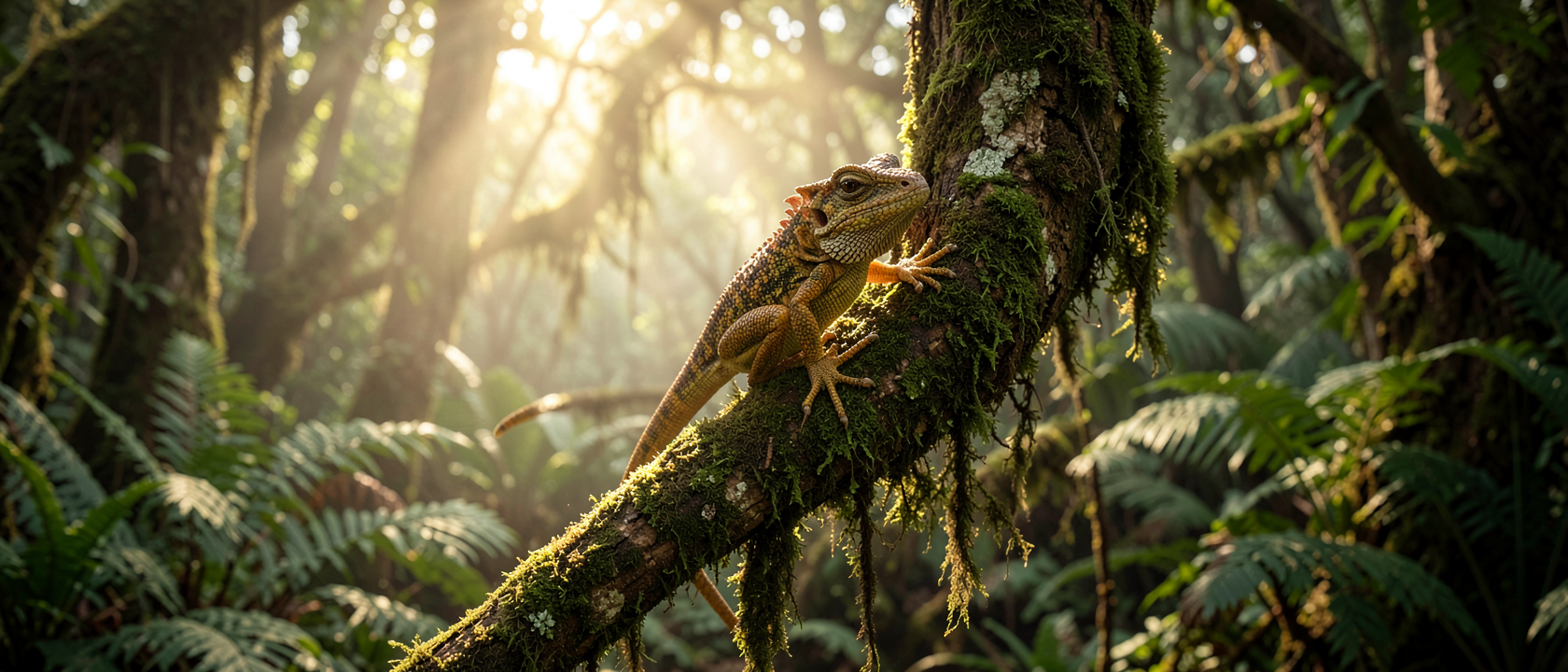
A rhynchocephalian skeleton pressed into limestone in Germany’s Solnhofen Archipelago spent decades split between two countries without anyone noticing it was one animal. One slab sat in the Senckenberg Museum in Frankfurt, cataloged as SMF R414. The other, cataloged as NHMUK PV R 2741, sat in the Natural History Museum in London, hundreds of miles away. Victor Beccari, Alexandre Guillaume, Marc Jones, Andrea Villa, Natalie Cooper, Sophie Regnault, and Oliver Rauhut rejoined the two pieces and described the animal as new to science in the Zoological Journal of the Linnean Society in July 2025. They named it Sphenodraco scandentis, a rhynchocephalian, the reptile group whose only living member today is the tuatara of New Zealand. It lived about 145 million years ago, in the same limestone beds that produced the Archaeopteryx fossils.
Reading a Reptile Through Rock
Limestone this fine preserves detail beautifully, and it also crushes it flat. Both halves of Sphenodraco had spent 145 million years pressed into rock the same shade as the bone itself. Beccari and Jones photographed the London counterslab, the matching half that carried most of the skeleton, under ultraviolet light, which makes bone fluoresce differently from the surrounding stone and reveals edges invisible to the naked eye. Once the skeleton was legible, the team measured it: limb bones long relative to the body, finger bones long relative to the hand, a body shorter than that of its closest relatives. These aren’t arbitrary numbers. They’re the same ratios already documented in living lizards known to climb and glide, and Sphenodraco’s proportions land on the climbing side of that scale, not the walking side.
The Tuatara Used to Have Cousins Everywhere
Sphenodraco scandentis is now the oldest known tree-dwelling rhynchocephalian on record. That matters because the whole lineage has been reduced to a single living species: the tuatara, Sphenodon punctatus, a ground-dweller in New Zealand often treated as a relic frozen in one lifestyle since the dinosaurs. It had already been known for decades that some Mesozoic tuatara relatives were long-bodied and aquatic. What nobody had found, according to the Natural History Museum, was one built for branches. Rhynchocephalians were once as widespread as lizards are today, and Sphenodraco shows why: 145 million years ago, this group had members on the ground, in the water, and up in the trees, an ecological spread closer to the mixed lizard faunas of a modern island than to a single unchanging body plan. The tuatara isn’t a preserved snapshot of what the whole family always looked like. It’s the one branch of a once-varied group that happened to still be here.
Studied for Decades, Filed Wrong
The Frankfurt slab of Sphenodraco sat in the literature under another name, Homoeosaurus maximiliani, for decades. Beccari’s team looked closely at the teeth and the hip bones and found that neither matched. That misfiling wasn’t an isolated slip. Many Solnhofen rhynchocephalian fossils were sorted decades ago by comparing rough limb proportions described in older papers, without the kind of detailed skeletal comparison and UV imaging that caught Sphenodraco. Beccari has said plainly that the closer you look at how these animals were classified in the past, the less well-defined the species boundaries turn out to be. None of this is a knock on the paleontologists who did that original sorting; they worked without the tools used here. But “sitting in a museum drawer for decades” and “correctly identified” are two different claims, and Sphenodraco was hiding in the gap between them. The paper’s authors suggest other Solnhofen drawers may hold the same kind of mistake.
Sold Twice, Reunited Once
Sometime in the 1930s, per the Natural History Museum, someone most likely sawed the original Sphenodraco slab in two, a known practice among fossil dealers of the era: two labeled specimens fetch more money combined than one, even when they used to be the same animal. One half went to Frankfurt. The other went to London. They sat in separate collections, under separate names, for nearly a century. In 2022, the London counterslab was reexamined and flagged as belonging to the same individual as the Frankfurt piece. The final piece fell into place when Victor Beccari, then a PhD student at the Palaeontological Museum in Munich, was working through fossil reptiles at the Natural History Museum and noticed something familiar: a skeleton that looked almost exactly like one he had already studied at the Senckenberg Museum in Frankfurt. He called it a serendipitous discovery. A dealer split one animal to sell it twice, and it took a student with a good memory for bone shapes to put it back together, nearly ninety years later.