
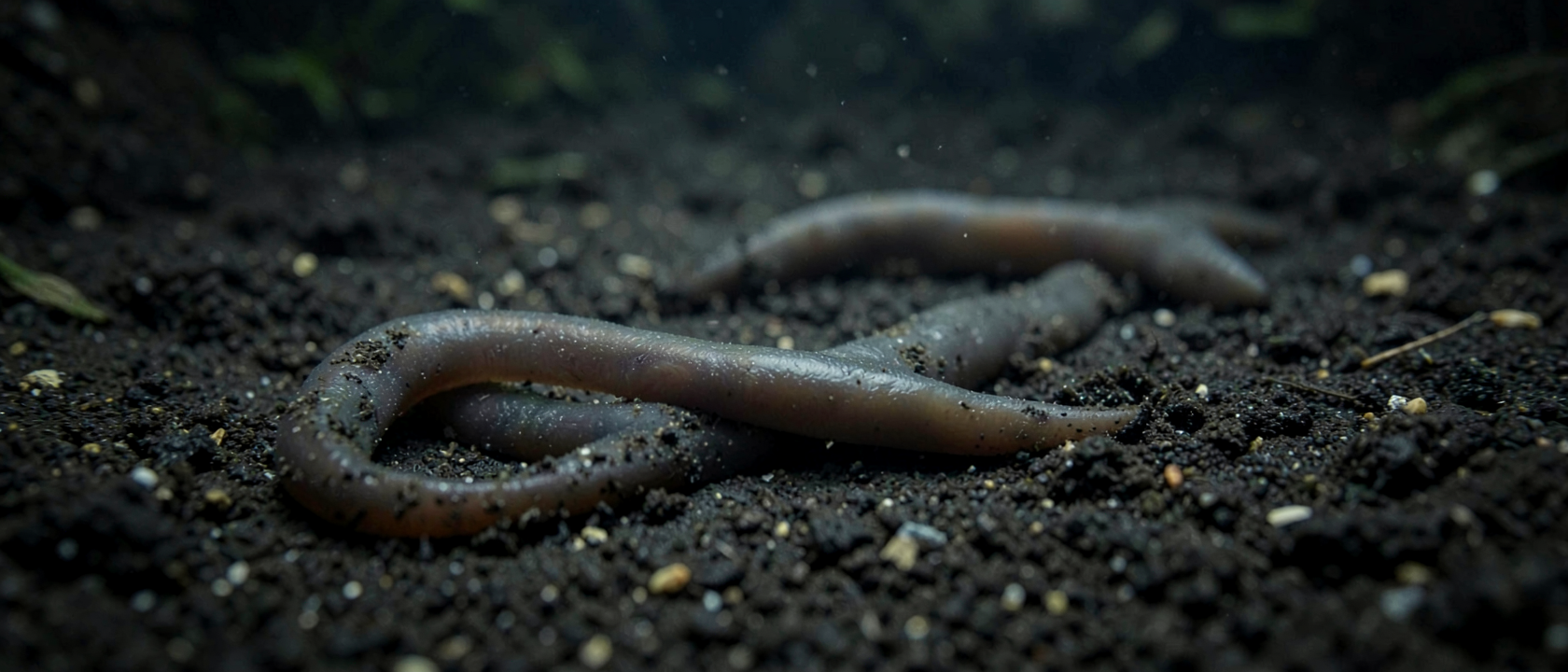
Meet B, a ribbon worm named Baseodiscus punnetti who is at least 26 years old, and probably closer to 30. That figure comes from biologist Jon Allen and colleagues, published in the Journal of Experimental Zoology. Stretched out in his tank, B measures about 3 feet (1 meter) long. He has lived that long as a single, continuously documented animal, not a number guessed from a shell or a growth ring.
The Paper Trail
B was collected as a full-grown adult from the San Juan Islands in Washington state sometime in the late 1990s, which means his actual hatch date was never recorded, only a floor under his age. Jon Allen took him in in 2005, after renovations at the University of North Carolina’s biology department left the worm without a tank. Allen simply kept him, through job changes that carried the worm from Washington to North Carolina, to Maine, to Virginia. In 2024, a former student’s suggestion led Allen to send a piece of tissue for genetic barcoding, a method that reads specific stretches of DNA to confirm exactly which species an animal belongs to. It came back as Baseodiscus punnetti, only the second individual of that species ever barcoded this way. The 26-to-30 estimate rests on that unbroken chain: a known collection point, a known adoption date, known moves, and no gap where a different worm could have quietly swapped in.
The Second Why
Ribbon worms hunt other invertebrates by ambush. They carry no shell and no bones, nothing that obviously guards against decades of wear. “Ribbon worms are an incredibly diverse and widespread phylum, yet almost nothing is known about their natural longevity,” Allen said. “This finding fills a genuine knowledge gap, increasing their known lifespan by an order of magnitude. This shifts our understanding of an entire major group of marine predators.” A worm surviving this long, with no special feeding and no special care, points toward an animal built around maintenance and repair rather than the fast-reproduce-and-die pattern usually assumed for simple invertebrates. Allen and his coauthors make the stakes explicit in the paper itself: developing real lifespan estimates for ribbon worms will help researchers judge the ecological impact of these long-lived, mud-dwelling predators on the marine food web around them.
The Record It Broke
Before B, the only ribbon worm age on record in the scientific literature belonged to an animal that lived 3 years. That number had quietly become the field’s working assumption: soft, boneless invertebrates don’t stick around. B doesn’t nudge that number, he multiplies it by roughly ten. Even the 26-to-30 figure is a floor, not a ceiling. Because he was caught as an adult, nobody knows how old he actually was on day one, and Allen has said the true upper limit for the species isn’t known at all, meaning B could be considerably older than current estimates suggest is even possible for a ribbon worm. Allen suspects B is fairly ordinary for his kind, mostly because nobody has ever given him anything beyond mud and a tank.
Nobody Was Chasing a Record
Allen wasn’t running a longevity study when he adopted B in 2005. The lab needed the tank space cleared, the worm needed somewhere to go, and that was the whole plan. For most of two decades since, B has been an annual guest star in Allen’s invertebrate zoology class, sifted out of his mud for students once a year and buried back in afterward. It took a former student, Chloe Goodsell, asking in 2024 how old the worm actually was before anyone bothered to check. Allen sent a tissue sample to Svetlana Maslakova, a ribbon worm geneticist at the Oregon Institute of Marine Biology, and that’s when the number finally surfaced. There was no grant proposal behind it, no expedition, just a tank that kept getting hauled from lab to lab, and a question someone finally thought to ask.