
A One-Minute Crawl That Takes Six
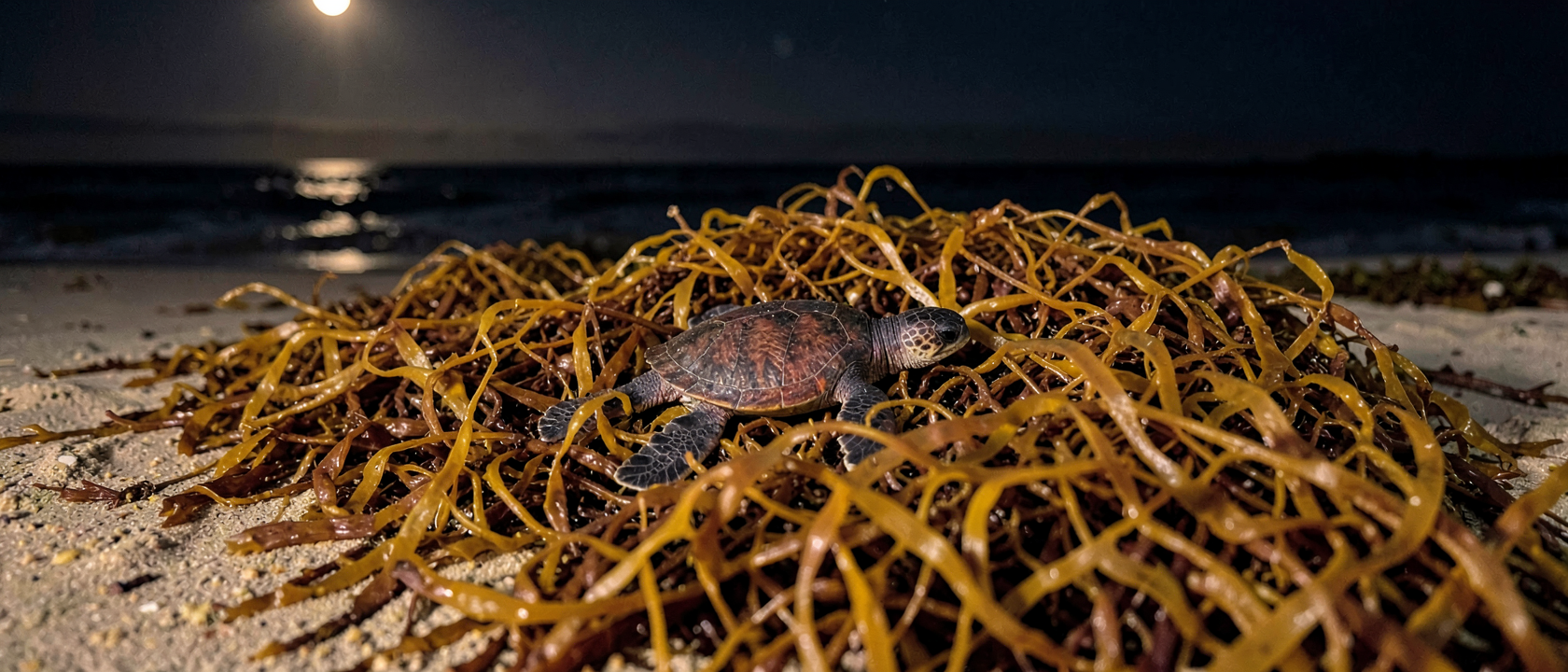
A sea turtle hatchling has one job on its first night out of the nest: get from the sand to the surf before the sun and the crabs find it. Florida Atlantic University researchers built 49-foot (15-meter) artificial crawlways on three Florida beaches, Juno Beach, Jupiter, and Boca Raton, to time that job under piles of sargassum seaweed up to 7.5 inches (19 cm) high. The study, published in the Journal of Coastal Research by Abbey M. Appelt and Sarah L. Milton of FAU’s Charles E. Schmidt College of Science, tested leatherback (Dermochelys coriacea), loggerhead (Caretta caretta), and green turtle (Chelonia mydas) hatchlings, each guided by a dim light standing in for the horizon glow they instinctively crawl toward.
Every species slowed down hard. Based on median crawl times, leatherbacks took 54% longer through light sargassum and 158% longer through heavy sargassum. Green turtles lost 75% and 159%. Loggerheads took the worst of it: 91% longer in light coverage, 175% longer in heavy. Even at the lower heights tested, 2.8 to 3.5 inches (7 to 9 cm), some hatchlings of all three species never finished the crawl within the time limit at all.
It Isn’t Fatigue. It’s Falling Over.
The obvious guess is that the seaweed just wears hatchlings out. It doesn’t. What actually eats the time is climbing: a hatchling hits the mat, tries to scale it, and topples onto its back, where a sea turtle hatchling is close to helpless until it rights itself and tries again. Researchers drew blood after the crawls and measured glucose, a rough gauge of energy spent. Across all three species, hatchlings that crawled through sargassum showed no significant glucose difference from hatchlings that crawled on clear sand. Only leatherbacks in the no-crawl control group ran noticeably higher, which suggests crawling itself, not the seaweed specifically, is what moves the needle physiologically in the short term.
In other words, the delay itself, not fatigue, is the danger.
The Real Cost Is Minutes, Not Calories
“The longer a hatchling stays on the beach, the more at risk it becomes, not just from predators like birds and crabs, but also from overheating and dehydration, especially after sunrise,” said Sarah Milton, Ph.D. the study’s senior author and chair of FAU’s Department of Biological Sciences. That reframes the whole danger. The question was never really “can this hatchling physically make it to the water.” It’s “how long is this hatchling a visible, exposed target on open sand while it makes it.” Extra minutes flipped over at the sargassum line are extra minutes for a ghost crab to notice movement, or for sun and dry sand to start working against an animal built for water.
The Smelly-Nuisance Myth
On a Florida beach, sargassum usually gets treated as a tourist-season annoyance: it smells, it piles up along the tideline, and it gets raked off before sunbathers show up. Milton also noted that piles on South Florida beaches can run over 3.3 feet (1 meter) high in summer and stretch for hundreds of yards (hundreds of meters) down the shore. That framing isn’t wrong about the smell. It’s wrong about who the pile is actually a problem for. For a beachgoer, it’s a mess to step around. For a hatchling only a few centimeters long, the same mat is a wall between the nest and the ocean, sitting across the single most dangerous stretch of its entire life.
What This Study Doesn’t Tell Us
The FAU team measured crawl time, glucose, and how often hatchlings flipped over. It did not measure survival. Nobody yet knows, from this data, how many hatchlings actually die from sargassum blockage on real beaches, or whether growing seaweed accumulation is already changing where turtles nest or how many hatchlings reach the water at a population level. Those are separate, harder studies, and they haven’t been done.
Twenty Flips, One Hatchling
During testing, one hatchling caught in a heavy sargassum pile flipped onto its back more than 20 times in a single attempt to cross. Not an average, not a statistic, just one small animal at Juno Beach, righting itself again and again against a wall of weed between it and the water it was born to reach.