
A fossil pulled from a quarry in Gloucestershire, England, in 1969 has been sitting in the Natural History Museum’s collection under someone else’s name for more than fifty years. It was cataloged as Terrestrisuchus gracilis, a small, land-dwelling Late Triassic crocodylomorph already well known from the same site. It was not Terrestrisuchus. Nobody checked closely enough to notice, until a PhD student went back through the drawers.
A filing-cabinet discovery
The specimen came out of Cromhall Quarry, also known as Slickstones Quarry, one of a set of ancient limestone fissure sites along the Bristol Channel, found by collector Ron Croucher. It went into the museum’s Terrestrisuchus tray and stayed there while Ewan Bodenham, a PhD student researching how early crocodile relatives are related to one another, worked through the collection specimen by specimen. He found that the bones did not match. The animal, now cataloged as NHMUK PV R 10002, the single physical specimen that formally defines a new species, was named Galahadosuchus jonesi, dated to around 215 million years ago. The find did not require a new excavation. It required someone to look at a fifty-seven-year-old drawer and question the label.
Thirteen differences, mostly in the wrist
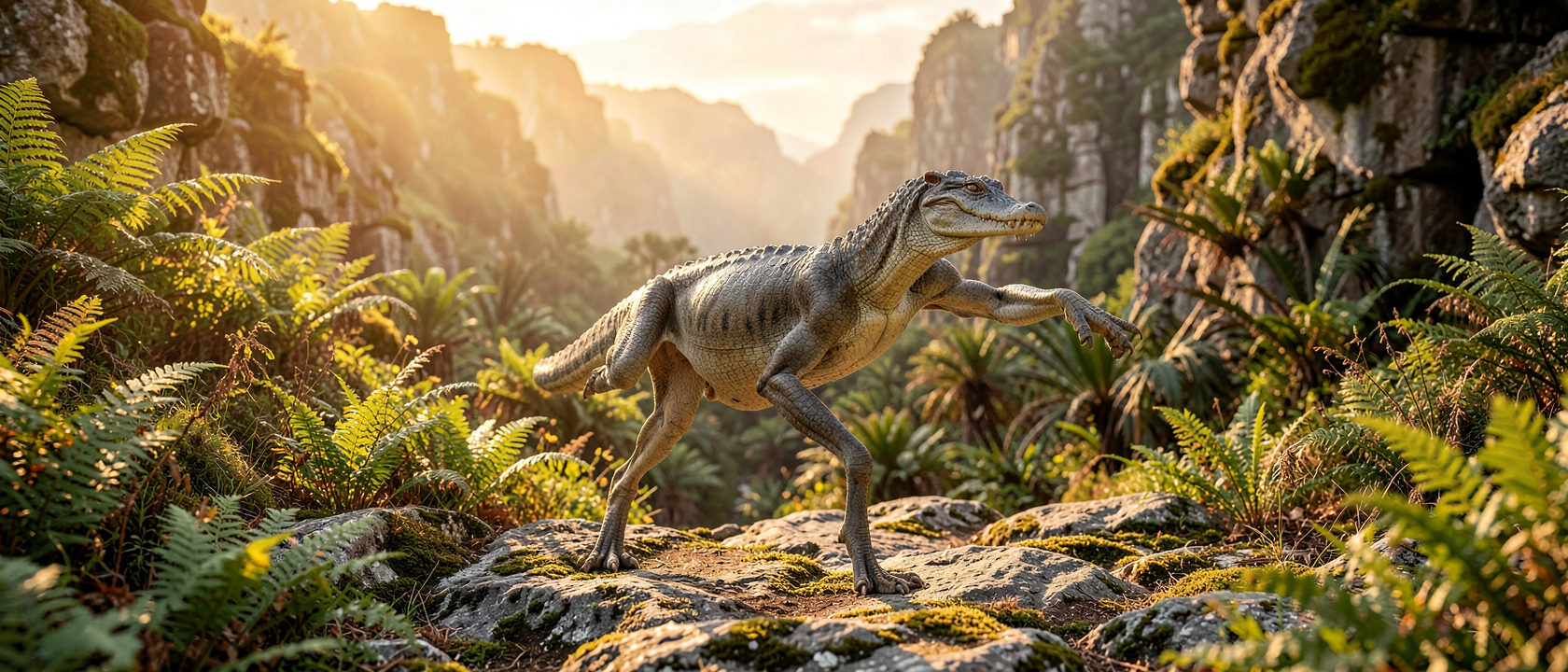
Bodenham’s case for a new species rested on thirteen distinct anatomical differences from genuine Terrestrisuchus specimens. Several of the clearest sit in the wrist: the ulnare and radiale, two small bones at the base of the forelimb, are short and stout in Galahadosuchus jonesi, where Terrestrisuchus has longer, slenderer versions of the same bones. Wrist bones are an unglamorous place to build a case for a new species, small enough to be dismissed as one animal being slightly bigger or older than another. Put together with the rest of the skeleton, though, they add up to an animal shorter and stockier overall than the leaner Terrestrisuchus, even though both share the same long, slender legs and the same upright, on-the-toes stance instead of a modern crocodile’s sideways sprawl. A femur measuring just about two and a half inches (64.4 millimeters) long puts Galahadosuchus jonesi at roughly the size of a house cat. Bodenham’s own word for the build: a reptilian greyhound.
A body built to run, not to lurk
None of that anatomy is decorative. Late Triassic southwestern Britain, per the museum’s account of the habitat, was an upland pocket surrounded by hot, arid plains, not a river delta. A crocodylomorph hunting small reptiles, amphibians, and early mammals in that country needed speed on dry ground, not the sit-and-wait ambush of a modern crocodile in water. The upright legs and the stiffened ankle joint, a configuration paleontologists call crurotarsal, are the running gear for exactly that job. The fossil’s own burial backs up the same story. It was not preserved in a riverbank the way most crocodile fossils are. It was washed into a limestone fissure cave system along the Bristol Channel sometime between roughly 230 and 200 million years ago, in sediment shared with the bones of a lizard-like reptile. The animal died on land, and water carried it underground afterward. The body and the burial both point the same direction: dry land, not water.
The picture in your head is the wrong one
“Crocodile relative” tends to summon a specific image: something low, wide, and half-submerged. Galahadosuchus jonesi breaks that image on every measurement the fossil offers. It stood upright, ran on long slender legs, lived in an arid upland, and never went near a swamp. Terrestrisuchus, the genus this specimen was filed under for decades, was also a fully terrestrial sprinter. The whole family it belongs to, Saltoposuchidae, which also includes the German species Saltoposuchus connectens, ran down prey on land long before anything resembling a modern crocodile existed.
What the fossil still can’t answer
A phylogenetic analysis of the skeleton, run under a method called Maximum Parsimony that builds family trees from shared anatomical traits, recovers Galahadosuchus jonesi as the closest relative of Terrestrisuchus, with the two clustering alongside Saltoposuchus connectens inside Saltoposuchidae. That part is settled. What is not settled is how many more species are hiding in the same fissure deposits under other animals’ names. Most fossils from these Bristol Channel sites have been lumped into Terrestrisuchus gracilis for decades, and researchers working on the group suspect that name has become a catch-all covering several genera nobody has properly split apart yet. Whether Galahadosuchus jonesi, or its wider family, has anything to say about why some crocodylomorph lineages survived the Triassic-Jurassic extinction and others didn’t is left for future work, not answered here.
The physics teacher fossilized in Latin
The genus name nods to Arthurian legend: Galahad, a knight known for standing upright and doing the right thing, a fit for an animal that walked tall on its toes instead of sprawling. The species name is personal. Jonesi honors David Rhys Jones, who taught physics to Bodenham at Ysgol Uwchradd Aberteifi in Cardigan, Wales. Bodenham has described him as a teacher who explained things clearly and was visibly excited about science himself, the kind of enthusiasm that is hard to fake and, apparently, hard to forget. Bodenham told Jones about the honor over a video call. A fossil that spent more than fifty years misfiled in a museum drawer now carries the name of a Welsh classroom nobody outside it would otherwise have heard of.