
Eight Identical Arms. Two Different Jobs.
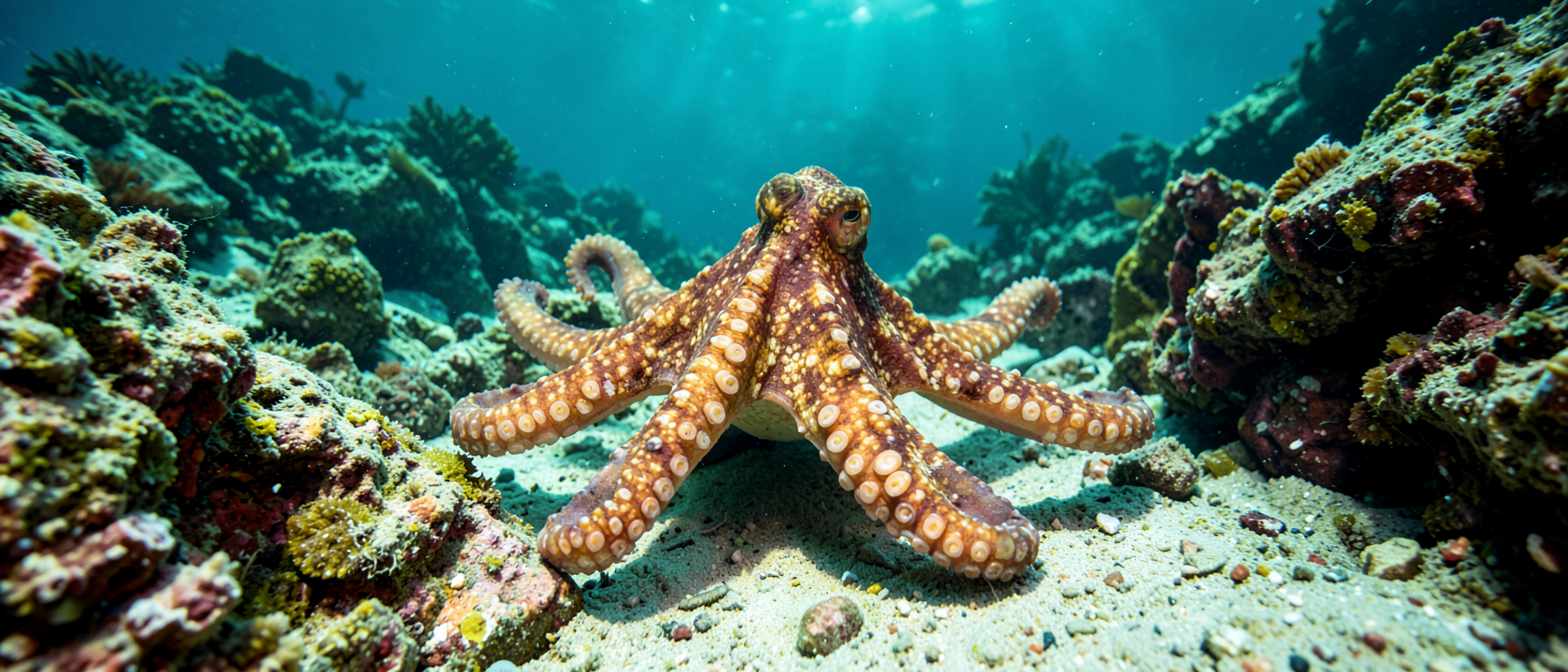
Sixty-four percent of everything a wild octopus’s arms do comes from the front four alone. The rear four cover the other 36 percent, and the two halves are doing almost entirely different jobs. Chelsea Bennice, a research fellow at Florida Atlantic University working with the Marine Biological Laboratory in Woods Hole, led a team that filmed 25 wild octopuses at five Caribbean sites and one site in Spain, all in water shallower than 33 feet (10 meters). The octopuses belonged to three closely related species, Octopus vulgaris, O. insularis, and O. americanus, often mistaken for one another and grouped as the “common octopus complex.” From the footage, filmed between 2007 and 2015 and published in 2025 in Scientific Reports, the team coded 3,907 separate arm actions. Front arms reached into crevices, tested surfaces, and handled food. Rear arms rolled the body forward like a conveyor belt or hauled it up onto a pair of makeshift stilts. “In general, we did see that for most actions the octopuses used their front arms more often than their back arms,” said Kendra Buresch, a study co-author at the Marine Biological Laboratory. The split held across all three species and every site filmed, not one dramatic clip.
Every Arm Can Do Either Job. It Just Doesn’t.
Here’s what makes that split strange. Every octopus arm carries its own dense local network of neurons, enough that an arm can act with a degree of independence from the brain, reaching and adjusting its grip on local signals alone. Front and rear arms are built the same way. The study’s own numbers make that explicit: those 3,907 actions were sorted into 12 cataloged arm actions built from four basic deformations, bend, elongate, shorten, and twist, spread across 15 distinct behaviors, and every arm proved capable of every one of them. The distal tip, the far end of the arm, away from the body, did the heaviest work, accounting for 47 percent of all recorded deformations, on front and rear arms alike. Nothing in a rear arm’s structure favors walking, and nothing in a front arm’s structure favors reaching. The division is behavioral, not built into the tissue. And when two arms need to work together, the octopus doesn’t grab whichever two are closest. It reliably pairs the matching left and right arm at the same position, front-left with front-right, rear-left with rear-right, using its own bilateral symmetry (the mirrored left-right body plan) to organize the work instead of picking at random.
This Is the Octopus Version of Hands and Feet
Bennice’s team draws the comparison to human hands and feet. Both are built from the same materials, bone, muscle, tendon, and either one could, in principle, grip an object or bear weight. People just don’t use them that way. An octopus lands on the same functional split with no anatomical head start at all: no separate limb type, no different muscle ratio front to back, nothing marked “for walking only.” Position on the body appears to do the organizing instead of the body plan itself. The comparison is loose, an arm is not a hand, but it highlights something real: the nervous system seems to assign a job by where an arm sits, not by what it happens to be built for.
Handedness Was Supposed to Need a Different Hand
In primates, rodents, and fish, a limb or side preference usually comes with a physical reason attached. A dominant hand tends to be stronger or more densely wired; a favored fin often does measurably more work than its counterpart. Octopuses break that rule twice over. They show a strong, repeatable front-versus-rear preference with no anatomical difference between front and rear arms to account for it, and at the same time show no left-or-right preference at all. Bennice’s team found arms on both sides of the body were used equally often; an octopus reaching for food was just as likely to lead with a left front arm as with its right-hand twin. Full ambidexterity stacked on top of a clean front-back split isn’t a shape any of the standard vertebrate handedness models would have predicted.
Nobody Knows Why Front and Back Exist At All
Before this study, it wasn’t even settled whether arm-favoring, well documented in primates, rodents, and fish, showed up in wild octopuses at all. Bennice’s footage answers that much: it does. What it doesn’t answer is why the split lands on front-versus-rear specifically, rather than any other arrangement, or what in the octopus’s neural organization decides that the front pair explores while the back pair walks. Not every specialist is fully sold on how the footage was coded, either. Jennifer Mather, a psychologist at the University of Lethbridge who studies octopus behavior and wasn’t part of the team, has questioned whether some of the cataloged deformations are truly distinct movements, and whether an action like tiptoeing reflects the whole arm at work or just its suckers. The front-rear split itself looks solid. Why it exists, and why it lands exactly there, stays open.