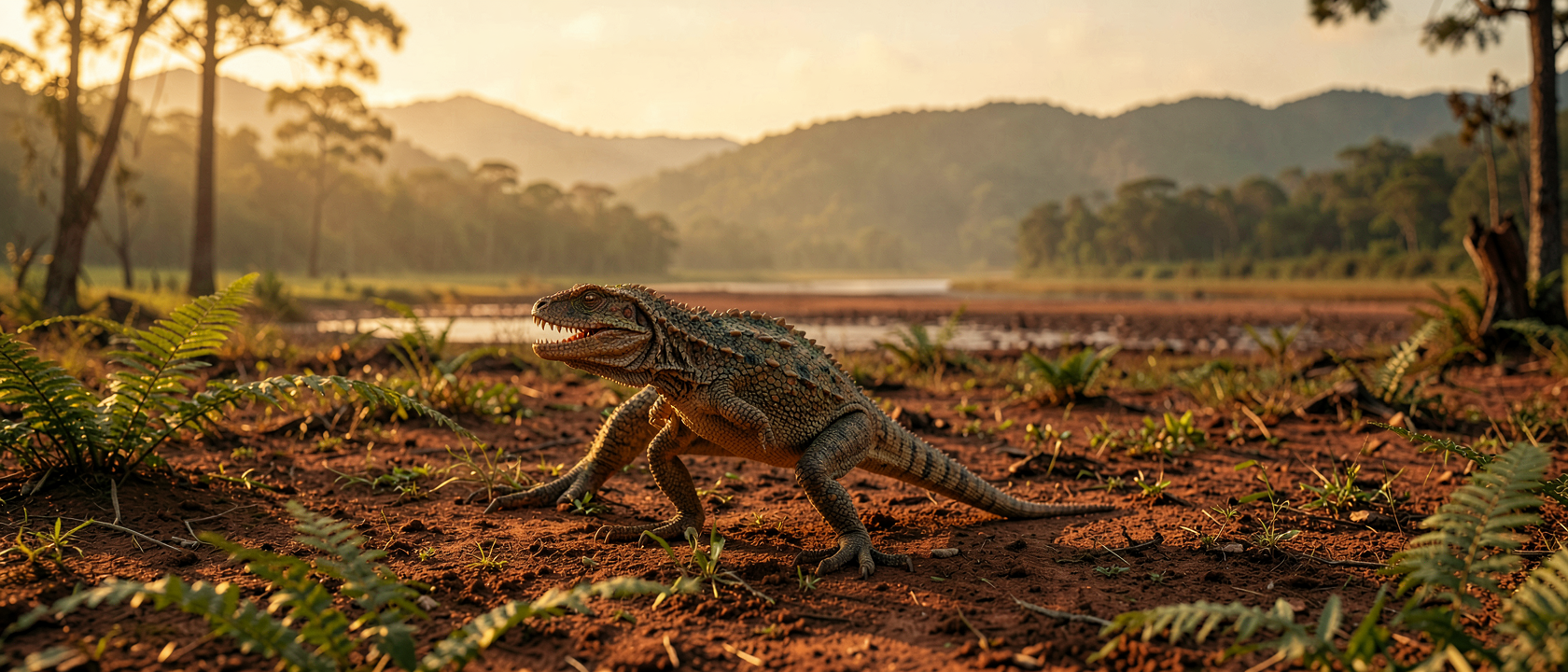
The reptile that lost its wings
Its dental spacing seemed to match a pterosaur. Its arm bone said otherwise. For more than a decade, Faxinalipterus minimus was filed away as one of the earliest known pterosaurs, a small flying reptile that shared Triassic skies with the first dinosaurs. It was described in 2010 from fragmentary bones dug out of Rio Grande do Sul, Brazil, and it kept that classification in books and phylogenies for over ten years. Then, in 2022, Kellner and colleagues published a reassessment in the journal PeerJ, working from the same fossils everyone thought they already understood, this time put under a CT scanner, a device that images the inside of an object in cross-section without cutting it open. What came out ended the pterosaur classification for good.
What the CT scan actually found
Part of the original case for Faxinalipterus as a pterosaur rested on its teeth, described as closely spaced in a way that matched known flying reptiles. The scan told a different story: many teeth had simply fallen out of the jaw during fossilization, and once the true spacing was reconstructed from the empty sockets, it matched no known pterosaur’s dental pattern. The second problem was worse. Every pterosaur that ever flew has an enlarged deltopectoral crest on its humerus, the upper arm bone, a ridge of bone that anchors the flight muscles. Faxinalipterus’s humerus barely projects one at all. No crest, no muscle attachment, no wing. A body built for flight leaves a signature in the bone, and this one simply isn’t there.
Two animals wearing one name
There was a deeper problem than tooth spacing. The original Faxinalipterus fossil, collected across two expeditions in 2002 and 2005 at the Linha São Luiz site near Faxinal do Soturno, had quietly combined bones from two different animals under one label: postcranial bones, meaning the skeleton behind the skull, from one individual, and an upper jaw with teeth from another. Kellner and colleagues separated the jaw and matched it to a newly recovered skull from the same site, one that now anchors a second, entirely new species: Maehary bonapartei, estimated at 15.7 inches (40 cm) long, known from a partial skull, mandible, scapula, and vertebral centra. Faxinalipterus, minus the borrowed jaw, comes out smaller, at roughly 11.8 inches (30 cm).
The phylogenetic analysis, a comparison of anatomical traits used to build a family tree, placed Faxinalipterus within Lagerpetidae, a group of small, running dinosaur relatives that sits alongside pterosaurs on the tree without belonging to them. Maehary bonapartei came out as the earliest-diverging, or most primitive, known member of Pterosauromorpha, the broader lineage that later produced true flying pterosaurs.
What the reclassification actually changes
The reclassification changes what paleontologists think the origin of flight looked like. Pterosaurs were the first vertebrates to fly under their own power, before birds existed and long before bats. Finding a wingless, ground-bound relative sitting right at the branching point where that lineage begins says something about how flight got built: not starting in the air, but modifying a body plan that started out walking. Faxinalipterus and Maehary are now the closest look paleontologists have at what a pterosaur’s ancestors looked like before any of them left the ground. They are not failed fliers. They are the raw material flight was eventually built from. And that is the part worth carrying to dinner: the animal everyone assumed had wings turns out to be more interesting for never having had them.
The myth this kills
For over ten years, Faxinalipterus minimus was printed as one of the earliest pterosaurs, cited in books and phylogenies alongside actual winged reptiles. Kellner and colleagues’ 2022 reassessment found no anatomical support for that at all: neither Faxinalipterus nor Maehary carries the skeletal signature of flight, and both are closer kin to running lagerpetids than to anything that ever left the ground on its own wings. That placement is the describing team’s own reading of the evidence; a later summary of the genus has instead grouped Maehary with a different archosaur family entirely, a disagreement the field has not settled yet.
“Who looks at the sky”
The genus name Maehary comes from a Guarani-Kaiowá phrase meaning “who looks at the sky,” chosen by the describing team as a nod to where the animal sits on the family tree: not a flier itself, but standing at the root of the lineage that would eventually produce one. The species name, bonapartei, honors Argentine paleontologist José Fernando Bonaparte (1928–2020), who worked on Triassic fossils in the same part of Brazil. Maehary never got off the ground. It just happened to be standing at the start of the road that led there.