One Mouse, Fifty-Eight Generations
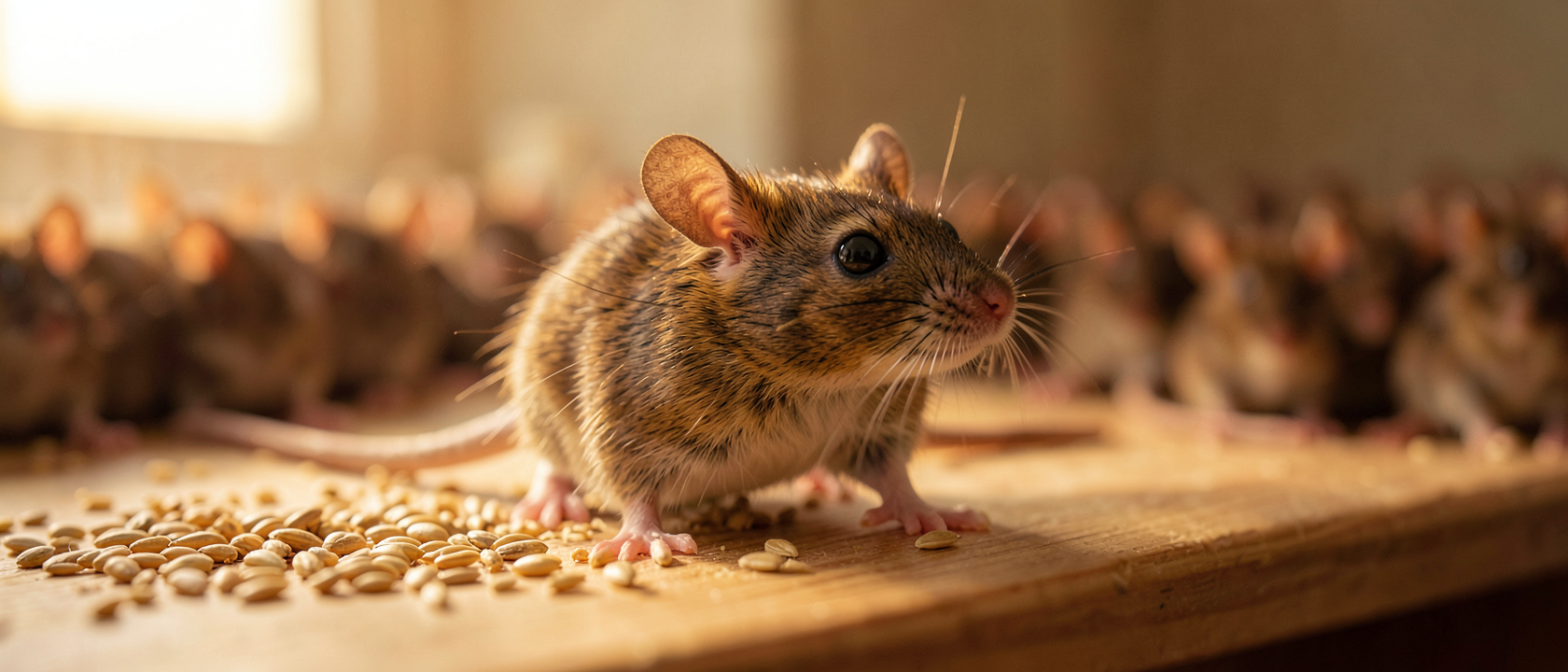
One house mouse (Mus musculus) is the ancestor of more than 1,200 clones spread across 58 generations of copies made from copies, a lineage Teruhiko Wakayama’s team at the University of Yamanashi has kept running for two decades. The animals are visually unremarkable: a laboratory line called BDF1, every clone female, every clone brown-furred, all of them housed at the university’s Advanced Biotechnology Center. What is remarkable is the paperwork behind them. To get those 1,200 live mice, the team attempted somatic cell nuclear transfer, the cloning technique, more than 30,000 times. And the success rate never held steady. It started strong, held up for a while, then began sliding after the 27th generation. By generations 57 and 58, only 0.6% of transferred cloned embryos became a live mouse, a steep collapse inside one continuous lineage, using the same method from start to finish.
Copying a Copy of a Copy
Somatic cell nuclear transfer takes the nucleus, the part of a cell that holds its full genetic code, out of a donor’s body cell and drops it into an egg cell that has had its own nucleus removed. The egg develops into an embryo genetically identical to the donor, not to whoever happens to carry the pregnancy. It’s the same technique that produced Dolly the sheep (Ovis aries) in 1996, and Wakayama’s team used it on the original mouse in 2005 to start this lineage. Here’s the detail that matters: each new clone in the study was made from a cell taken from the previous clone, not from that founding mouse. Generation 58 is not a fresh copy of the 2005 original. It’s a copy of a copy, 58 layers deep. Wakayama’s team, in a study titled “Limitations of Serial Cloning in Mammals” published in Nature Communications in 2026, reports that genome sequencing across the lineage found harmful mutations building up with each cloning round, a photocopy losing sharpness with every extra pass. Somatic cell nuclear transfer didn’t get worse at its job. The genetic material fed into it, generation after generation, did.
Sex Does Something Cloning Can’t
Sequencing across the lineage found the cloned mice carried roughly three times more mutations than mice born through ordinary mating. Some late-generation clones were also missing a copy of an X chromosome and had unusually large placentas. One detail in the study sharpens the point: when clones from generation 57, well into the decline, were mated with ordinary male mice instead of being re-cloned again, their pups were healthy and carried fewer mutations than their cloned parents. Sex undid, in a single generation, what 57 rounds of cloning had been slowly breaking. That’s the second why here. Sexual reproduction mixes genetic material from two parents and lets selection quietly weed out the worst combinations before birth. Serial cloning skips that process entirely; it just hands the same, increasingly damaged script to the next copy. Wakayama’s team frames this as support for Muller’s ratchet, a long-standing prediction that asexual lineages accumulate harmful mutations with no way to reverse course, eventually heading toward collapse.
The Photocopy-Machine Myth
Wakayama’s own team once believed serial cloning could continue without limit, since the earliest generations showed the success rate holding steady or even ticking up slightly. In earlier work using a chemical additive called a histone deacetylase inhibitor, published in Cell Stem Cell in 2013, cloning efficiency held steady across 25 generations and produced more than 500 viable mice from a single original donor. That result fed a wider assumption: a clone as a genetic photocopy, same DNA in, same DNA out, generation after generation, with no reason it should ever stop. The 58-generation lineage says otherwise. “We had believed that we could create an infinite number of clones,” Wakayama told AFP once the results were in. “That is why these results are so disappointing.” A clone isn’t a freeze-frame of the donor’s genome. It’s a genome that starts eroding the moment it’s copied, and every re-cloning event pushes it a little further along.
What Nobody Can Untangle Yet
Two questions sit underneath the collapse, and the study doesn’t settle either one. Is the mutation buildup simply what happens when sexual reproduction’s repair mechanism is removed, or does cloning itself, the stress of reprogramming a donor nucleus inside a stripped egg, actively add damage? Both are plausible, and the current data can’t cleanly separate them. There’s also the ending itself: every mouse in generation 58 died shortly after birth, with no visible abnormalities in the pups and, in Wakayama’s own words, an unknown cause of death. Nobody has pinned down how many harmful mutations a mouse genome can absorb before another cloning round simply fails. The ceiling is real, the numbers show it, but where it sits and why remains unmapped. Asked how to get past it, Wakayama said his team has no idea, and suggested only that a better cloning method might be the answer.
A Ferret, Dead Thirty Years, Cloned Anyway
Cloning has already moved out of the lab and into conservation work, at a far smaller scale than 1,200 mice. Scientists have cloned a black-footed ferret (Mustela nigripes) using genetic material preserved from an individual that had been dead for roughly 30 years, aiming to reintroduce genetic diversity long lost from the wild population. It’s one animal, one project, not proof that serial cloning scales, and not a way around the ceiling the Yamanashi mice spent two decades finding. But it shows where the technology is actually being pointed, while labs like Wakayama’s are still working out, mouse by mouse and generation by generation, exactly how far a copy of a copy can go before it stops being viable at all.