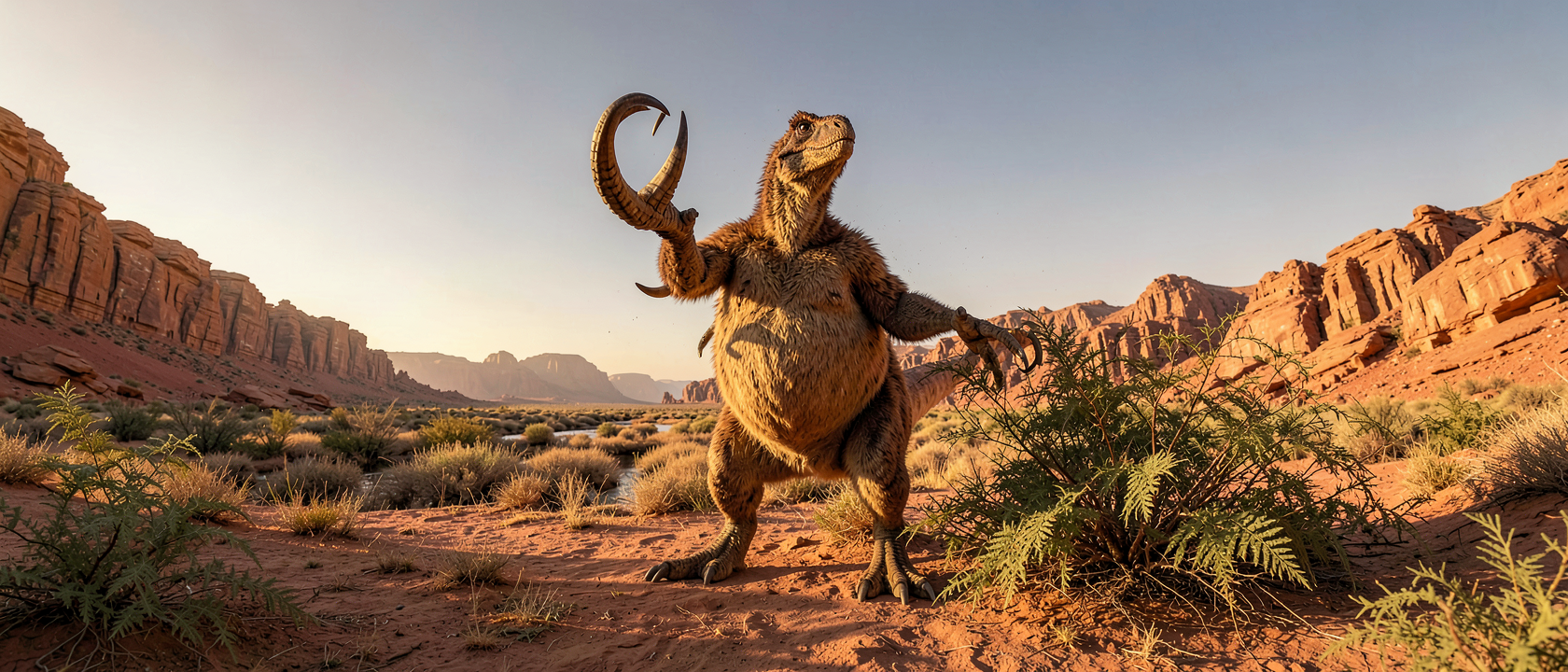
A dinosaur pulled from the Gobi Desert in Mongolia had two fingers on each hand, not the three that every other known member of its family had, and each finger carried a claw close to a foot long, sheath, bone, and all, still fossilized together.
One Fossil, Two Fingers
In 2012, a team from the Mongolian Academy of Sciences dug a partial skeleton out of the Bayanshiree Formation, a stretch of Late Cretaceous rock in the Gobi Desert of southeastern Mongolia. The bones sat unstudied for over a decade until a team led by Yoshitsugu Kobayashi of the Hokkaido University Museum formally described them in the journal iScience on March 25, 2025, naming a new species: Duonychus tsogtbaatari. The genus name pairs the Latin duo, “two,” with the Greek onyx, “claw.” The species name honors Mongolian paleontologist Khishigjav Tsogtbaatar.
What the team recovered was partial: some vertebrae, part of the pelvis, ribs, part of one shoulder blade, and most of an arm and hand. Uranium-lead dating of the surrounding mineral layers, a technique that estimates a rock’s age from radioactive decay, puts the fossil at roughly 90 to 95 million years old. The animal itself wasn’t even full-grown; the researchers identified it as a subadult, built at around 260 kilograms and roughly 3 meters (10 feet) long.
Every therizinosaur known before this one, a group of pot-bellied, long-necked, feathered theropods, or two-legged dinosaurs, that gave up hunting for foliage, had three fingers on each hand. This one had two.
The Claw Under the Claw
The bony core of each claw measures nearly 12 inches (30 cm) long, but bone was never the whole claw. Keratin, the same protein behind fingernails and bird beaks, almost never survives tens of millions of years underground; it usually rots away long before the bone beneath it finishes fossilizing. On this specimen, it didn’t. A sheath of fossilized keratin was still wrapped around the bony core when the fossil came out of the ground.
That sheath added more than 40 percent to the claw’s length beyond the bony core alone, according to the study. Co-author Darla Zelenitsky of the University of Calgary has called it, by far, the largest three-dimensional dinosaur claw ever recovered fully intact. “These were big, sharp and nasty claws,” she said. Bone alone tells a paleontologist only the claw’s minimum size; the keratin showed them how much longer, and how much more sharply curved, the working claw really was.
The fingers weren’t fixed spikes, either. The team found each one had roughly 90 degrees of rotational movement, a hinge built to curl closed rather than a rigid hook frozen in one position.
What the Hook Was For
The researchers propose the curved, mobile claws worked as grasping hooks, similar in function, though not in ancestry, to a sloth’s claw or a chameleon’s, used to snag a branch or stem and pull it toward the mouth. That idea is consistent with, though not proven by, everything else known about Duonychus tsogtbaatari: a plant-heavy diet, a long neck built for reaching into foliage, and small, leaf-shaped teeth suited to shredding vegetation rather than tearing flesh.
The paper describes this as the best-supported explanation, not a settled one. Display, defense, courtship, even play haven’t been ruled out. A hand this unusual may have earned its keep more than one way.
The Three-Fingered Rule, Broken
Three fingers per hand was close to a defining trait of therizinosaurs as a group, a textbook feature rather than a quirk of preservation. Duonychus tsogtbaatari is the first confirmed exception on record: a therizinosaur with only two.
Zoom out across every known theropod, including Tyrannosaurus rex, and losing a finger turns out to be rare and scattered rather than a trend. Only five lineages are known to have independently reduced their finger count over their evolutionary history. Duonychus tsogtbaatari is the first case documented within therizinosaurs specifically, a new entry on that short list rather than a repeat of one already known.
One Specimen, Many Questions
Why this particular species, out of every known therizinosaur, ended up with two fingers instead of three is not known. Whether the claws’ primary job really was hooking vegetation, or something else the study can’t currently rule out, is also unresolved.
The reason is straightforward: there is exactly one Duonychus tsogtbaatari fossil in existence. No second skeleton to compare it against, no wear patterns across multiple individuals, no way yet to track how the hand changed as the animal grew. Kobayashi has described the moment of realizing what he was looking at as a rush of excitement, “am I actually looking at something completely new here?” Until another specimen turns up in the Gobi Desert, the question of why this hand exists the way it does stays open.