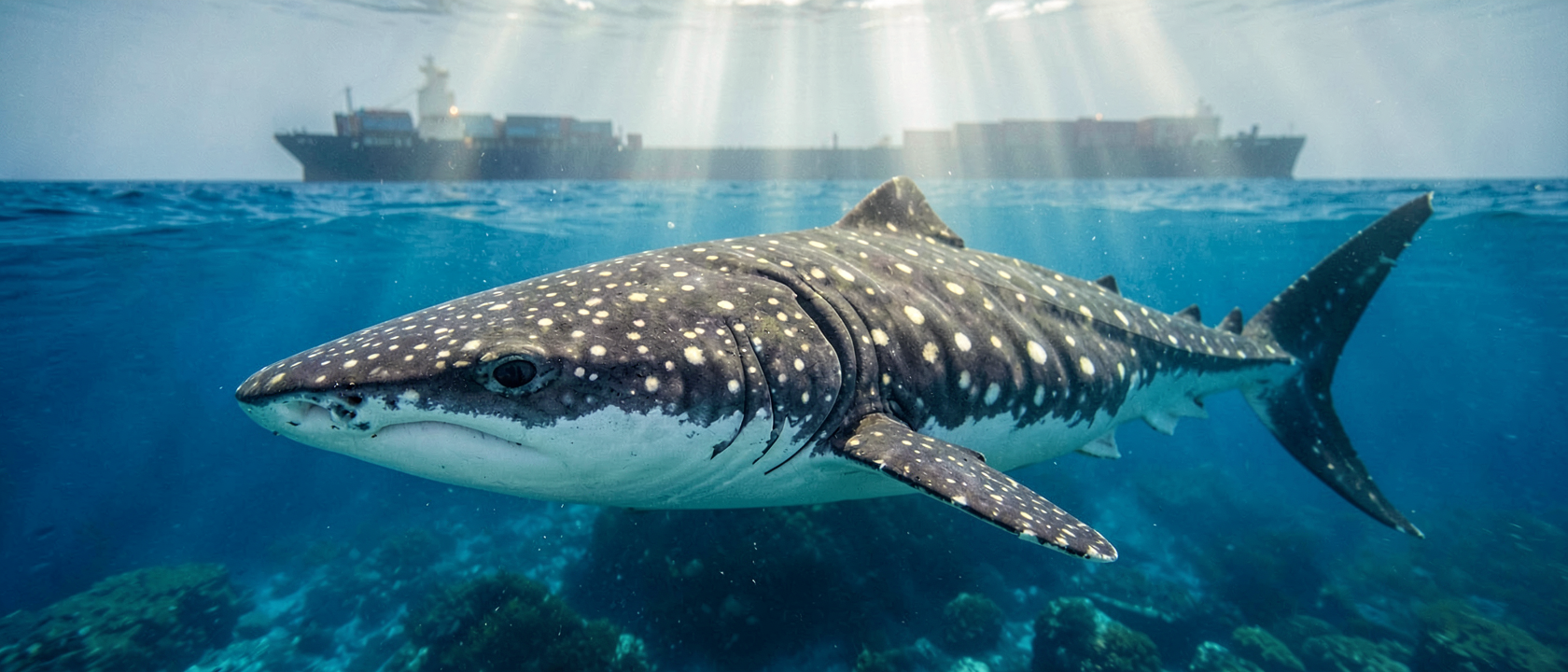
15,000 Times More Likely to Die, and There Won’t Be a Single Extra Ship
By 2100, a free-ranging whale shark (Rhincodon typus) could be up to 15,000 times more likely to be struck and killed by a vessel than it is now. The shipping fleet is not growing by a factor of 15,000. That multiplier comes entirely from where the sharks are going to end up.
Dr. Freya Womersley and Professor David Sims at the University of Southampton published those projections in Nature Climate Change in October 2024. Their model drew on 15 years of satellite-tracking data from approximately 350 wild whale sharks across the Indian, Pacific, and Atlantic Oceans, combined with ocean temperature projections under three emissions scenarios. Under the worst of those three, modeled co-occurrence between whale sharks and large vessels rises by up to 15,000 times by 2100. Even the low-emissions scenario produces a 20-fold increase. On the north Pacific coast of the United States specifically, the model projects a 95-fold increase.
A Filter-Feeder at the Surface Is Already Halfway Into a Hull
Rhincodon typus is a surface filter feeder: it cruises near the waterline with its wide mouth open, drawing in plankton-rich water through 10 filter pads. An adult whale shark averages approximately 31.8 feet (9.7 m) in length and around 9.9 short tons (9 t) in mass, with a considerable proportion of that bulk sitting directly in the zone swept by the hull of any large commercial vessel. That surface posture is not a behavioral choice the animal can revise. It is how Rhincodon typus eats.
As ocean surface temperatures rise, the warm equatorial belt that defines suitable whale shark habitat becomes progressively less hospitable. Womersley and Sims modeled how their 350 satellite-tagged individuals are expected to track that retreating envelope toward higher, cooler latitudes, which host the world’s major commercial ports and densest shipping corridors. The analysis flags the western coast of the United States and the coast of Sierra Leone as particular emerging collision hotspots. The animal’s feeding posture makes it structurally exposed to strike; losing its current home directs it into exactly the geography where strike density is highest.
60% of Countries Lose Half Their Sharks, and the New Habitat Is a Shipping Lane
Under a high-emissions scenario, nearly 60% of countries will lose more than half of their current whale shark habitat by 2100. In the eastern Pacific alone, up to approximately 1.93 million square miles (5 million km²) of suitable habitat is projected to disappear, an area larger than the entire European Union.
New habitat does form in the model: a band of suitable ocean stretching across the Atlantic from the northern tip of South America to Angola. The problem is what occupies that band already, some of the busiest shipping routes in the Atlantic basin. Whale sharks are not trading one patch of ocean for a comparable one. They are trading habitat with relatively low vessel-traffic density for habitat with substantially higher exposure, while simultaneously losing the space they currently occupy.
The Womersley and Sims figures were calculated against current shipping levels held constant. Professor Sims noted that co-occurrence rises under all modeled scenarios even on that conservative assumption, setting aside the projected expansion of global shipping capacity by up to 1,200% by 2050, cited in the study. The 15,000-fold and 20-fold figures are floors.
The “They’ll Recover If We Stop Fishing Them” Assumption Just Got Complicated
Whale sharks are listed as Endangered on the IUCN Red List. The Indo-Pacific subpopulation has declined by approximately 63% over 75 years; the Atlantic subpopulation by more than 30% over the same window. Conservation planning has centered on fishing bycatch, unsustainable tourism, and pollution, with some estimates cited in the Womersley and Sims paper putting a plausible recovery timeline at around 100 years, provided bycatch could be controlled.
What those models did not include was ship-strike risk as a quantified, escalating threat. By tracking 350 actual individuals over 15 years and projecting their likely future positions against real shipping-traffic data, Womersley and Sims have introduced a mortality driver that is newly measured and projected to intensify under every emissions scenario. Controlling fishing bycatch remains necessary. Projecting species recovery on that basis alone is no longer a complete picture.
A Small Adjustment That Could Matter Enormously
The study does not leave the problem without a lever. Reducing ship speeds by up to 75% in key whale shark hotspot zones is proposed as a mitigation measure, and prior research cited in the paper puts the cost of that reduction at roughly 5% added journey time per vessel. That is a striking asymmetry: a modest scheduling inconvenience on one side, a dramatically lower collision probability on the other. Designating major aggregation sites as vessel exclusion zones at peak times is also proposed, consistent with recommendations already on the table under the Convention on Migratory Species.
We Can Only Track the Sharks We’ve Found. We’ve Found About 25 Spots.
The 350 satellite-tagged whale sharks underpinning the model represent the largest dataset ever assembled for this species, and a fraction of the total population, whose actual size cannot be stated with confidence. Approximately 25 aggregation sites have been identified globally. Breeding grounds have never been located, and whale shark reproduction has never been directly observed in the wild, despite the species carrying more than 300 embryos simultaneously, as confirmed from the only pregnant female on record.
Every gap in what is known about Rhincodon typus is also a gap in the risk model. The sharks science cannot currently locate are absent from every current calculation. The 15,000-fold figure applies to the animals that have been tracked. For the ones nobody is watching, the question of how dangerous the future actually is remains genuinely open.