The Animal That Rests at Peak Hour
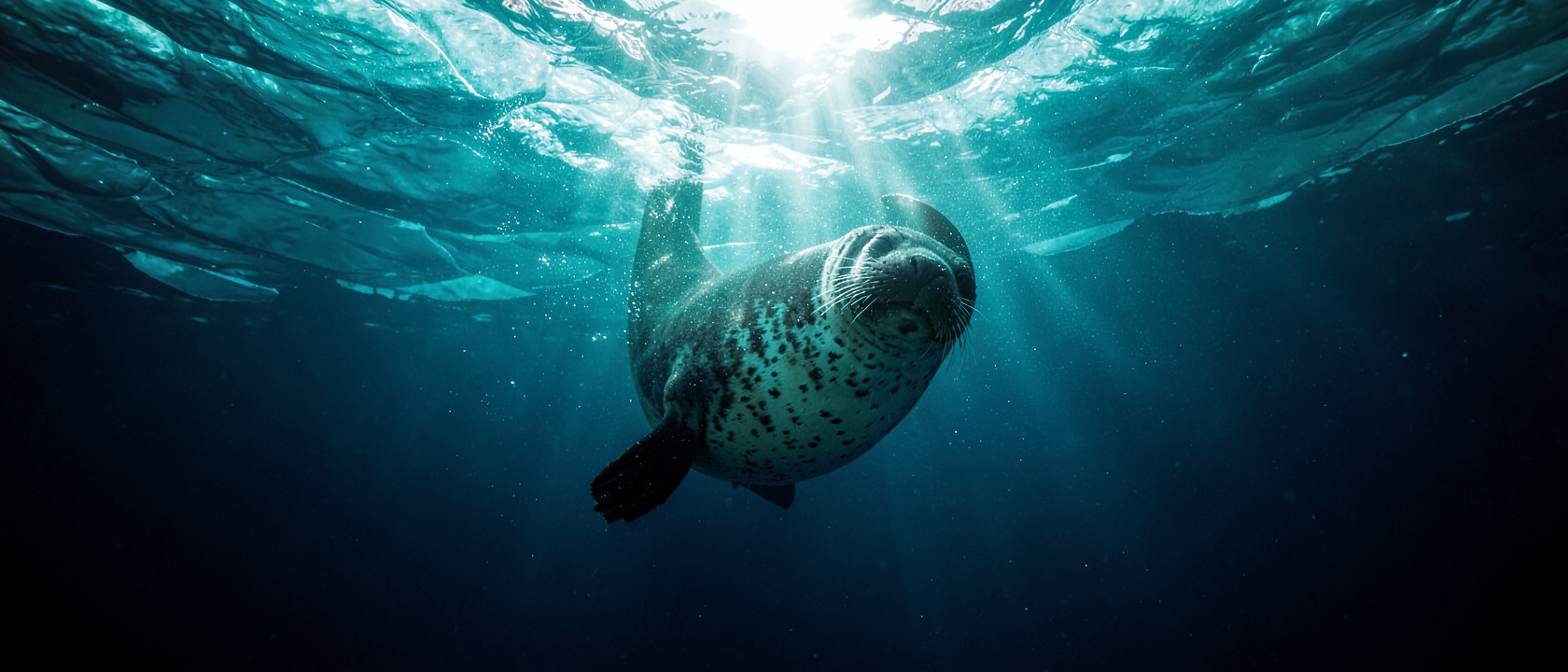
A Weddell seal (Leptonychotes weddellii) can hold its breath for 96 minutes and reach depths exceeding 2,952 feet (900 meters), and it systematically avoids deploying those capabilities when hunting conditions are best. A 2024 study in Communications Biology, led by Michelle Shero at Woods Hole Oceanographic Institution with co-authors Daniel Costa (UC Santa Cruz), Jennifer Burns (Texas Tech University), and Kimberly Goetz (NOAA Marine Mammal Laboratory), tracked 59 adult seals at Erebus Bay in Antarctica’s western Ross Sea across 8,913 seal-days and 281,268 dives. The pattern was consistent enough to look like deliberate policy: the seals’ deepest, longest dives clustered before solar noon, not at the midday window when Antarctic light peaks and prey should, in principle, be most accessible to a visual hunter.
The Recovery Tax
Weddell seals have a calculated aerobic dive limit, or cADL: the threshold beyond which a dive burns oxygen faster than blood and muscle stores can supply it cleanly. For the 54 seals in the Shero et al. dataset for which this was measured, the mean cADL was 19.1 minutes. A 96-minute dive is five times that figure. Any dive that far exceeds the cADL forces a mandatory surface recovery period; lactate clears, oxygen stores refill, and the animal cannot efficiently submerge again until that debt is settled.
The scheduling logic follows directly. A seal making its deepest dives at midday simultaneously commits to a recovery interval running through its best foraging window. By front-loading extreme dives in the pre-noon hours, the seal arrives at peak light already recovered, free to run rapid, shallow dives with minimal surface time. Shero and colleagues interpret the pattern as a physiological accounting decision: schedule costly dives away from the hours their recovery would hurt most.
Why Midday Isn’t Actually About Depth
When Antarctic light is strongest, many prey species sink deeper to escape visual predators. Chasing prey to depth at that moment is, as the data suggest, not the optimal play. Peak light rewards rapid, repeated foraging at shallower depths, where illumination does part of the detection work. Shero et al. found that overall dive effort, measured as depth, duration, and how far seals pushed past their physiological limits, peaked around solar noon, driven by the accumulation of those fast, shallower dives.
The strategy is doubly rational. Extreme dives happen before noon because their recovery cost is too high to absorb during the best hunting hours. Shallow dives happen at noon because light makes them productive. Neither half of the schedule is a fallback; each is calibrated to what conditions actually offer.
The Clock That Ignores the Sky
The Shero et al. dataset covered the full spectrum of Antarctic light: perpetual daylight during the austral summer, alternating light and dark during transitional seasons, and continuous polar night in winter. The pre-noon clustering of extreme dives was sharpest during light-dark cycling periods. Rhythmicity weakened during polar day and polar night but did not disappear; the scheduling pattern persisted across weeks of continuous light and continuous darkness alike.
Shero and colleagues interpret this as evidence of a robust internal clock that keeps driving foraging timing even when the sky provides no usable day-night signal. How that circadian rhythm stays calibrated through perpetual light or darkness is, as the paper explicitly states, not resolved by this research. Most simple models of biological clocks predict that removing the light-dark cycle would suppress or randomize the rhythm. In the 59 Weddell seals of Erebus Bay, it does not.
What the Hauled-Out Seal Is Actually Doing
Two assumptions die clearly in the Shero et al. data. The first is the intuitive predator model: a visual hunter should make its deepest dives at peak light. The 8,913-seal-day dataset contradicts this directly. The second is the image of the Weddell seal as Antarctica’s champion idler. What the data reveal is that a seal hauled out at mid-morning is not resting from exhaustion; it is clearing a lactate debt on what Shero et al. frame as a physiologically deliberate schedule, recovering from pre-noon extreme dives to be ready for a foraging window it has already planned around. The Weddell seal on the ice is an athlete in a scheduled recovery interval, not a sleeper.
What Nobody Knows Yet
The Shero et al. study documents the pattern and proposes the mechanism, but leaves three questions open. Whether this scheduling behavior is innate or acquired is not addressed; the data describe what the seals do, not how they came to do it. Whether juvenile Weddell seals run the same program is unresolved, as all 59 animals were adults. And the mechanism by which circadian rhythms remain functional through continuous polar day or polar night is, as the paper states, unexplained.
Goetz flagged emperor penguins (Aptenodytes forsteri) as a strong candidate for analogous scheduling behavior: similarly extreme divers, similarly extreme light environment, similarly untested. The Weddell seal’s pre-noon front-loading may turn out to be a solution evolution landed on more than once in the same ocean.