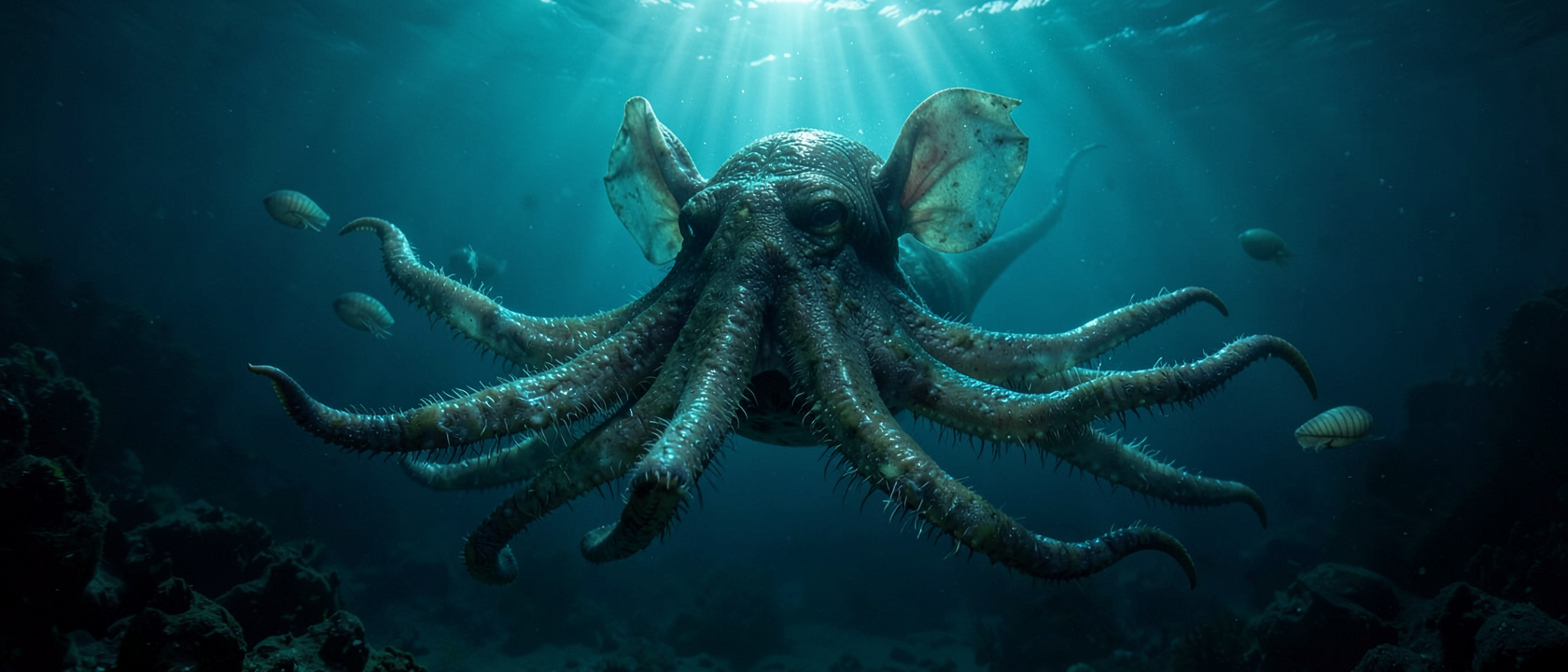
Nineteen Metres of Octopus
A 2026 paper in Science by Ikegami et al. places Nanaimoteuthis haggarti at up to 61 ft (18.6 m) in total body length, longer than Mosasaurus hoffmannii, roughly 59 ft (18 m), which has occupied the apex of Cretaceous ocean reconstructions for decades. N. haggarti was a cirrate octopus, the finned branch of the order, with two ear-like fins on the head and comb-like filaments alongside each sucker. It lived in circum-North Pacific seas between about 86 and 72 million years ago.
That upper figure is the high end of a range. The paper places total body length for N. haggarti at 22–61 ft (6.6–18.6 m). Its smaller relative, Nanaimoteuthis jeletzkyi, first appearing around 100 million years ago, is estimated at 9–25 ft (2.8–7.7 m). Both had previously been classified as vampire squid, a different and considerably smaller order of cephalopod.
The Jaw-to-Body Equation
The only physical evidence for either species is fossilized lower jaws. Ikegami and colleagues analyzed 27 specimens: 15 previously catalogued from rock formations on Vancouver Island, Canada, and 12 newly identified from sediment samples in Hokkaido, Japan, using an AI-assisted detection. No soft tissue, no arms, no fins.
Size estimates came from allometric relationships measured in living long-bodied cirrate octopuses, in which total body length averages approximately 4.2 times the mantle length. The largest recovered N. haggarti beak has a hood length of 3.4 in (86.4 mm), roughly 1.5 times the hood length of the largest known giant squid jaw; the N. jeletzkyi jaw measures 1.6 in (39.6 mm).
The assumption is that Nanaimoteuthis shared body proportions with its living cirrate relatives. A technical comment published in Science in May 2026, led by Paxton and colleagues, argued the true size likely sits closer to the lower end of the range, citing difficulties in scaling cephalopod body size from beak dimensions and the patchy data available for deep-water cirrate octopuses. Christian Klug of Zürich was among the external researchers raising similar concerns. Ikegami et al. responded in June 2026 that their dataset does not support that critique. The range stands as the paper’s conclusion; where within it the animal actually sat remains contested.
Jaw wear patterns add behavioral detail. Adult specimens show chipping and cracking consistent with crushing hard prey; juvenile specimens show less of it. The authors interpret adult wear as evidence of a diet including hard-shelled ammonites and bony fish. They also note asymmetric wear, which they propose reflects lateralized feeding behavior, a preferred crushing side, pointing toward more advanced cognitive organization than a simple predator might require.
Size as a Survival Tool
Zoe Hughes, senior curator of fossil cephalopods at the Natural History Museum, draws a direct comparison: modern giant squid (Architeuthis dux) are large enough to actively resist sperm whale attacks. At sufficient scale, an invertebrate stops being a component of a food web and starts being a structural feature of it. N. haggarti at 22–61 ft shared the water with Mosasaurus hoffmannii, with plesiosaurs such as Elasmosaurus exceeding 33 ft (10 m), and with large ammonites including Parapuzosia seppenradensis, whose shells reached up to 6.6 ft (2 m) in diameter.
Whether N. haggarti actively preyed on marine reptiles is not confirmed. The jaw-wear evidence supports hard-prey crushing but does not extend to vertebrate predation. Hughes describes that possibility as physically plausible but unconfirmed. What size alone establishes is that N. haggarti occupied an ecological position no previous reading of the Cretaceous fossil record had assigned to an invertebrate.
The Vertebrate Monopoly Was Always a Fossil Bias
Standard reconstructions of Cretaceous marine food webs place mosasaurs, plesiosaurs, and large predatory fish at the apex, with invertebrates as background fauna, partly because soft-bodied animals fossilize poorly, and partly, in this case, because of a misclassification.
Nanaimoteuthis haggarti and N. jeletzkyi were assigned to Vampyromorphida until the 2026 beak-morphology analysis by Ikegami et al. moved both into the cirrate octopuses. Previous size estimates, derived using vampire-squid body proportions, had placed related specimens at roughly 3.6–7.9 ft (1.1–2.4 m). That misclassification kept the genus ecologically invisible at the scale that would have mattered. The fossil record of cephalopods is, by the paper’s own description, generally poor, what has been documented is the sample taphonomy selected for, not an accurate census of who was actually there.
What the Rock Cannot Answer
Nanaimoteuthis haggarti disappears from the fossil record approximately 72 million years ago. Whether it went extinct at that point or simply stopped leaving preservable material is unknown. Stomach-content evidence from Cretaceous marine reptiles confirms large cephalopods were eaten but does not confirm Nanaimoteuthis specifically was among them. The N. jeletzkyi specimens push the cirrate octopus fossil record back by approximately 15 million years, suggesting the group’s Mesozoic history is substantially longer than the existing record shows.
The Curator’s Baseline
Hughes noted that the Cretaceous octopuses she knows from the fossil record are roughly the size of a human hand. That was the professional baseline before 27 jaw specimens arrived at an analysis, a useful place to stand when reading the number 61 ft.