The oldest crocodile relative you’ve never heard of just rewrote the map
Eighty million years ago, in what is now Egypt’s Western Desert, a crocodile relative roughly 11 to 13 feet (3.5 to 4 meters) long was already perfecting the marine lifestyle that would eventually let its descendants outlive the dinosaurs. The skull it left behind, recovered near the Kharga and Baris oases, has now dismantled the working timeline for an entire reptile family.
The animal is Wadisuchus kassabi, formally described by Sara Saber of Assiut University and colleagues, with senior author Professor Hesham Sallam of Mansoura University, in a paper published October 27, 2025, in the Zoological Journal of the Linnean Society. High-resolution CT scanning of two partial skulls and two snout tips, four individuals in total, at different growth stages, placed Wadisuchus kassabi consistently at the base of the entire dyrosaurid family tree. That makes it the oldest confirmed member of Dyrosauridae, a family of extinct crocodile-like reptiles, by a margin of 10 to 20 million years over every previous record holder.
It was not hiding in a museum drawer somewhere in Europe. It was sitting in the red sandstones and green shales of the Quseir Formation, near the Kharga Oasis, until the right researchers and the right equipment arrived at the same site.
A four-toothed front row and a snout built for the sea
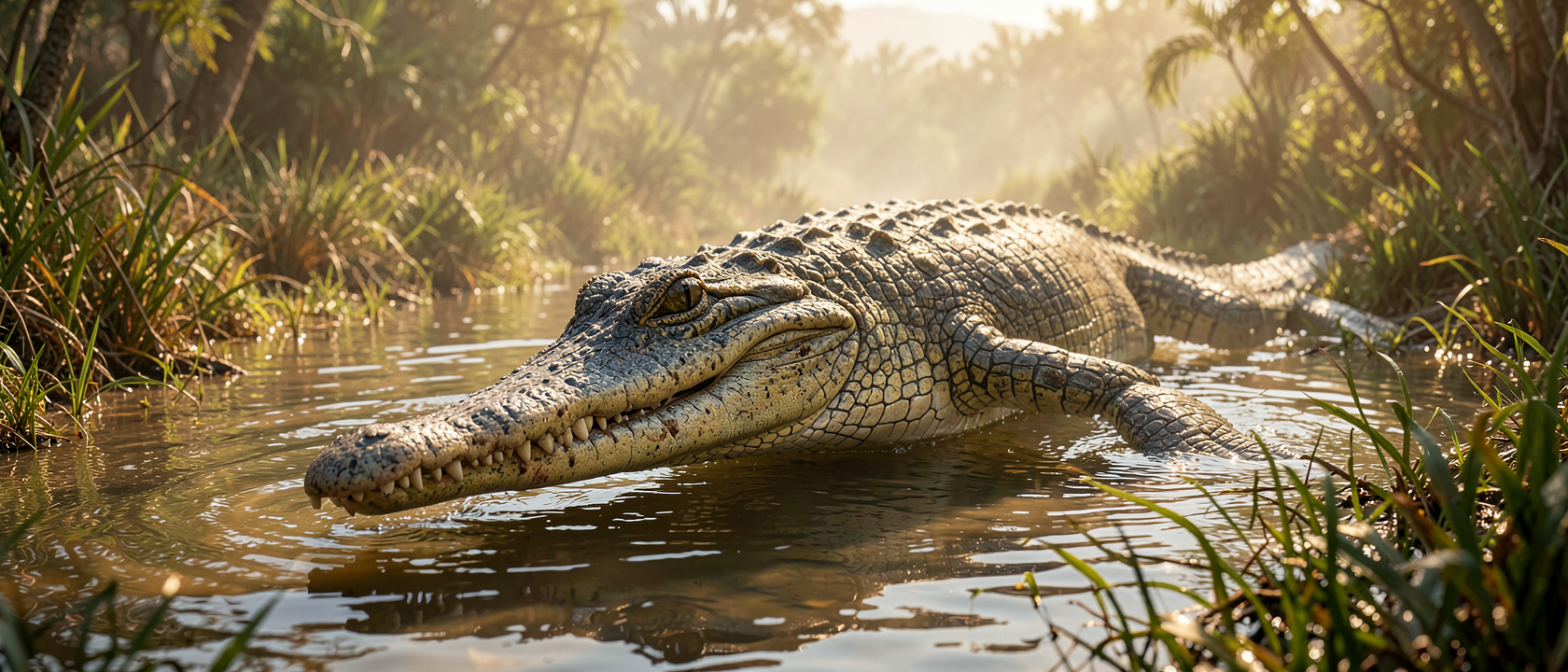
The 2025 paper identifies several anatomical features in Wadisuchus kassabi that mark it as unmistakably dyrosaurid, and specifically as a dyrosaurid already moving toward a marine specialist’s body plan. The snout is long and narrow, armed with tall, slender, needle-like teeth: the standard toolkit for an animal that catches fish and turtles by snatching rather than crushing. The nostrils sit on top of the snout rather than at its tip, an arrangement that lets the animal breathe at the surface while keeping its head almost entirely submerged. A deep notch at the very front of the jaws completed the picture.
The single most precise detail is the tooth count. The premaxilla, the frontmost bone of the upper jaw, carries four teeth in Wadisuchus kassabi. Other dyrosaurids retain the ancestral five. One tooth fewer might sound like a rounding error. The researchers interpret it as a discrete, measurable step in the gradual refinement of the dyrosaurid bite, a step CT scanning confirmed unambiguously even from fragmentary material. The count was not inferred from a relative; it was read directly from the bone.
Why a one-tooth difference from 80 million years ago still matters
Dyrosaurids are already unusual for a reason that predates this paper: as a group, they survived the end-Cretaceous mass extinction approximately 66 million years ago, the event that eliminated non-avian dinosaurs, and persisted well into the Eocene epoch. The question the fossil record has long struggled to answer is when, exactly, they assembled the anatomical toolkit that made that resilience possible.
Wadisuchus kassabi moves that question substantially. The Saber et al. (2025) paper argues that the marine morphology, the needle-tooth bite, the surface-breathing nostrils, the elongated snout, was not thrown together quickly under end-Cretaceous pressure. It was already being refined in Africa at least 14 million years before the asteroid. The reduced premaxillary tooth count is part of the evidence that this refinement was measurable and progressive rather than assumed.
The geographic implication runs parallel to the temporal one. Because Wadisuchus kassabi sits at the root of the dyrosaurid family tree, Africa is not a later stop on a dispersal route that started somewhere else. The 2025 paper proposes Africa as the starting point, the place from which later lineages that spread to Asia, Europe, and the Americas originally diverged.
The assumption that just lost 10 to 20 million years
Before October 2025, the consensus placed the origin of Dyrosauridae in the Maastrichtian stage, approximately 72 to 66 million years ago, with the group’s geographic point of origin assumed to lie outside Africa. Both assumptions are directly contradicted by Wadisuchus kassabi.
At approximately 80 million years old, the fossil falls in the Campanian stage, not the Maastrichtian. The researchers go further: based on where Wadisuchus kassabi falls in the phylogenetic tree, a branching diagram of evolutionary relationships, built here from CT-scanned anatomy, they propose that dyrosaurid diversification may have begun in the Early Coniacian–Santonian, roughly 87 to 83 million years ago. The gap between 72 million years and 87 million years is not a minor recalibration. It is larger than the entire span of time the previous record-holders were thought to represent the family’s beginnings.
The geographic assumption collapses at the same time. Consistent phylogenetic analyses place Africa at the root of Dyrosauridae, not on the receiving end of a dispersal from somewhere else. The combination of an older date and a different continent of origin rewrites the opening chapter of the group’s evolutionary history in full.
Three questions the Egyptian desert has not answered
The 2025 paper is direct about what it has not resolved. The dispersal routes by which dyrosaurids spread from Africa to other continents remain unknown. Wadisuchus kassabi establishes where the story began; it says nothing about the itinerary that followed.
The paper also acknowledges that older dyrosaurid material may be waiting in African fossil sites not yet excavated or analyzed. The 80-million-year date is a new floor for the confirmed record, not a guaranteed origin point. If the Early Coniacian–Santonian hypothesis is correct, roughly 7 more million years of dyrosaurid history are still missing from the physical record.
The third open question sits outside phylogenetics entirely. The authors state that the fossil-rich sites near the Kharga and Baris oases face active threats from urban expansion and agricultural encroachment. Future answers about dyrosaurid origins depend partly on whether the deposits that contain them survive long enough to be excavated. No CT scanner addresses that problem.