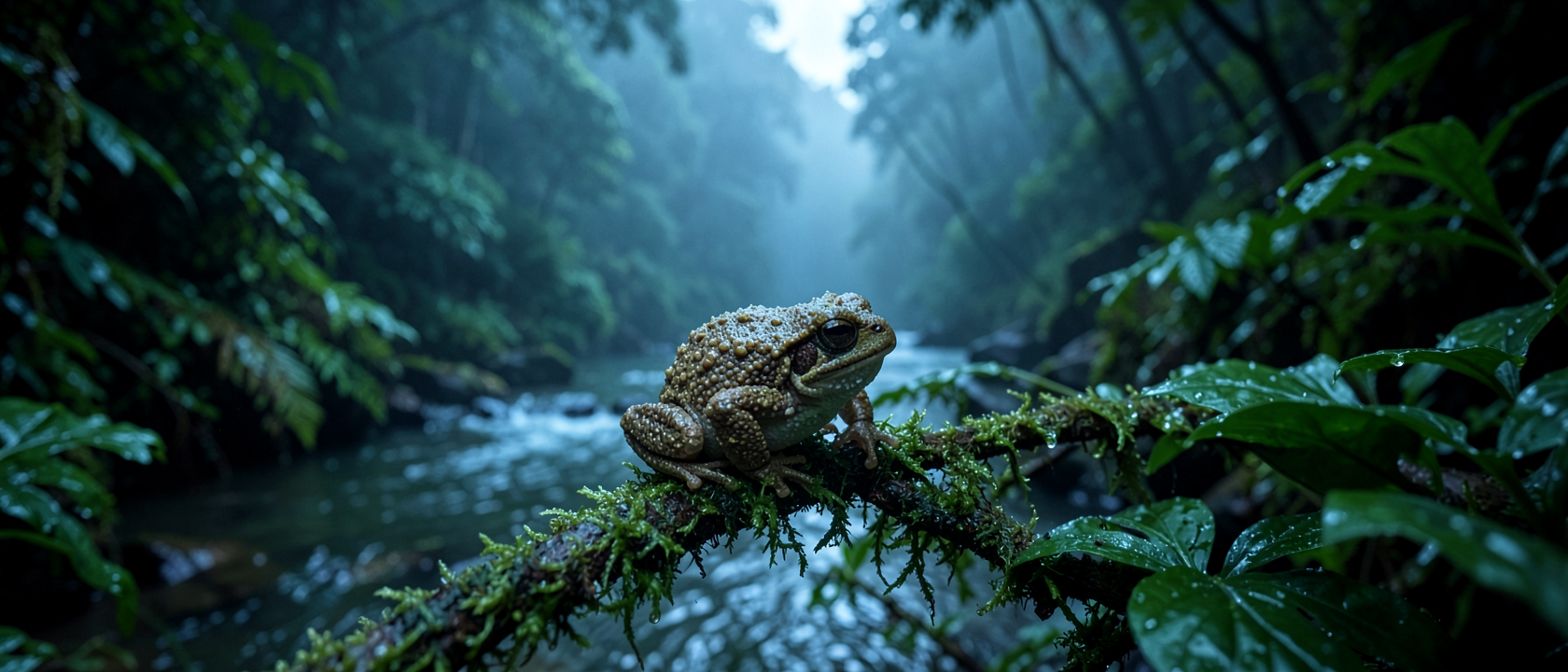
A Frog Confirmed Alive by Matching Nothing
The identification of Pristimantis ruidus in 2022 worked backwards. Geneticists at Universidad Técnica Particular de Loja ran the DNA of two newly collected females against sequences from 35 related species held in a gene bank. Every comparison came back negative. That clean sweep of non-matches was the confirmation.
The species had not been recorded in the wild since 1922. The IUCN had listed it as “possibly extinct.” No genetic material from P. ruidus had ever been entered into any reference database, because no one had handled a live specimen in over a century. The non-match was not a failure of identification, it was the only possible result for a lineage science had never genetically catalogued.
How a Zero-Match Becomes Proof
Standard molecular identification works by finding a hit: you run an unknown sample against a database of known sequences and look for a close match. That method requires at least one prior sequence for the species in question. Pristimantis ruidus had none. Herpetologist John D. Lynch described the species in 1979 from preserved specimens collected in 1922 by zoologist George H. Tate, decades before molecular taxonomy existed.
The team used three genetic markers: two mitochondrial genes (12S and 16S rRNA) and one nuclear gene (RAG-1), compared against sequences from 35 other Pristimantis species. Under standard molecular taxonomy, a complete non-match against 35 catalogued relatives establishes that the sample represents a genetically unrecorded lineage. Elimination rather than recognition, the only available method when a species predates the molecular era and no museum specimen was ever sequenced.
Morphology confirmed the same conclusion from a different direction. The two females, measuring 0.79 in (20.1 mm) and 1.18 in (30.0 mm) snout-to-vent, matched Lynch’s published description point for point: rough dorsal skin covered in numerous rounded low warts and tubercles, a distinctive W-shaped occipital fold, and a complete absence of any externally visible eardrum.
Two Female Frogs, a Fallen Trunk, and a Rumbling Volcano
In November 2022, biologist Juan C. Sánchez-Nivicela and his team were running a night survey at the Reserva de Conservación Quitahuaycu, Molleturo Parish, Azuay Province, in the southern Ecuadorian Andes, approximately 3.7 miles (6 km) northeast of the exact spot where Tate had collected the original specimens 100 years earlier. Sangay volcano was audible in the distance. Both females turned up on shrubs near a fallen trunk at the edge of a stream.
It mattered that the survey was nocturnal. Lynch’s original 1979 material had been collected during daytime surveys, which is almost certainly why specimens turned up under rocks rather than on vegetation, the frogs are active at night, and daytime collection misses them entirely. The photographs taken by Jaime Culebras and Sánchez-Nivicela that night were the first photographs of a living P. ruidus ever taken. “We were going crazy with excitement,” Sánchez-Nivicela told National Geographic. “It was perfect. The description matched perfectly.” The paper was published on August 13, 2024, in Zoosystematics and Evolution.
A Living Frog Is a Legal Document
The Andean foothill forests around Molleturo now retain only 30 percent of their original extent, reduced over two decades by deforestation, agricultural conversion, and mining. The conservation significance the researchers themselves name is partly legal. A formally documented, georeferenced record of a threatened species at a specific location can be used to challenge environmental impact assessments for mining and logging concessions in the same area. Under Ecuadorian environmental law, an impact assessment that fails to account for a recorded threatened species in its operational area is contestable.
This mechanism has precedent. In 2019, conservationists and northern Ecuadorian communities invoked Atelopus longirostris, a harlequin frog rediscovered in 2016 after 27 years without a sighting, in their legal challenge against mining concessions in Imbabura Province, arguing that environmental impact studies had failed to account for the species. The paper by Sánchez-Nivicela’s team makes explicit their view that documenting P. ruidus serves this same function. The frog is not a symbol in their framing. It is a data point in an argument. The team also intends to use the newly obtained genetic sequences as a reference library for future surveys, the first time this species will exist as a searchable entry in any database.
“Possibly Extinct” Was Always a Hypothesis
The IUCN category “possibly extinct” is probabilistic by design, applying to species that are almost certainly gone but for which formal confirmation is lacking. The P. ruidus case demonstrates that the category is routinely received as something close to a verdict. The species was quietly persisting in a rainforest described in the literature as one of Ecuador’s most ecologically damaged ecosystems, through 102 years of unrecorded survival. The absence of sightings reflects two things: search effort, and the fact that daytime surveys under rocks are the wrong method for a nocturnal species that sits on streamside vegetation after dark.
Two Frogs, One Forest, and What Nobody Knows Yet
Only two individuals of Pristimantis ruidus have been documented in over a century. Both are female. No male of this species has ever been recorded, which means no call, no breeding behavior, no egg clutch, and no larva appears in the scientific record. Whether the Reserva de Conservación Quitahuaycu is the only place on Earth where P. ruidus currently survives is unknown. Herpetologist Diego Armijos Ojeda, quoted in National Geographic, described the site as potentially the only location in the world where the species can be found. No systematic survey of other candidate sites in the southern Ecuadorian Andes has been conducted to confirm or contradict that.
The rediscovery also opens a broader question the paper does not answer: how many other Ecuadorian amphibians currently listed as possibly extinct are persisting in damaged or under-surveyed habitat, located by the wrong method at the wrong time of day? A national Red List assessment published in 2021 in PLOS ONE by Ortega-Andrade and colleagues, covering 635 Ecuadorian amphibian species, found that 57 percent (363 species) are categorized as Threatened. The proportion of those that have simply not been looked for correctly is not known.