He Emerged in Perfect Health. His Sperm Were Half Gone.
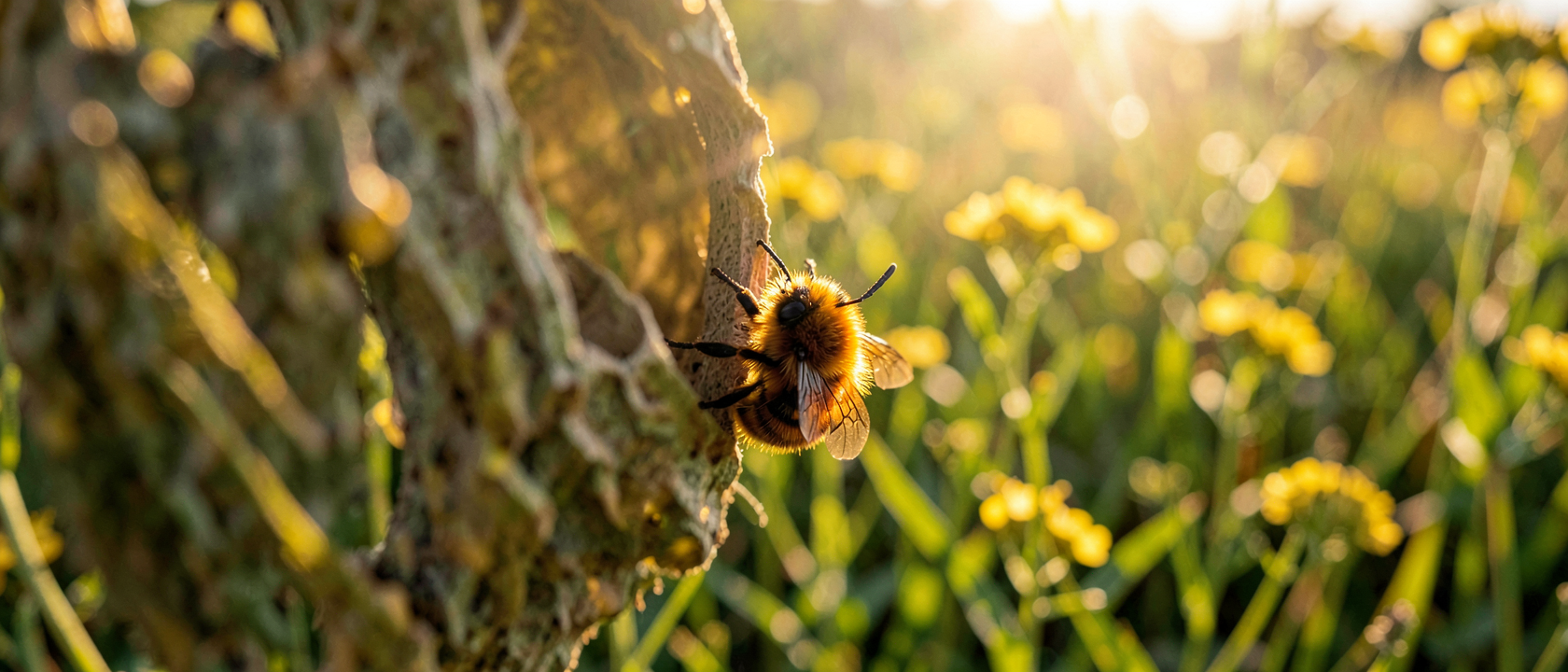
Nine months after a three-day heat wave, a male red mason bee (Osmia bicornis) flew out of his nest looking completely normal. Right size, right color, right behavior. Researchers at the University of Hull had split a group of O. bicornis larvae into two batches: one experienced a simulated version of the Hull, UK heat wave of July 2022, three days with a daily peak of 104 °F (40 °C); the other developed at normal Hull July temperatures, peaking around 77 °F (25 °C). Both groups overwintered identically and emerged alive nine months later, with no visible abnormalities.
Then the dissections started. Smith, Duncan, and Gilbert, writing in the Journal of Thermal Biology in July 2026, found that the heat wave males were carrying severe hidden damage: 33% fewer sperm, sperm 17% shorter than in controls, and a 53% reduction in sperm motility, the proportion of sperm capable of movement at all. Females from the same batch were also affected, with developing oocyte number and volume each down by roughly 15%. Males were more severely affected than females. Not one of these animals looked wrong at emergence. The injury had been there since before the bees had wings, and nothing about the adult gave it away.
Why This Bee Has No Backup Plan
The reason O. bicornis is so exposed comes down to architecture. Honeybees and bumblebees rear their larvae collectively, with workers buzzing their flight muscles to keep brood temperature at a precise set point regardless of outside conditions. Red mason bees do none of this. Each larva develops alone, sealed inside an individual mud-walled cell, with no workers, no communal buffer, and no thermoregulation. Whatever temperature the air is outside the nest is the temperature inside the cell.
The Hull team identified this solitary developmental window as the critical vulnerability. Heat stress was applied during the prepupal stage, when spermatogenesis is underway. Damage inflicted at that point is structural: written into the cells themselves rather than into some condition the adult body can later detect and correct. Nine months of normal hibernation did not erase it. The adult bee was not recovering from anything.
One additional detail: heat wave males did emerge with lower body mass than controls, but body mass did not significantly predict sperm count, sperm length, or motility. The gamete damage was not a downstream consequence of being underweight. It was a separate, direct injury to the reproductive system.
The Apples Won’t Know Either
Red mason bees are significant pollinators of apples, cherries, and oilseed rape. Smith, Duncan, and Gilbert argue that the reproductive damage accumulates silently at the population level: a heat wave strikes in summer, larvae are injured during development, adults emerge the following spring looking fine, and the actual population collapse only becomes apparent in reduced numbers the season after that. The signal is delayed by a full year and carries no visible warning at any intermediate stage.
The authors also flag the commercial irony this sets in motion. Reduced wild bee numbers push fruit growers toward renting honeybee hives to fill the pollination gap, but the authors note that published research consistently finds wild bees, including O. bicornis, are more effective pollinators per individual visit than honeybees, and their services arrive at no commercial cost. A heat wave’s agricultural bill may therefore land twice: first when yields drop because a wild bee population has quietly collapsed, and then again in the invoice for a replacement service that cannot fully do the same job.
“If It Survived, It’s Fine”, That Assumption Is Now Broken
Most heat wave research on bees has concentrated on the temperature at which adult bees die outright. The operating logic follows directly: if bees are flying after a hot spell, the population has come through. The 2026 study directly contradicts this. A peak of 104 °F, below the temperature threshold at which adult O. bicornis die outright, produced permanent reproductive impairment in larvae, with no outward signal at emergence, in flight, or in any observable behavior.
The myth is built into standard monitoring practice, which counts adult bees and does not dissect them. That method is structurally blind to sublethal larval heat damage. Normal adult emergence after a heat wave, this study demonstrates, is not evidence that a population is reproductively intact. It is evidence only that the bees did not die. Those are now two different things, and the gap between them is 53%.
Two Questions the Bees Haven’t Answered Yet
The first open thread is combinatorial. Male O. bicornis emerging with reduced sperm counts, shorter sperm, and less than half their normal motile sperm still face a full season of pesticide exposure, disease, nutritional gaps, and habitat pressure. Smith, Duncan, and Gilbert identify as their immediate research priority how an already-compromised reproductive system interacts with those additional stressors, whether the damage compounds, whether earlier mortality masks it, or whether the two kinds of harm run in parallel.
The second question is harder to test. The University of Hull team is currently investigating whether mother bees can detect something different about heat-reared larvae, an unusual nutritional demand or some other detectable shift. Red mason bee mothers provision each sealed cell before laying and cannot return to it afterward. If a mother can read a signal from an already-stressed larva and adjust the pollen she collects in response, some portion of the reproductive damage might be buffered before it is locked in. If the signal is absent or undetectable, the damage accumulates across the entire cohort with nothing to check it. That experiment is running.